
The biggest misunderstanding about a no-KYC casino is assuming those three words tell you everything about privacy, withdrawals, security or legality.
They do not.
In practice, “no KYC” commonly means that a casino does not require routine identity documents before registration, deposit or initial play. Some operators may allow withdrawals without documents too. Others reserve the right to verify a player’s identity when a withdrawal, security issue, payment mismatch or compliance concern arises. That is why the safest interpretation is no routine upfront KYC, not “the casino can never ask who I am.”
No-KYC is also not the same as anonymous, untraceable, unregulated or legally available everywhere. Those are separate questions.
For U.S. readers, another distinction is essential: a casino being accessible online—or even holding an overseas gambling license—does not automatically mean it is authorized to offer online casino gambling in the state where the player is located. Michigan, for example, maintains its own list of authorized online gaming operators and continues enforcement against offshore operators it says are unlawfully serving Michigan residents.
Here are the most common misconceptions worth clearing up.
No-KYC Casino Myths: Quick Reality Check
| Myth | Reality |
| No KYC means I can never be asked for ID | Verification can still occur under the operator’s terms |
| No KYC means anonymous | It mainly describes identity-verification policy |
| Crypto transactions cannot be traced | Many blockchain transactions are publicly visible |
| All no-KYC casinos are illegal | Legality depends on jurisdiction, licensing and where wagering occurs |
| An offshore license makes a casino legal in every U.S. state | It does not replace required state authorization |
| No KYC automatically means unsafe | KYC status alone does not measure cybersecurity or payout reliability |
| Provably fair means the entire casino is trustworthy | It addresses game-result verification, not the entire operator |
| No verification means instant withdrawals | Casino approval occurs before blockchain/payment settlement |
| There is one universal KYC threshold | Policies and triggers differ by operator and jurisdiction |
| A VPN makes restricted play legitimate | A privacy tool does not change gambling law or operator eligibility rules |
Myth 1: “No KYC Means the Casino Can Never Ask for ID”
Reality: some no-KYC casinos can still request verification later.
This is probably the most important misconception.
A casino may advertise simple registration with only an email, username or connected crypto wallet. That describes the onboarding stage. It does not automatically define what happens during every later stage of the account.
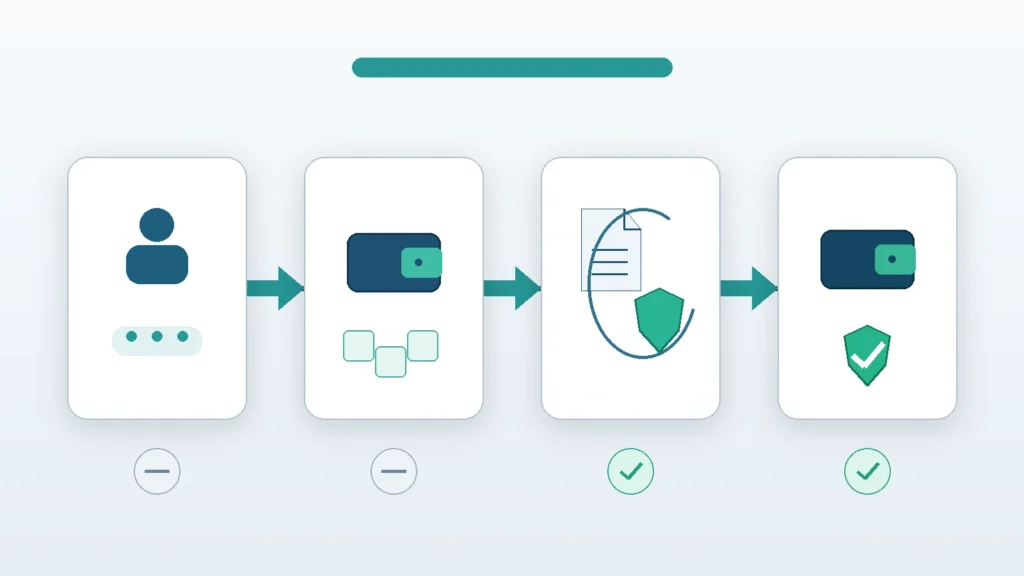
The more useful way to think about a no-KYC policy is to examine four separate checkpoints:
- Registration.
- Deposit.
- Account or security review.
- Withdrawal.
A casino can be document-free at the first two stages while reserving verification rights at the third or fourth.
Potential reasons include account-ownership concerns, suspicious transactions, payment discrepancies, bonus-rule investigations, restricted-jurisdiction questions or other regulatory and security issues. There is no universal trigger applicable to every casino. The operator’s current terms matter most. The site’s detailed guide to why no-KYC casinos can still request verification examines these checkpoints separately.
This distinction is becoming more important as crypto-gambling regulation develops. The Curaçao Gaming Authority’s June 2026 crypto policy says accepting cryptocurrency does not create an exemption from AML/KYC or responsible-gambling obligations. Its guidance also discusses transaction monitoring, blockchain analytics and source-of-funds controls.
So if a casino’s terms say verification “may be required,” assume that possibility is real.
Myth 2: “No KYC Means Completely Anonymous”
Reality: no KYC and anonymity describe different things.
KYC concerns identity verification.
Anonymity concerns whether activity can be connected to a real person.
A casino can avoid asking for a driver’s license while still potentially processing information such as:
- Email address.
- Crypto wallet address.
- IP or network information.
- Device information.
- Login records.
- Deposits and withdrawals.
- Account activity.
- Customer-support communications.
The exact information collected depends on the operator’s privacy policy and technology.
That is why no-KYC and anonymous crypto casinos are not interchangeable. A no-KYC policy can reduce one source of identity collection without making every other digital trail disappear.
A useful privacy model separates three layers:
| Privacy Layer | Relevant Question |
| Document privacy | Did you upload ID or proof of address? |
| Platform privacy | What account, device and network data does the casino collect? |
| Transaction privacy | What information is visible through the payment network or blockchain? |
“No KYC” mainly addresses the first layer.

Myth 3: “Crypto Casino Payments Are Untraceable”
Reality: many commonly used cryptocurrencies operate on transparent public ledgers.
Bitcoin is the clearest example.
Bitcoin.org’s privacy guidance notes that balances and transactions associated with addresses can be publicly visible and explicitly warns that Bitcoin addresses cannot be assumed to remain fully anonymous.
The U.S. Department of Justice likewise describes blockchain as a permanent public record of transactions and has documented how blockchain analysis can help trace cryptocurrency funds.
The important distinction is pseudonymity versus anonymity.
A blockchain address does not ordinarily display:
John Smith, 123 Main Street
It displays an address.
But if that address becomes associated with an identifiable exchange account, merchant account or other information source, transaction history can potentially be connected to that identity.
Current Curaçao crypto guidance goes further: licensed operators accepting crypto are expected to maintain controls capable of tracing fund origins and destinations and identifying exposure to high-risk sources.
So:
No identity document at the casino does not equal an invisible blockchain transaction.

Myth 4: “No-KYC Casinos Are Automatically Illegal”
Reality: “no KYC” by itself does not determine legal status.
The answer requires more jurisdictional nuance than simply asking whether a no-KYC platform can operate legally somewhere.
For U.S. players, online gambling authorization is substantially jurisdiction-specific.
A better question is:
Is this operator authorized to offer this form of gambling where I am physically located?
Michigan provides a useful example. The Michigan Gaming Control Board maintains a list of operators authorized to offer internet gaming in the state and states that only MGCB-licensed operators are authorized to legally provide those services there.
In April 2026, the MGCB announced cease-and-desist actions against 45 offshore gambling operators it said had unlawfully offered online gambling to Michigan residents.
Therefore:
No KYC does not automatically mean illegal—but neither does online accessibility mean legally authorized.
Readers can see the broader distinction in Are No-KYC Casinos Legal in the United States?
Myth 5: “An Offshore License Makes a Casino Legal Everywhere in the U.S.”
Reality: an offshore license and U.S. state authorization answer different questions.
Some crypto casinos operate under overseas licensing systems such as Curaçao or Anjouan.
Those licenses can impose genuine requirements. Curaçao now regulates online gaming under its current national gaming framework, and its June 2026 crypto policy expressly connects cryptocurrency gambling with AML/KYC obligations.
Anjouan’s gaming authority likewise states that licensed operators must maintain AML and responsible-gambling compliance throughout their license term.
But an overseas license does not automatically provide permission to operate in every other country or U.S. state.
Think of two separate questions:
Question 1: Does the operator hold a valid license where it is licensed?
Question 2: Is that operator authorized to accept players where you are located?
Passing Question 1 does not automatically answer Question 2.
This is why “licensed” should never be translated into “legal everywhere.”
Myth 6: “No KYC Automatically Means Unsafe”
Reality: KYC status alone is not a security rating.
This misconception works in both directions.
It is incorrect to assume:
No KYC = unsafe
but it is equally incorrect to assume:
No KYC = safer because the casino has less data
KYC is primarily an identity/compliance process. It is not a substitute for:
- Account authentication.
- Secure software.
- Withdrawal controls.
- Wallet security.
- Transparent ownership.
- Valid licensing.
- Game integrity.
- Clear terms.
- Responsible-gambling controls.
- A workable complaint process.
Not requiring a passport could reduce the amount of highly sensitive identity-document data stored by an operator if the documents genuinely are never collected. It tells you almost nothing, however, about whether the operator will honor withdrawals or protect a player’s account balance.
The site’s broader guide to no-KYC crypto casino safety and red flags uses this distinction: no KYC alone neither proves nor disproves safety.
A better safety assessment examines the whole operator.
Myth 7: “Provably Fair Means the Casino Itself Is Proven Safe”
Reality: provably fair has a much narrower purpose.
A provably fair system can let players verify information used to generate a particular game result.
That can be useful.
It does not automatically verify:
- Whether the casino is legally authorized.
- Whether withdrawals will be processed.
- Whether bonus terms are reasonable.
- Whether customer funds are adequately protected.
- Whether account security is strong.
- Whether every game on the site uses the same verification model.
- Whether responsible-gambling controls are effective.
The distinction is simple:
Provably fair evaluates a game-result mechanism.
Operator safety requires evaluating the business around it.
Myth 8: “No Verification Means Every Withdrawal Is Instant”
Reality: eliminating one verification step does not eliminate every stage of a withdrawal.
A crypto withdrawal generally involves at least two stages:
1. Operator Processing
The casino may review:
- Available balance.
- Account status.
- Bonus conditions.
- Withdrawal limits.
- Payment information.
- Security concerns.
- Verification requirements.
2. Payment Settlement
Only after the casino approves and broadcasts or sends the payment does the relevant blockchain or payment system process it.
A fast cryptocurrency network therefore cannot make a withdrawal “instant” while the request is still waiting inside the casino.
This is why “no verification” should not be treated as a guarantee of instant settlement.
When evaluating an “instant withdrawal” claim, check what the advertised time measures:
- Request to approval?
- Approval to blockchain broadcast?
- Broadcast to wallet confirmation?
- An average or maximum?
- Only previously verified accounts?
- Only certain currencies?
Without that information, “instant” is marketing terminology rather than a complete payment specification.
Myth 9: “Every No-KYC Casino Has the Same Verification Threshold”
Reality: there is no universal KYC-free cashout number.
This is an area where online guidance often becomes too confident.
A review can be caused by more than transaction size.
Possible factors include:
- Operator policy.
- Cumulative activity.
- Payment ownership.
- Account-security alerts.
- Multiple-account concerns.
- Location inconsistencies.
- Fraud indicators.
- Bonus disputes.
- Transaction-monitoring alerts.
- Applicable licensing requirements.
Curaçao’s current crypto guidance, for example, addresses ongoing transaction monitoring and source-of-funds controls rather than presenting one universal dollar threshold that guarantees document-free activity.
Do not structure transactions to evade a casino’s compliance or verification process.
Instead, read the actual terms before depositing and assume a verification exception can be applied whenever the policy says one exists.
Myth 10: “A VPN Makes a Restricted Casino Legally Available”
Reality: a VPN is a networking/privacy technology, not a gambling license.
A VPN can have legitimate cybersecurity and privacy uses.
It does not change:
- Your physical location.
- Your state’s gambling laws.
- The casino’s restricted-country rules.
- The operator’s licensing permissions.
- Your obligation to provide accurate eligibility information.
If a casino’s terms prohibit play from your jurisdiction, masking an IP address does not transform an otherwise prohibited account into an authorized one.
The practical risk is also contractual: location discrepancies can themselves lead to account reviews, and accessibility is not the same as legal authorization.
The Michigan Gaming Control Board provides a real-world reminder: only the operators it authorizes can legally provide online gaming services in Michigan, regardless of whether another website is technically reachable from inside the state.
Another Misconception: “No KYC Means the Casino Stores No Personal Data”
Not necessarily.
An operator could avoid collecting a passport while retaining other information covered by its privacy policy.
Depending on the platform, this may include account identifiers, transaction records, device information, IP data, cookies, support correspondence or wallet addresses.
That is why privacy-conscious readers should check both:
- Verification policy.
- Privacy policy.
They answer different questions.
The same distinction applies when comparing a verification policy with a privacy policy: they answer different questions about what data an operator may collect and how it may use that data.
Another Misconception: “No KYC Means No Tax Record or Tax Obligation”
For U.S. taxpayers, casino verification policy does not decide federal taxability.
The IRS states that gambling winnings are generally taxable and must be reported, including when a taxpayer does not receive a Form W-2G. Cryptocurrency can also create separate digital-asset reporting obligations depending on what transactions occur.
“No KYC” therefore should never be interpreted as “no tax responsibility.”
Tax treatment can become complicated when both gambling winnings and later cryptocurrency dispositions are involved, so significant activity may warrant advice from a qualified tax professional.
What No KYC Actually Tells You—and What It Doesn’t
The easiest way to avoid being misled by the label is to narrow its meaning.
| Claim | Can “No KYC” Alone Prove It? |
| No routine ID at registration | Often, but verify terms |
| No documents ever | No |
| Complete anonymity | No |
| Untraceable payments | No |
| Legal in your state | No |
| Strong cybersecurity | No |
| Reliable withdrawals | No |
| Provably fair games | No |
| Instant withdrawals | No |
| No personal data collection | No |
| No tax obligations | No |
That table captures the central lesson:
No KYC is one characteristic of a casino account model. It is not a complete trust score.
How to Evaluate a No-KYC Casino More Carefully
Before depositing, evaluate the platform in roughly this order.
Read the Verification Policy
Look for phrases such as:
- “KYC may be required.”
- “Additional verification.”
- “Source of funds.”
- “Account ownership.”
- “Enhanced due diligence.”
- “At our discretion.”
- “Restricted jurisdictions.”
Understand them before the withdrawal stage.
Verify the Operator and License
Do not rely only on a badge or logo displayed in the footer.
Check the regulator’s official information where possible and make sure the domain and operator details correspond.
Check Whether It Is Authorized Where You Live
This is particularly important for U.S. readers.
A Curaçao or Anjouan license is not a substitute for U.S. state authorization where state authorization is required.
Read the Withdrawal Terms Before Depositing
Check:
- Minimum withdrawals.
- Maximum withdrawals.
- Processing periods.
- Verification clauses.
- Wallet/payment restrictions.
- Pending-withdrawal rules.
- Fees.
- Bonus-related cashout restrictions.
Review Privacy Separately From KYC
Determine what data the operator says it collects even when identity documents are not routinely requested.
Check Responsible-Gambling Controls
Low-friction gambling is still gambling.
NoKYCCasino.us’s responsible gambling guidance notes that rapid crypto deposits and fewer onboarding steps can remove some of the natural pauses that exist with conventional payment systems. Set financial and time limits independently of what the casino allows.

Bottom Line
No-KYC casinos are surrounded by exaggerated claims from both supporters and critics.
They are not automatically scams simply because they avoid routine document checks.
They are also not automatically private, anonymous, instant, legal or secure simply because the homepage says No KYC.
The most accurate interpretation is narrower:
A no-KYC label generally signals reduced or delayed conventional identity-document verification under the operator’s stated policy. Everything else—privacy, withdrawal rules, licensing, legal availability, cybersecurity and payment monitoring—must be evaluated separately.
For U.S. players, check the operator’s terms, the relevant state regulator and any claimed overseas license before depositing, rather than discovering the restrictions after requesting a withdrawal.
FAQ
Not necessarily.
Many platforms use “no KYC” to mean no routine document verification at registration. Their terms may still permit identity, payment or source-of-funds checks in particular circumstances. There is no universal industry definition guaranteeing that verification can never occur.
Yes.
A withdrawal can trigger account-ownership, payment, security or compliance review if permitted by the casino’s rules. A delayed request is not automatically proof of wrongdoing, but the possibility should be disclosed clearly in the operator’s terms.
There is no blanket nationwide answer that makes every no-KYC casino lawful throughout the U.S.
Online casino authorization depends heavily on applicable state law and licensing. Michigan, for example, maintains its own authorized-operator list and states that only MGCB-licensed operators may legally offer online gaming there. An offshore license does not replace required state authorization.
Not completely.
Bitcoin addresses do not inherently display a user’s legal name, but transactions and balances can be visible on its public blockchain. Bitcoin.org warns that addresses should not be assumed to remain fully anonymous, and U.S. authorities have repeatedly used blockchain analysis to trace cryptocurrency transfers.
Some may implement meaningful security, licensing and game-integrity measures, but “no KYC” itself does not establish safety.
Evaluate the operator, license, withdrawal record, security controls, terms, payment practices and responsible-gambling features separately.
Some do.
Curaçao licenses online gaming operators under its current framework, while Anjouan also operates an internet-gaming licensing system and states that licensees must comply with AML and responsible-gaming obligations. A foreign license does not automatically authorize play in every player’s home jurisdiction.
Generally, a casino’s KYC policy does not remove U.S. federal tax obligations.
The IRS states that gambling winnings are generally taxable and that taxpayers need to report gambling winnings even if they do not receive a W-2G. Crypto-related transactions can create additional digital-asset reporting considerations.