
No-KYC crypto casinos are not automatically safe or unsafe. Skipping routine identity-document uploads can reduce the amount of sensitive personal information a casino receives at signup, but that benefit does not establish that the operator is licensed, financially reliable, secure, fair or authorized to serve players in a particular U.S. state.
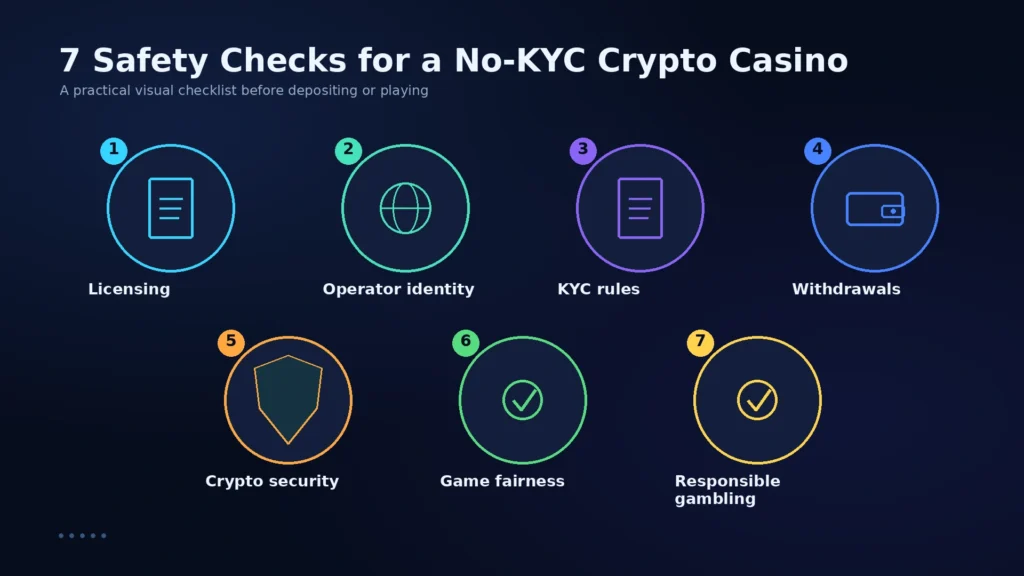
The safest way to assess a No KYC casino is therefore not to ask whether it requests a passport. Check several separate issues: who operates it, which regulator actually licenses the domain, what can trigger later verification, how withdrawals are handled, how crypto wallets are protected, how games are tested, what responsible-gambling tools exist and what recourse is available if a dispute develops.
For U.S. readers, one point is especially important. State-authorized online casino markets operate within state-specific licensing and player-protection systems. The American Gaming Association reported seven states with lawful full online casino markets during 2025, while Maine enacted an internet-gaming framework in January 2026 and was still conducting rulemaking during July 2026. A foreign or offshore license does not automatically substitute for U.S. state authorization.
That distinction should come before any discussion of bonuses, game libraries or payout speed.
Practical takeaway: No KYC is primarily an onboarding or verification policy. It is not a safety certificate.
What Does “Safe” Mean at a No-KYC Crypto Casino?
Casino safety is not one question.
A platform might have strong account encryption but poor withdrawal terms. Another might offer provably fair games but lack a meaningful dispute process. A third might collect very little personal information yet be unauthorized where a player lives.
A useful framework is to separate safety into seven areas.
| Safety area | Main question |
| Legal/regulatory | Is this operator authorized and properly licensed? |
| Operator | Can the company behind the website be identified? |
| Withdrawal/KYC | Can the casino introduce verification or hold funds? |
| Crypto payments | Who controls the funds and how are transfers handled? |
| Game integrity | Is there credible evidence that game results are fair? |
| Account security | Are there practical protections against unauthorized access? |
| Player protection | Are limits, self-exclusion and complaint mechanisms available? |
A casino should not be considered trustworthy simply because it performs well in one column.
Does No KYC Mean Anonymous?
Usually, no.
A no-KYC casino may allow an account to be opened without uploading a passport, driver’s license or proof of address. That can reduce direct identity-data collection.
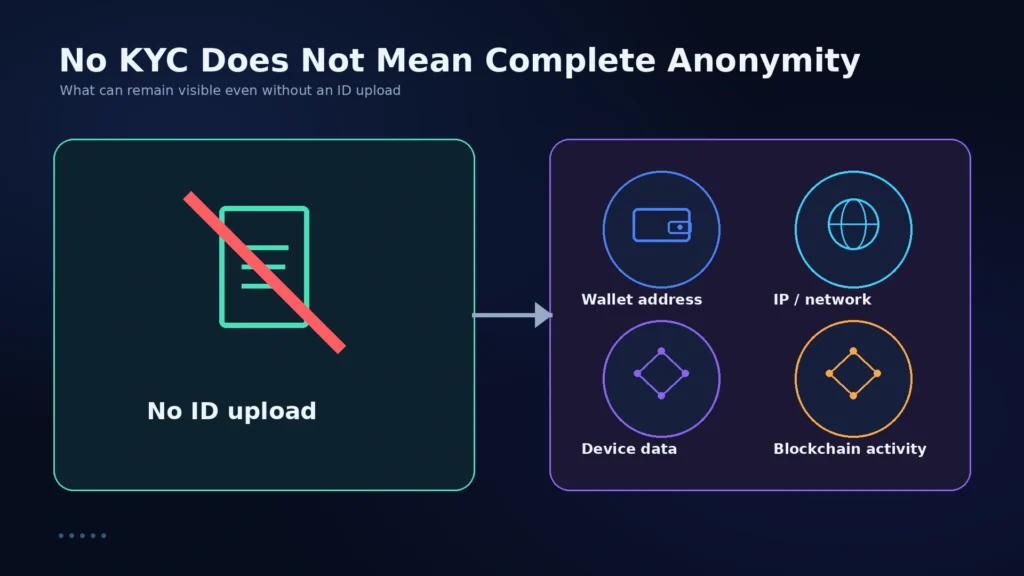
It does not necessarily mean the platform sees nothing about the player.
Depending on the system, an operator may still process or observe:
- email or username;
- IP address;
- device information;
- login history;
- wallet addresses;
- deposits and withdrawals;
- bonus activity;
- game history;
- geolocation indicators;
- transaction patterns.
The distinction is covered in more detail in the site’s guide to No-KYC vs anonymous crypto casinos.
Cryptocurrency also should not automatically be equated with invisibility. Curaçao’s current crypto-gambling guidance explicitly discusses tracing the origin and destination of funds, risk-scoring wallets, identifying suspicious exposure and conducting withdrawal screening.
That is strong evidence of a broader point:
No document upload is not the same thing as no monitoring.
The Genuine Privacy Benefit of No-KYC Casinos
There is still a legitimate privacy distinction.
If a casino never asks a player to upload:
- a passport;
- driver’s license;
- utility bill;
- selfie;
- banking statement;
- or other identity document,
then those particular documents are not being handed to that operator.
That reduces the quantity of highly sensitive identity information entrusted to the casino.
But the conclusion should stop there.
It does not prove:
- that no other data is collected;
- that a wallet cannot be linked to an identity elsewhere;
- that IP or device information is not logged;
- that transactions cannot be analyzed;
- that the casino has good cybersecurity;
- or that the player’s identity can never be requested later.
This is why the site’s broader guide to what no KYC actually means distinguishes no upfront verification from a permanent promise of zero verification.
1. Check Whether the Casino Is Actually Licensed and Authorized
This is the first safety check because almost everything else depends on who has jurisdiction over the operator.
Do not stop at a logo in the website footer.
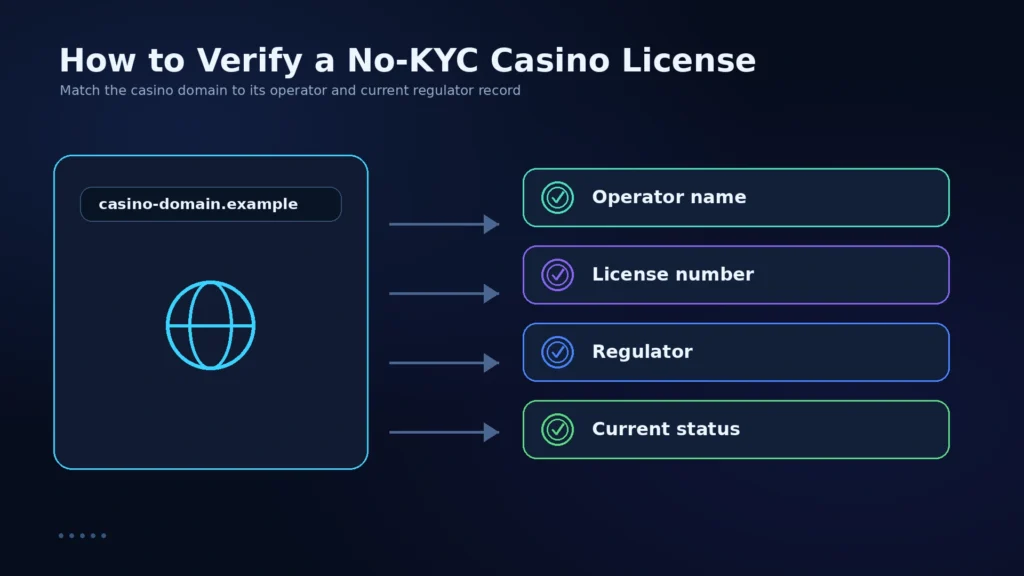
Identify:
- The operating company’s legal name.
- The license number.
- The licensing authority.
- The domain covered by the license.
- The current status of the license.
- Whether the regulator accepts player complaints.
For a Curaçao-licensed casino, for example, the Curaçao Gaming Authority provides a public license register. Its certification policy states that the player-facing Certificate of Operation seal should link to the CGA certificate system and display the exact domain, licensed operator and current license status.
That is much stronger evidence than a static regulatory logo.
Foreign licensing and U.S. authorization are different
A legitimate Curaçao license can demonstrate that a company is licensed in Curaçao.
It does not establish that the casino is authorized to accept online casino wagers in Michigan, New Jersey, Pennsylvania or another U.S. state.
Michigan provides a useful real-world example. In April 2026, the Michigan Gaming Control Board said it had issued cease-and-desist orders to 45 offshore gambling operators over a four-month period for unlawfully offering gambling to Michigan residents. The Board separately states that only operators licensed by the MGCB are authorized to offer online gaming in Michigan.
For a deeper jurisdiction-specific discussion, see Are No-KYC Casinos Legal in the United States?.
2. Identify the Company Behind the Casino
A license check should lead to an identifiable legal operator.
Look for:
- legal company name;
- registration information;
- registered address;
- license details;
- privacy policy;
- terms and conditions;
- complaint policy;
- customer-support contact.
A brand without a clearly identifiable operator creates a basic problem: if the withdrawal fails or an account is closed, who exactly owes the money?
It also makes regulatory verification difficult.
Website age and HTTPS are not enough
HTTPS protects data in transit between a browser and a website.
It does not establish that the people running the website are honest.
Similarly, a professionally designed site, large bonus or recognizable game graphics do not establish regulatory legitimacy.
The operator and license should be checked separately.
3. Read the KYC Rules Before the Withdrawal Rules Become Relevant
This is arguably the most important check for someone specifically choosing a no KYC crypto casino.
Look for phrases such as:
- verification may be requested;
- enhanced due diligence;
- source of funds;
- source of wealth;
- AML review;
- wallet ownership verification;
- suspicious activity;
- account security review;
- proof of address;
- proof of identity;
- payment ownership;
- prohibited jurisdiction.
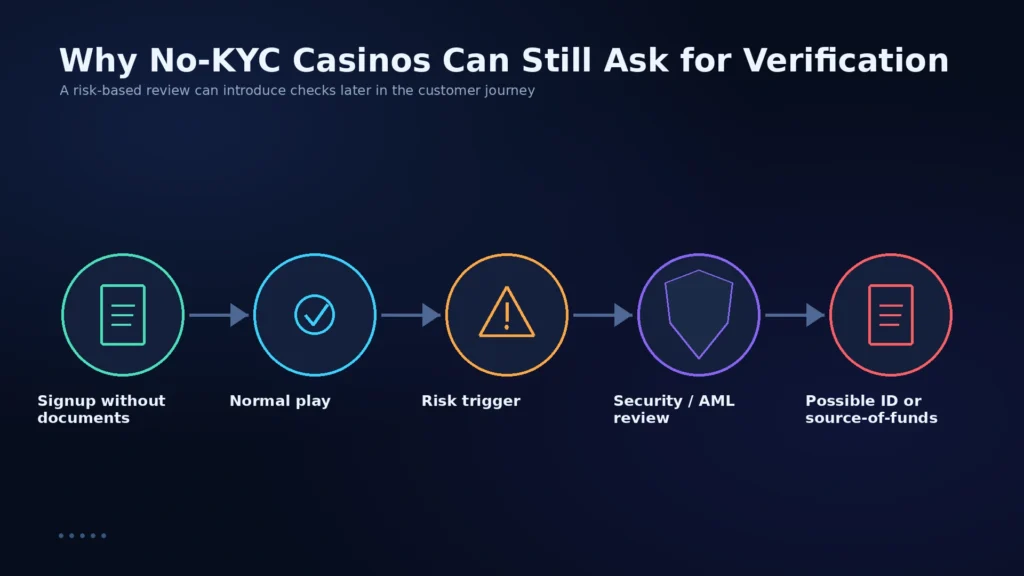
The website may advertise “no KYC,” while the legal terms provide a conditional right to request documents.
That does not automatically mean the casino is dishonest.
It may simply mean “no routine upfront KYC.”
The site’s guide to why no-KYC casinos still ask for verification explains this distinction in detail.
Why crypto does not eliminate compliance checks
Curaçao’s June 2026 crypto policy is particularly instructive. It states that cryptocurrency is not a carve-out from AML/CFT or responsible-gambling obligations. The guidance addresses blockchain transaction monitoring, source-of-funds verification, destination-wallet screening and verification that a customer controls an unhosted wallet.
The policy has phased implementation dates extending through June 2027, so individual requirements should be checked against the operator’s current licensing status and implementation obligations.
The larger lesson is straightforward:
A licensed crypto casino can offer low-friction onboarding while still conducting risk-based checks.
4. Treat Withdrawal Safety Separately From Blockchain Speed
A blockchain can settle a transaction quickly once the casino broadcasts it.
That does not mean the casino must approve the withdrawal immediately.
There are two separate clocks:
Casino processing
Withdrawal request → account review → bonus check → security/KYC review → approval
Blockchain processing
Transaction broadcast → network confirmation → wallet receipt
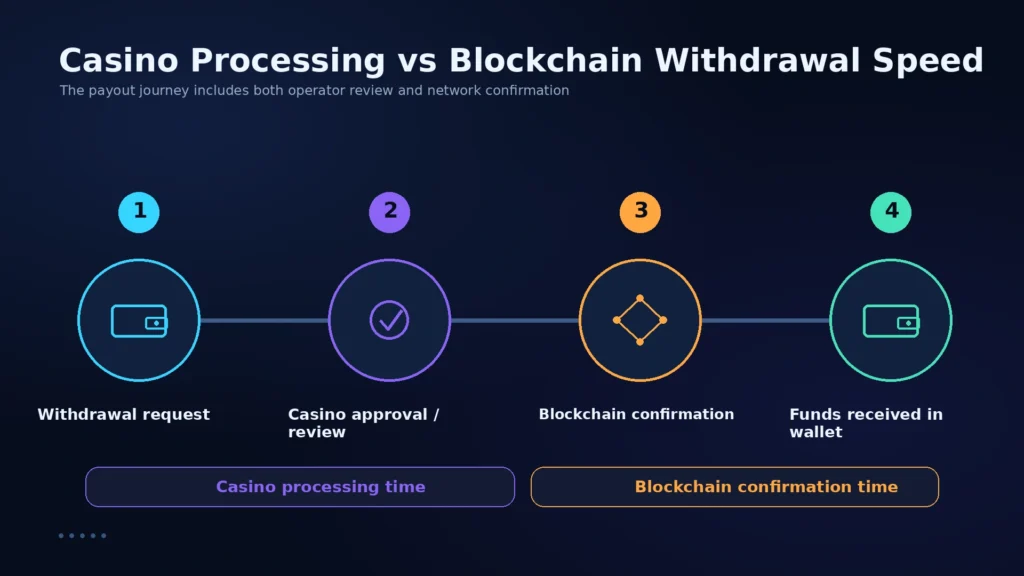
An operator could therefore advertise a fast blockchain while still taking hours or days to approve a particular withdrawal.
Before depositing, check:
- minimum withdrawal;
- maximum daily withdrawal;
- weekly or monthly caps;
- internal pending period;
- manual-review policy;
- bonus restrictions;
- network fees;
- supported withdrawal networks;
- whether withdrawals must return to the original wallet;
- circumstances that can pause a withdrawal.
“Instant withdrawal” should never be interpreted as a guarantee unless the operator defines exactly what the word covers.
Crypto transfers also have an important downside
The U.S. Federal Trade Commission warns that cryptocurrency payments are typically not reversible. Once crypto is sent, recovery generally depends on the recipient voluntarily sending it back.
That makes wallet-address and network checks particularly important.
Sending USDT over the wrong network, pasting an incorrect address or sending funds to an unsupported token contract can have very different consequences from entering an incorrect card number on a conventional payment page.
5. Check Who Controls the Crypto
“No KYC” and “self-custody” are not the same thing.
A player may deposit from a non-custodial wallet but then hold a balance inside a casino account.
At that point, the player’s ability to recover that balance depends on the operator honoring the withdrawal request.
The SEC notes a fundamental feature of crypto custody: control over the relevant private key generally gives the holder the ability to transfer assets associated with that blockchain address.
That leads to several practical security rules.
Never provide a wallet seed phrase
A casino may legitimately ask someone to demonstrate control of a wallet using an approved method.
It does not need the wallet’s recovery phrase or private key.
A seed phrase can provide access to the wallet itself.
Use separate credentials
Where supported:
- use a unique casino password;
- enable multifactor authentication;
- protect the associated email;
- enable withdrawal-address controls;
- verify every withdrawal address manually.
Avoid leaving unnecessary balances on-site
A casino account balance remains exposed to operator, account and platform risk.
Crypto moving quickly does not remove counterparty risk while funds remain under the casino’s control.
6. Verify Game Fairness Separately From Casino Trust
No-KYC casino marketing frequently uses provably fair as a broad safety claim.
The technology is useful, but its scope is narrower.
A properly implemented provably fair game can allow a player to verify that a particular result corresponds to a disclosed cryptographic process.
That does not automatically establish:
- casino licensing;
- payout reliability;
- withdrawal speed;
- operator solvency;
- account security;
- responsible gambling;
- favorable RTP;
- or U.S. authorization.
Your site’s Mines Casino Game Guide already makes this distinction: provably fair verification addresses a defined game-result process, not the entire casino-safety question.
For conventional third-party games, look for credible providers and appropriate testing or regulatory oversight rather than assuming every game at a crypto casino is provably fair.
7. Check Responsible-Gambling Protections
Privacy should not come at the expense of basic player controls.
Useful protections include:
- self-exclusion;
- deposit limits;
- loss or spending limits where available;
- cooling-off periods;
- session/time controls;
- straightforward account closure;
- access to gambling-support resources.
The National Council on Problem Gambling’s Internet Responsible Gambling Standards cover areas including informed decision-making, player assistance, self-exclusion, advertising, game features and payments.
NoKYCCasino.us similarly treats responsible-gambling tools as an evaluation criterion on its Responsible Gambling page.
A platform that markets “freedom” while making account closure or self-exclusion unnecessarily difficult deserves closer scrutiny.
Does No KYC Make a Casino Safer for Privacy?
It can reduce one type of risk: document exposure.
Consider two hypothetical accounts.
Casino A
Requires:
- driver’s license;
- selfie;
- home address;
- utility bill;
- payment statement.
Casino B
Requires:
- username;
- password;
- wallet address.
Casino B has substantially fewer identity documents to store.
That is a real privacy difference.
But Casino B could still have:
- poor wallet security;
- unclear ownership;
- weak withdrawal terms;
- inadequate responsible-gambling controls;
- no meaningful complaint process.
So the correct conclusion is:
Less data collection can improve data minimization. It cannot substitute for operational trust.
Can a No-KYC Casino Still Ask for ID?
Yes.
“No KYC” frequently means no routine document verification during initial registration, not “identification can never be requested under any circumstances.”
Later checks may arise in connection with:
- withdrawals;
- account recovery;
- payment ownership;
- security concerns;
- suspicious activity;
- wallet screening;
- source-of-funds questions;
- sanctions screening;
- location issues;
- bonus investigations.
Current Curaçao guidance is another reason not to interpret crypto gambling as document-free by definition. Its 2026 policy expressly integrates crypto transactions into AML/KYC controls.
The question is therefore not simply whether KYC can happen.
The more useful questions are:
When can it happen? What documents can be requested? What happens to the balance while the review is open?
A transparent operator should make those answers reasonably clear before a deposit.
What Should You Do If KYC Appears After You Deposit?
An unexpected document request should be handled methodically.
- Do not make additional deposits while the issue is unresolved.
- Check the casino’s KYC, AML and withdrawal terms.
- Ask support to identify the exact reason or review category.
- Confirm that the request came through the official website or verified support channel.
- Ask exactly which documents are required.
- Review the operator’s privacy and data-retention policy.
- Keep screenshots and copies of correspondence.
- Never send a seed phrase, private key or online-banking password.
- If the issue remains unresolved, identify the regulator or formal complaint channel associated with the operator.
A vague request for ever-increasing amounts of personal or financial information without explanation is materially different from a clearly documented verification process.
Are No-KYC Crypto Withdrawals Really Instant?
Sometimes they can be very fast.
They are not inherently instant.
Three separate factors affect the result:
Operator approval
The casino must first release the funds.
Blockchain conditions
The transaction then needs to propagate and receive the required confirmations.
Receiving wallet or exchange
A custodial wallet or exchange can impose its own confirmation or compliance requirements.
This distinction appears repeatedly in user questions and ranking content because a fast network does not eliminate casino-side review. The uploaded reference material also identifies withdrawal-stage KYC and manual review as a central practical risk.
A more meaningful casino disclosure would state:
- normal internal processing time;
- maximum review time;
- blockchain/network used;
- withdrawal limits;
- conditions requiring manual approval.
Are Bitcoin Casino Payments Anonymous?
Bitcoin should not be treated as synonymous with anonymity.
Blockchain addresses do not normally display a person’s passport name directly, but transactions occur on a public ledger, and wallet activity can be analyzed.
Curaçao’s current regulatory guidance explicitly expects licensed operators to be capable of tracing fund origins and destinations, risk-scoring wallets and identifying suspicious transaction exposure.
Identity linkage can also occur outside the casino—for example, when coins pass through a service that knows the customer’s identity.
A better description for many public-blockchain transactions is pseudonymous, not completely anonymous.
Does Using a VPN Make a No-KYC Casino Safer?
A VPN can protect network privacy in some contexts, but it should not be used to misrepresent a player’s location or bypass casino restrictions.
If a casino prohibits access from a state or country, changing an apparent IP location does not create legal authorization.
It can also create account inconsistencies between:
- registered country;
- IP address;
- wallet behavior;
- device information;
- payment information.
Those inconsistencies can themselves prompt account review.
In regulated U.S. markets, geolocation is an explicit part of the legal framework. New Jersey’s internet-gaming system, for example, includes geolocation and player-identification controls.
Use privacy technology for legitimate security purposes—not to defeat jurisdictional restrictions.
No-KYC Casinos vs State-Regulated U.S. Online Casinos
The comparison is more nuanced than “privacy versus paperwork.”
| Area | No-KYC/offshore model | State-regulated U.S. casino |
| Upfront ID documents | Often reduced or delayed | Identity verification normally required |
| Data minimization | Can be stronger at signup | More identifying data generally required |
| State authorization | Must be checked; foreign license is not enough | Licensed by applicable state authority |
| Geolocation | Varies | Required where applicable |
| AML/KYC | Can be risk-based or delayed | Formal regulatory requirements |
| Complaint route | Depends on foreign regulator/operator | State regulatory structure |
| Crypto support | Often extensive | Varies |
| Provably fair originals | More common | Less central to regulatory model |
| Self-exclusion | Varies by operator/license | State-regulated controls apply |
| Withdrawal recourse | Depends heavily on operator/regulator | Stronger local regulatory route |
The U.S. difference matters because legal online casino gaming remains a state-by-state market. The AGA’s 2026 report described seven states with lawful online casino markets during 2025, while Maine was moving through implementation of its newly enacted framework during 2026.
A player prioritizing regulatory recourse may therefore evaluate safety differently from someone prioritizing minimum identity-document collection.
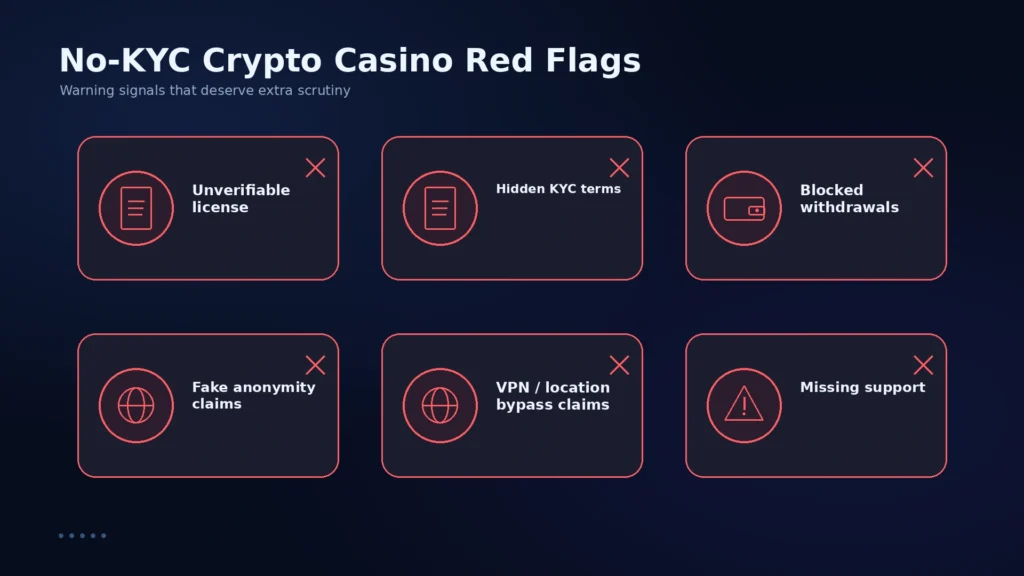
The Biggest No-KYC Casino Red Flags
Some warning signs deserve more weight than others.
1. No identifiable legal operator
A brand name is not enough.
2. License cannot be verified
Do not rely on an image or logo.
3. The licensed domain does not match the casino domain
This can indicate copied licensing information or an unauthorized mirror.
4. “100% anonymous” with no qualifications
Absolute privacy claims deserve skepticism when the platform still processes wallet, network and account data.
5. “KYC will never happen” while the terms say otherwise
The contradiction matters more than the fact that risk-based verification exists.
6. Withdrawals are barely mentioned
Deposit instructions should not be dramatically clearer than cashout rules.
7. Unlimited or guaranteed instant withdrawals
Absolute payout promises should be treated cautiously unless the conditions are fully defined.
8. Support asks for a private key or wallet seed phrase
Do not provide it.
9. Players are encouraged to bypass location restrictions
That is not a privacy feature.
10. Bonus conditions appear only after depositing
Wagering requirements, maximum bets, expiry rules and withdrawal restrictions should be available beforehand.
11. No complaint process
A casino should explain how disputes escalate beyond first-line live chat.
12. No self-exclusion or limit controls
Responsible-gambling protections belong in a serious safety assessment.
A Practical No-KYC Casino Safety Scorecard
Before sending funds, answer these questions.
Licensing and legality
- Can I identify the legal operator?
- Can I independently verify the license?
- Does the license cover this exact domain?
- Is this type of gambling authorized where I am physically located?
- Is there a regulator or complaint route?
KYC
- Does “no KYC” mean no signup KYC or no KYC under normal circumstances?
- What can trigger verification?
- Can a withdrawal be frozen during review?
- What documents can be requested?
- Does the privacy policy explain how verification data is handled?
Withdrawals
- What is the minimum?
- What is the maximum daily/weekly/monthly cashout?
- Is there an internal pending period?
- Can bonuses reduce the withdrawable amount?
- Are there fees?
- Which networks are supported?
- Is the casino’s advertised payout time operator processing or blockchain settlement?
Crypto security
- Is 2FA available?
- Can withdrawal addresses be protected?
- Is the deposit network clearly displayed?
- Does the casino explain wallet-control checks?
- Is support asking only for appropriate information?
Games
- Are game providers identifiable?
- Are game rules and RTP information available where appropriate?
- If a game claims to be provably fair, can the result actually be verified?
Responsible gambling
- Are deposit or time controls available?
- Is self-exclusion possible?
- Can the account be closed without unreasonable friction?
- Are support resources clearly available?
A platform that performs well across all these areas deserves more confidence than one whose only selling point is “no ID required.”
Key Takeaways
- No KYC is not a safety certificate.
- It can reduce the amount of identity documentation stored by the casino.
- It does not automatically make gambling anonymous.
- Public-blockchain activity can be analyzed.
- Some no-KYC casinos can request identification later.
- Crypto is not automatically exempt from AML or wallet screening.
- Fast blockchain settlement does not guarantee instant casino approval.
- Crypto transfers are typically difficult to reverse once sent.
- Provably fair games verify a limited part of game integrity, not the whole casino.
- A foreign gambling license does not provide automatic authorization in a U.S. state.
- A strong safety review should include licensing, operator ownership, withdrawals, KYC terms, wallet security, game fairness, responsible-gambling tools and dispute procedures.
Conclusion
The safest interpretation of a No KYC casino is not “a casino where nobody knows anything about me.”
It is a casino that may require less routine identity information during onboarding.
That can be a meaningful privacy advantage. It can also shift more responsibility onto the player to examine the operator’s license, legal availability, withdrawal conditions, verification clauses and crypto-security controls before money is sent.
For U.S. readers, the regulatory distinction is particularly important. A casino being accessible from a browser, accepting Bitcoin or holding an offshore license does not establish that it is authorized by a U.S. state regulator. Michigan’s continuing enforcement against offshore online gambling operators illustrates that distinction clearly.
The most useful question is therefore not:
“Does this casino require KYC?”
It is:
“If something goes wrong with my identity, account, game or withdrawal, what protection and evidence do I actually have?”
That question provides a much better measure of safety than the no-KYC label alone.
FAQ
Some can implement meaningful security, licensing, game-integrity and responsible-gambling controls, but no KYC alone does not establish safety.
There is no single nationwide answer that makes every no-KYC casino lawful throughout the country.
Online casino authorization is largely state-specific. The AGA reported seven lawful full online casino markets during 2025, and Maine enacted additional internet-gaming legislation in early 2026 that was still moving through rulemaking in July.
An offshore license does not replace authorization required by a particular U.S. state.
Yes.
Some operators use delayed or risk-based verification. Withdrawals, wallet ownership, security reviews, suspicious transactions, payment discrepancies or source-of-funds issues can lead to additional checks.
Curaçao’s June 2026 crypto guidance expressly incorporates crypto into AML/KYC controls and discusses wallet verification and transaction monitoring.
No.
The absence of an ID upload does not prevent a casino from processing wallet addresses, IP information, device data, login history or transaction behavior where its systems and privacy policy permit.
Blockchain analytics can also be used to examine transaction history.
They can be fast, but “instant” should not be assumed to apply to every stage.
The casino may first perform an internal withdrawal, bonus, security or compliance review. Blockchain settlement occurs only after the operator broadcasts the transaction.
Not completely.
Bitcoin addresses do not inherently contain a player’s real name, but transactions occur on a public blockchain and can be analyzed. Identity may also become linked to a wallet through other services or records.
No.
Provably fair technology can provide evidence about how a particular game outcome was generated. It does not prove the casino’s license, payout reliability, financial condition, cybersecurity or legal availability.
A VPN can have legitimate privacy and network-security uses, but it should not be used to bypass a casino’s geographic restrictions or misrepresent location.
Doing so can violate the operator’s rules and does not make otherwise unauthorized gambling legally available.