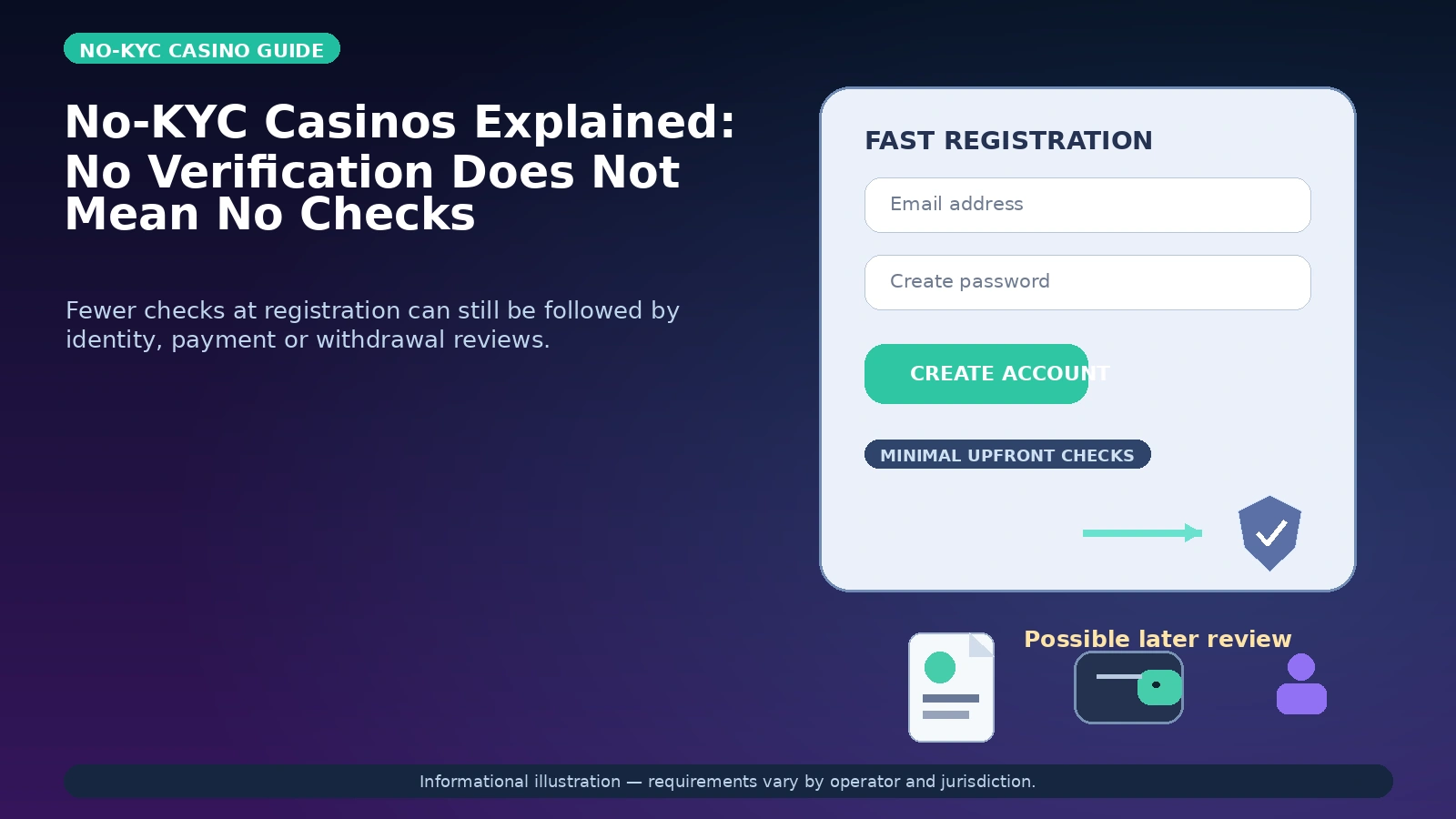

A no-KYC casino normally lets a player register, deposit or begin playing without completing a routine document check at the start. It does not necessarily mean that the casino will never request identification.
In practice, many platforms use risk-based or delayed verification. They may not ask for a passport, driver’s licence or proof of address during registration, but their terms may still permit checks before a withdrawal, when account details do not match, or when activity requires a security or compliance review.
The safest interpretation is therefore:
“No KYC” usually means no routine upfront document verification—not guaranteed anonymity and not a permanent exemption from every identity check.
KYC stands for “Know Your Customer.” In regulated financial and gambling environments, identity and transaction checks can support age verification, fraud prevention, account security and anti-money-laundering controls.
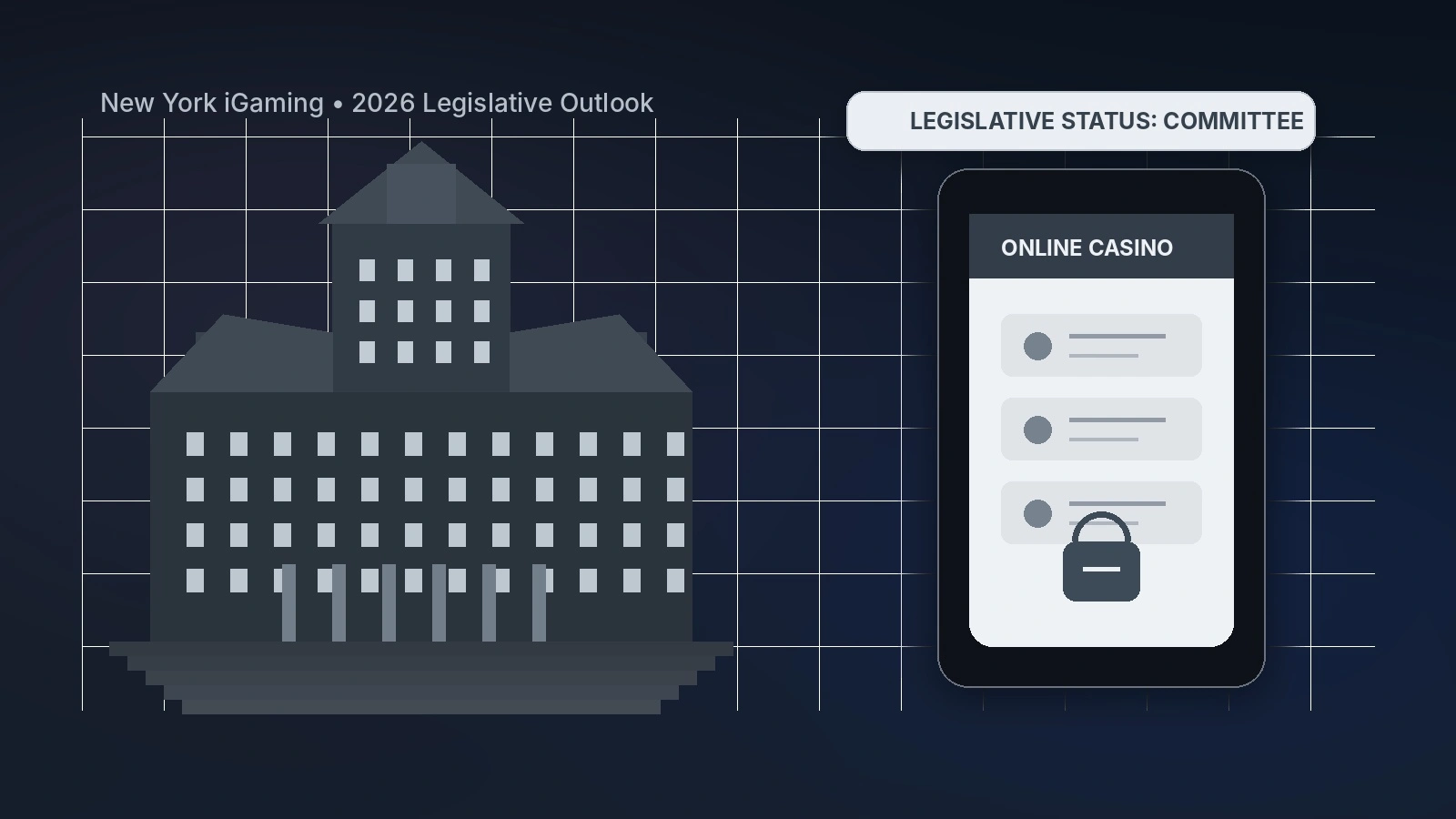
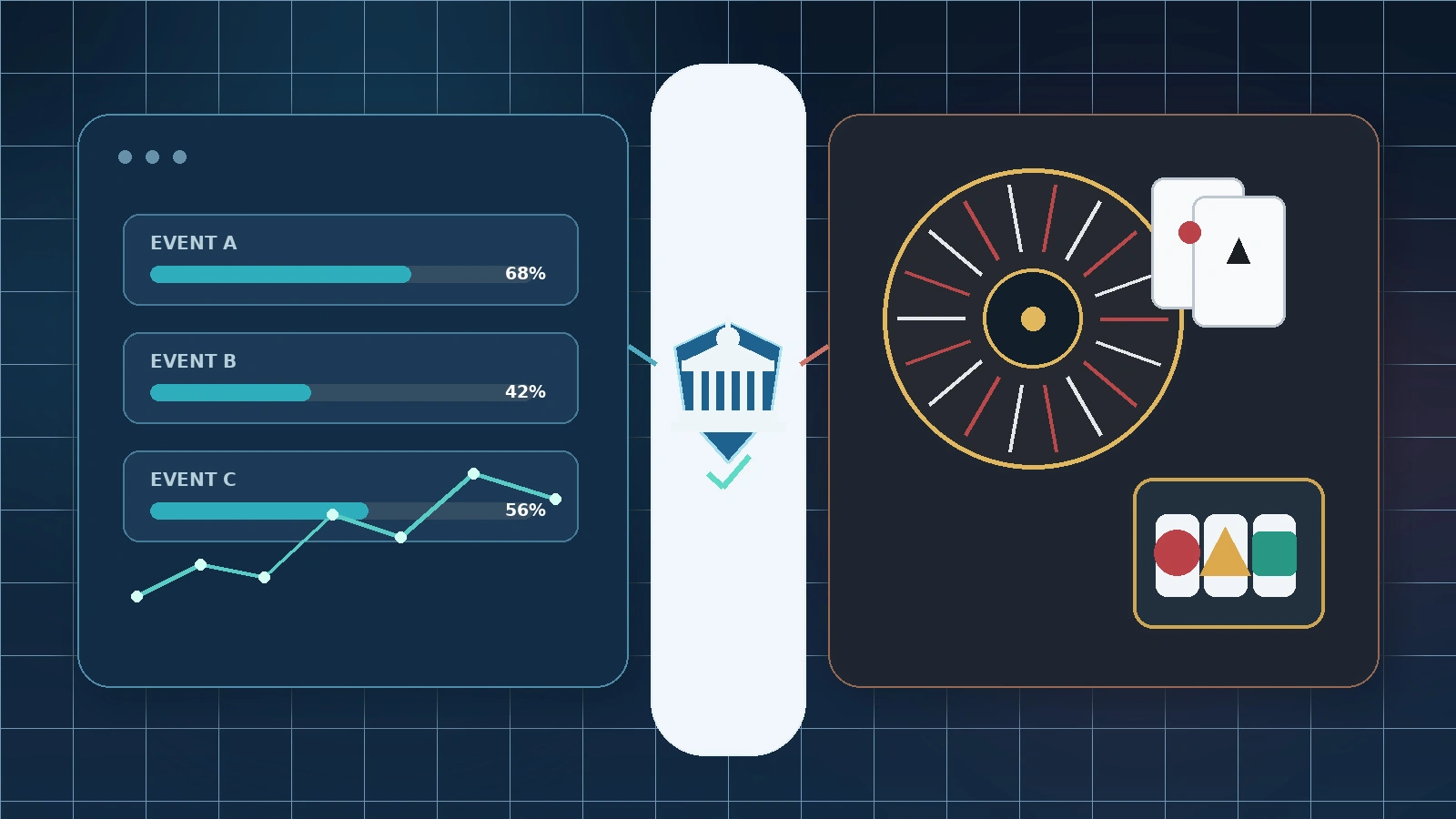
For US readers, another distinction matters: an overseas casino licence does not automatically authorize an operator in a particular US state. Online casino laws, licensed operators and player-protection rules are determined at state level.
Legal and gambling notice: This article provides general information, not legal advice. Check the laws, legal gambling age and licensed-operator register that apply where you are located. Gambling should be treated as paid entertainment, not as income or a way to recover losses.
Key takeaways
- No KYC normally refers to the absence of an upfront document check.
- A casino may still reserve the right to verify identity later.
- There is no universal “KYC-free withdrawal limit” across all operators.
- Crypto payments are generally pseudonymous, not automatically anonymous.
- A fast blockchain does not guarantee immediate casino approval.
- An offshore licence is different from authorization by a US state regulator.
- The operator’s terms, restricted-country rules and withdrawal policy matter more than a homepage badge.
- Readers should never use false information or location-masking tools to evade eligibility restrictions.
No KYC is a spectrum, not a guarantee
The term is used for several different account models. Two casinos can both advertise “no verification” while applying very different rules.
| Marketing claim | What it may mean in practice | What could still happen |
| No KYC signup | No ID upload during registration | Verification may occur later |
| No-document deposit | Crypto can be deposited without uploading documents | The payment or wallet may still be screened |
| No-verification withdrawal | Some approved withdrawals can be processed without documents | Security, eligibility or compliance checks may still apply |
| Wallet signup | A crypto wallet replaces a conventional registration form | The operator may still collect device, IP or transaction data |
| Anonymous casino | Limited personal information is collected initially | Blockchain, account and network activity may remain traceable |
| Fully no KYC | The operator says it does not routinely request documents | Legal, sanctions, fraud or security obligations may override the normal process |
This variation is why a fixed claim such as “KYC starts at $5,000” should not be treated as an industry rule. Some comparison pages publish estimated thresholds, but the controlling source is the operator’s current terms and the applicable regulatory framework.
What does a standard casino KYC check involve?
A conventional verification process may confirm:
- Identity.
- Age.
- Residential address.
- Account ownership.
- Ownership of a card, bank account, e-wallet or crypto wallet.
- Source of funds in higher-risk cases.
- Whether the player is in an eligible jurisdiction.
- Whether the activity presents fraud or money-laundering concerns.
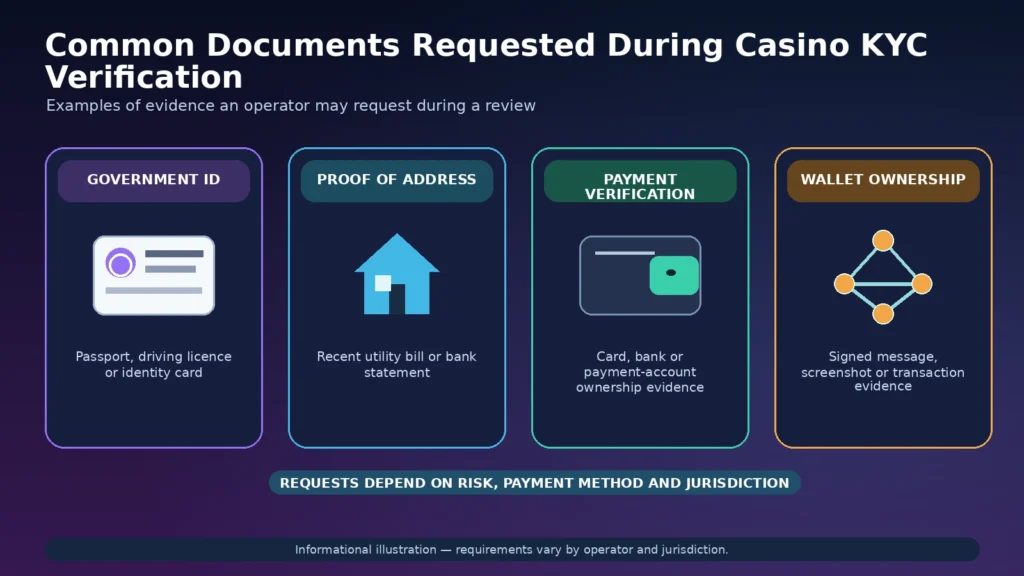
Common document requests include a passport, driver’s licence or national identity card; a utility bill or bank statement; a payment-ownership record; and sometimes a photograph or liveness check. The exact request depends on the operator, jurisdiction and reason for the review.
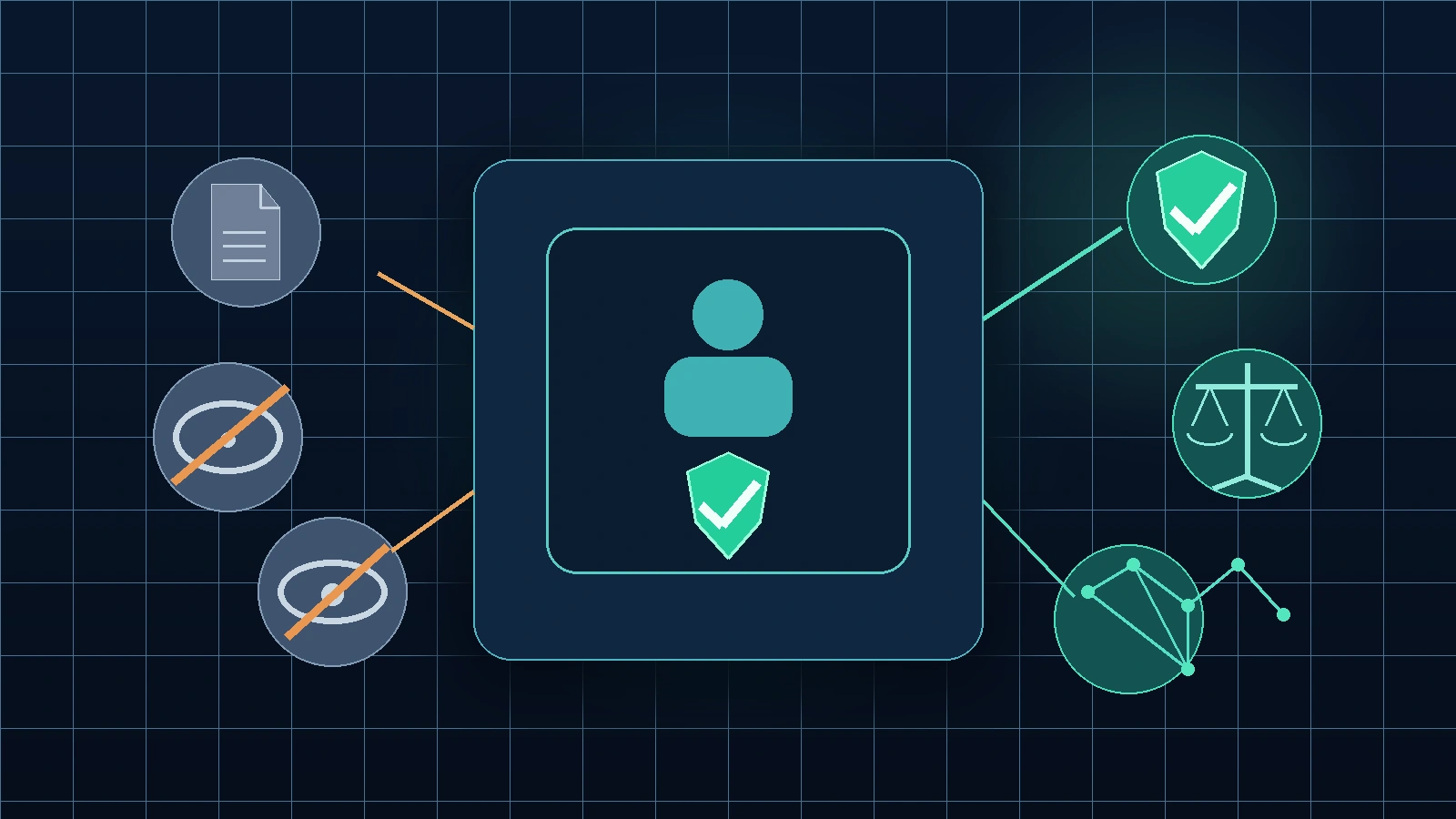
“No KYC” removes or delays some of this process. It does not necessarily remove every form of monitoring. A platform can conduct account, device, location or transaction screening without asking the player to upload a document.
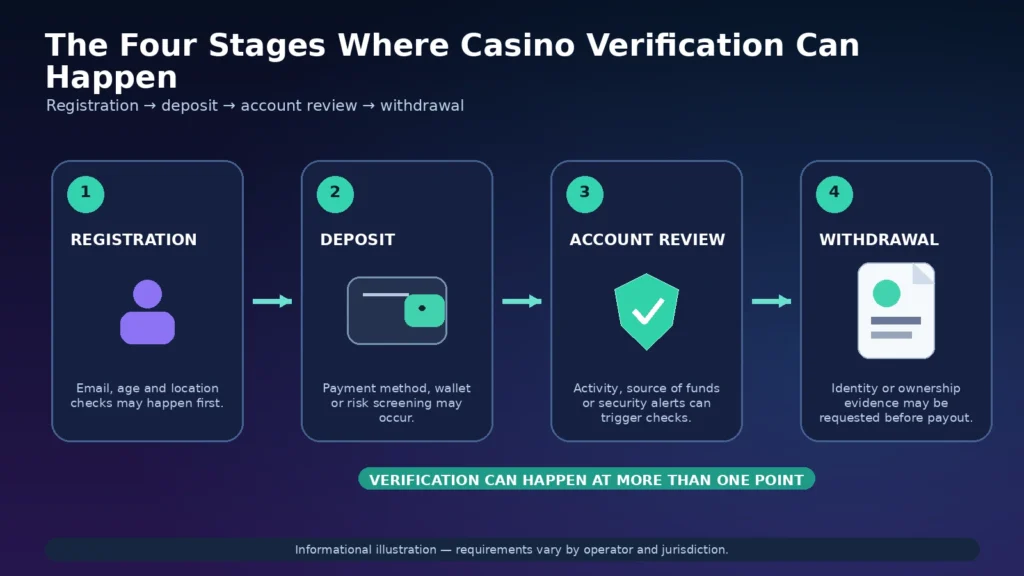
The four points where verification can happen
A more useful way to evaluate a casino is to examine four separate checkpoints.
1. Registration
At a traditional casino, registration may require a legal name, date of birth, home address, phone number and identity confirmation.
At a no-KYC platform, registration might require only:
- An email address and password.
- A username.
- A phone number.
- A connected crypto wallet.
- Acceptance of the terms and age requirement.
This is the stage most no-KYC advertising refers to. A quick signup does not tell the reader what will happen at withdrawal.
2. Deposit and payment
A casino may accept a crypto transfer without asking for documents. However, that does not make the entire payment chain identity-free.
For example, a crypto exchange, card processor or e-wallet may have completed its own KYC process before the money reached the casino. The casino may also screen wallet transactions or require the withdrawal method to match the funding method.
A no-KYC casino policy only describes the casino’s process. It does not determine what an exchange, wallet provider or payment processor requires.
3. Account-risk review
An account can be reviewed while the player is using it. The reasons differ by operator but may include:
- Inconsistent personal or location information.
- Multiple accounts.
- Account takeover concerns.
- A disputed payment or chargeback.
- Bonus-rule violations.
- Unusual transaction patterns.
- A request from a payment provider or regulator.
- A sanctions or anti-money-laundering alert.
A risk review does not always lead to document verification, but the casino’s terms may permit it.
4. Withdrawal
Withdrawal is where the meaning of “no verification” matters most.
A casino must first approve the request. Only after approval does it send the transaction to the payment network. These are two separate stages:
- Operator processing: The casino checks the balance, bonus terms, account status and withdrawal details.
- Payment settlement: The card network, e-wallet or blockchain delivers the funds.
A cryptocurrency can settle quickly after broadcast, but the casino may take longer to approve and broadcast it. “Instant withdrawal” should therefore be read as a processing claim that needs defined conditions—not a guarantee that every request reaches a wallet immediately.
Readers researching payment-specific options can compare the site’s guide to Ethereum casinos for US players, which also explains why the operator, licence, domain and state eligibility should be checked before depositing.
Types of no-KYC casino policies
No upfront KYC
This is the most common model.
The player can create an account and usually deposit without uploading identity documents. Verification remains possible later under the terms.
This model is more accurately described as delayed KYC than “no KYC forever.”
Risk-based or partial KYC
The operator applies different levels of review according to account activity.
Routine activity may proceed without documents, while a security, payment or compliance event can trigger a review. There is rarely one public threshold that applies to every account and every transaction.
Wallet-only registration
Some crypto platforms allow the player to connect a wallet instead of entering a conventional profile.
That reduces the information entered during signup, but it does not make the session invisible. The operator may still see the wallet address, transactions, browser information, device data and network connection.
No-document-by-default
A platform may state that it does not ordinarily request identity documents. Its terms may still contain exceptions for suspected fraud, legal requirements, restricted jurisdictions or account ownership disputes.
Full verification
A fully verified casino checks identity before deposits, play, withdrawals or a combination of those stages.
This creates more onboarding friction but may provide clearer access to a locally regulated complaint process, self-exclusion framework and player-protection rules.
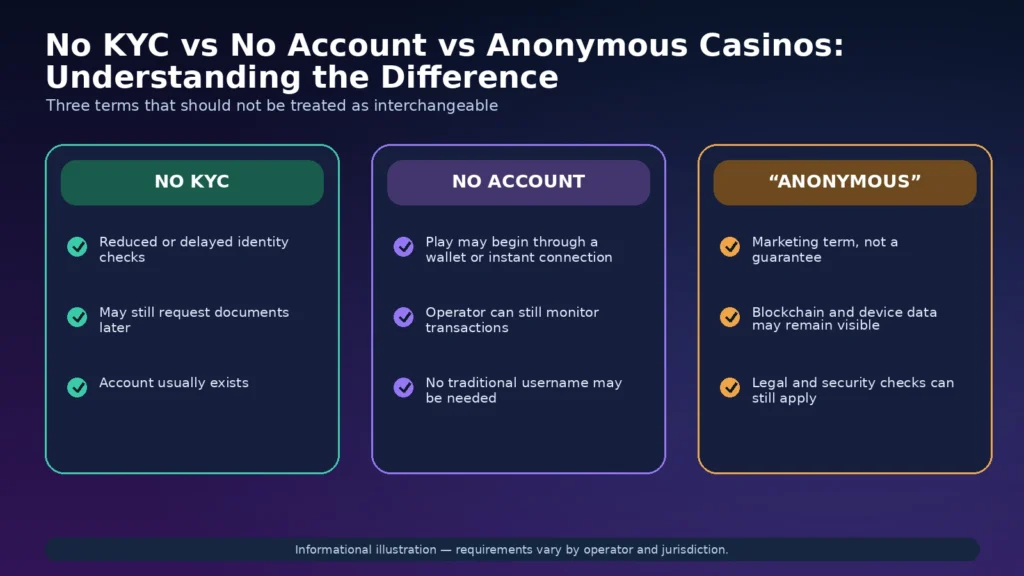
No KYC, no account and anonymous are not the same thing
These labels are often used together, but they describe different features.
| Term | What it primarily describes |
| No KYC | The level or timing of identity verification |
| No verification | A broad marketing phrase that must be checked against the terms |
| No account | A simplified login or wallet-based access method |
| Anonymous casino | A claimed level of privacy |
| Crypto casino | A casino that accepts cryptocurrency |
| Offshore casino | An operator licensed or based outside the player’s home jurisdiction |
| Provably fair casino | A platform offering games whose results can be checked using cryptographic data |
A crypto casino can require full KYC. A no-account casino can rely on a third party that has already verified the user. An offshore casino can request documents. A wallet-only casino can still record transaction and device data.
The labels are not interchangeable.
Why do players look for no-verification casinos?
The main attractions are understandable.
Less document sharing
A player may prefer not to upload a passport, home-address document or payment statement to another website.
Collecting fewer documents can reduce the amount of sensitive identity information stored by the operator. That benefit only applies when the casino genuinely does not collect those documents and secures the other information it holds.
Faster registration
Removing an upfront document review can shorten the time between account creation and access to the cashier or game lobby.
Crypto-focused payments
Many no-KYC casinos are designed around wallet-to-wallet deposits and withdrawals. This can remove bank-processing hours and card-network delays, although operator approval and blockchain congestion still affect the final timing.
Separation from conventional banking
A direct crypto payment may not appear on a bank statement as a payment to a casino. A purchase from an exchange or payment provider may still appear, and the blockchain transaction itself can remain publicly visible.
Access to crypto-native games
Some platforms offer Mines, dice, Plinko, crash games and other formats with provably fair verification tools.
Readers interested in a rules-based example can review the Mines casino game guide.
Is a no-KYC crypto casino actually anonymous?
Not automatically.
Many public blockchains provide pseudonymity, meaning that activity is associated with a wallet address rather than a person’s name. The transactions and account identifiers can still be visible publicly.
The National Institute of Standards and Technology explains that Bitcoin users can be pseudonymous while their account identifiers and transaction history remain observable.
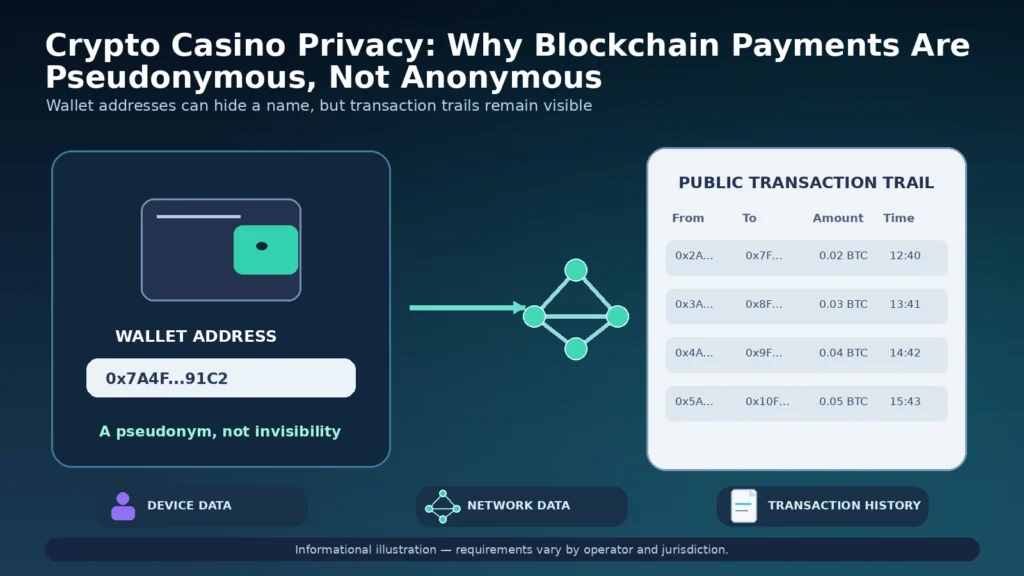
A casino may also receive or retain:
- The wallet address used for deposits and withdrawals.
- Email or phone details.
- IP and device information.
- Login history.
- Browser and cookie data.
- Game and transaction records.
- Communications with customer support.
- Details supplied to a payment partner.
If a wallet has been linked to an identity through an exchange, merchant, investigation or previous transaction, associated activity may become easier to connect.
“No document upload” is therefore not the same as complete anonymity.
Does no verification mean faster withdrawals?
It can remove one potential source of delay, but it does not control the entire process.
A withdrawal can be affected by:
- The operator’s approval queue.
- Pending bonus wagering.
- Withdrawal minimums and maximums.
- Account-risk checks.
- Payment-method ownership.
- Manual review.
- Blockchain congestion.
- Network fees.
- An incorrect wallet address or network.
- Limits on the number or value of pending requests.
A credible payout claim should explain:
- Whether the quoted time begins when the request is submitted or approved.
- Whether it refers to operator processing or network settlement.
- Which currencies qualify.
- Whether weekends are included.
- Whether first withdrawals receive additional review.
- Whether active bonuses delay cashout.
- What minimum and maximum limits apply.
The NoKYCCasino.us guide to Bitcoin no-deposit bonuses and instant withdrawals provides additional context on promotion and withdrawal claims. Its operator-specific details should still be rechecked against current terms before use.
Why might a no-KYC casino ask for documents later?
There is no universal trigger, but operator terms commonly reserve review rights for security, eligibility and compliance reasons.
Possible reasons include:
Confirming age or identity
The casino may need to establish that the account holder meets its age and eligibility rules.
Confirming account ownership
A review may occur if the operator suspects that someone other than the registered user controls the account or withdrawal method.
Payment mismatch
Depositing through one method and attempting to withdraw through an unrelated method can create ownership or fraud concerns.
Multiple-account concerns
Operators generally prohibit one person from opening multiple accounts to claim repeat bonuses or bypass limits.
Location inconsistency
An operator may review an account when the registered country, payment details, IP information or login pattern conflicts with its jurisdiction rules.
Bonus investigation
A withdrawal may be reviewed when betting activity appears to breach the maximum-bet rule, game-contribution rule, restricted-strategy rule or another promotion condition.
Transaction monitoring
Regulated casinos and financial institutions use transaction monitoring to identify activity that may require further review or reporting. US casinos covered by the Bank Secrecy Act have suspicious-transaction reporting responsibilities. Those US requirements should not be assumed to apply identically to every offshore operator, but they illustrate why financial reviews exist in regulated gambling.
Legal or regulatory request
A licence condition, sanctions requirement, court order, regulator request or law-enforcement inquiry may override the casino’s normal no-document process.
What documents could be requested?
Depending on the review, the operator may request one or more of the following:
| Document | Possible purpose |
| Passport or driver’s licence | Identity and age |
| Utility bill or bank statement | Residential address |
| Selfie or liveness check | Confirming that the document belongs to the account holder |
| Payment statement | Ownership of a deposit or withdrawal method |
| Wallet screenshot or signed message | Wallet control |
| Source-of-funds information | Explaining higher-value transactions |
| Additional account history | Investigating fraud, chargebacks or duplicate accounts |
Do not send documents through an unofficial social-media account or an unverified email address. Use the operator’s secure verification channel and confirm the request through its official support contact.
Never disclose a crypto-wallet seed phrase or private key. Those credentials provide control over the wallet and are not required for a legitimate identity check.
Are no-KYC casinos legal in the United States?
There is no single nationwide answer for every form of online gambling.
Online casino authorization is primarily determined at state level. The American Gaming Association reported lawful online casino markets in seven states during 2025: Connecticut, Delaware, Michigan, New Jersey, Pennsylvania, Rhode Island and West Virginia. Maine’s tribal internet-gaming authorization became law in January 2026, with implementation and licensing handled through the state’s Gambling Control Unit.
A site being accessible from a state does not prove that it is licensed there.
Michigan’s Gaming Control Board, for example, has repeatedly ordered offshore operators to stop offering unlicensed gambling to Michigan residents. The regulator distinguishes state-authorized operators from offshore websites that may hold a foreign licence but lack Michigan authorization.
Before playing, check:
- Whether online casino gambling is authorized in the state.
- The state regulator’s current operator list.
- The operator’s restricted-state list.
- The legal gambling age.
- Whether the site’s licence covers the exact operating domain.
- Whether the regulator accepts player complaints.
An offshore licence may establish that an operator is registered in another jurisdiction. It does not replace local authorization.
How to verify an offshore casino licence
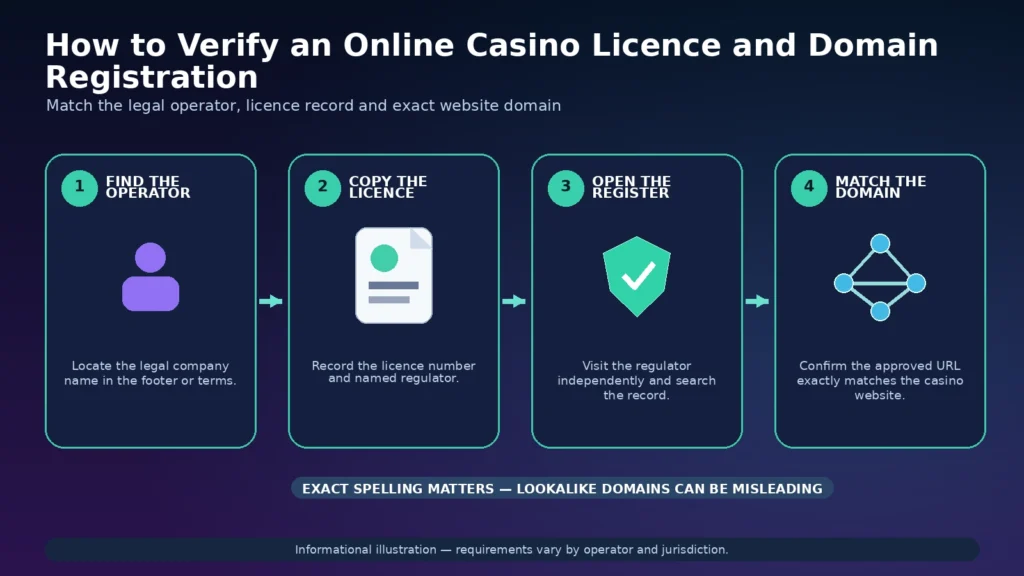
Do not rely on a regulator logo displayed in the footer. A logo can be copied.
Use this process instead.
Step 1: Identify the legal operator
Open the terms and conditions and locate:
- The company’s legal name.
- Registration number.
- Registered address.
- Licence number.
- Licensing authority.
- Exact operating domain.
A brand name alone is not enough.
Step 2: Open the regulator’s official register
The Curaçao Gaming Authority publishes an online gaming licence register. Its portal also explains that online gaming licences are issued under Curaçao’s current National Ordinance on Games of Chance framework.
Anjouan Gaming provides a public register that can be searched by company, licence number or operational domain.
Step 3: Match all important details
Confirm that the register entry matches:
- The company in the casino’s terms.
- The displayed licence number.
- The casino’s exact domain.
- The licence status.
- Any approved trading names.
A legitimate company licence does not automatically cover every website using that company’s name.
Step 4: Check the current status
Look for status terms such as:
- Active.
- Provisional.
- Suspended.
- Revoked.
- Expired.
Anjouan’s register uses active, suspended, revoked and expired licence-status categories.
Step 5: Examine the complaint process
A meaningful licence should provide a route for complaints or regulatory escalation.
Anjouan’s published player-complaint procedure requires players to complain to the operator first. If the matter is not resolved within 30 days, it may be escalated to an approved alternative-dispute-resolution provider.
The availability of a process does not guarantee that the player will win a dispute, but it is more useful than a static licence image with no verifiable record.
For a platform-specific comparison, readers can consult the site’s US no-verification casino guide. Any operator claims on a comparison page should be checked again against the latest terms and regulator record.
Benefits and limitations of no-KYC casinos
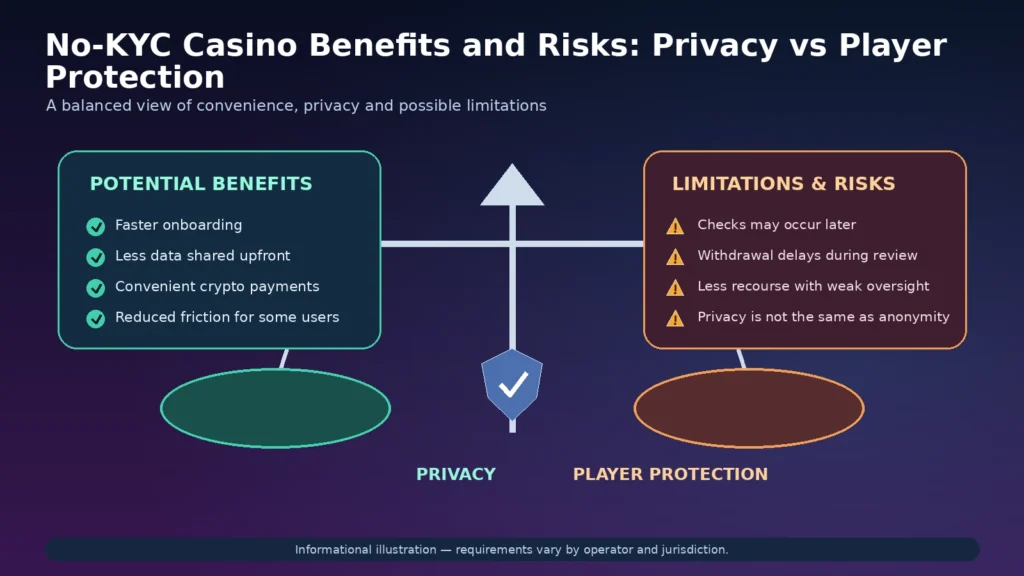
| Potential benefit | Important limitation |
| Fewer identity documents collected at signup | Documents may still be requested later |
| Faster initial registration | Fast signup does not guarantee fast withdrawal |
| Crypto-focused payment options | Public blockchains are not automatically anonymous |
| Less reliance on cards and bank transfers | Crypto transfers may be irreversible |
| Access to crypto-native games | Some platforms provide weaker consumer recourse |
| Reduced exposure of passport or address documents | The operator can still collect transaction and device data |
| Wallet-based access | Wallet access does not establish legal eligibility |
| Fewer routine checks | Reduced checks may also mean weaker age, fraud or responsible-gambling controls |
Are no-KYC casinos safer for privacy?
They can reduce one type of exposure: the storage of identity documents.
That does not prove the platform is safer overall. Safety also depends on:
- Licensing and legal authorization.
- Ownership transparency.
- Account security.
- Withdrawal reliability.
- Data-protection practices.
- Game integrity.
- Complaint handling.
- Responsible-gambling tools.
- Financial controls.
- The security of the player’s own wallet.
A casino collecting fewer documents may reduce the consequences of an identity-document breach. An unlicensed or poorly governed operator may create larger risks involving withheld funds, weak dispute resolution or misleading terms.
The correct comparison is not simply:
No KYC = safe
KYC = unsafe
It is:
What information is collected, why is it collected, how is it protected, who regulates the operator and what recourse exists if something goes wrong?
A practical pre-deposit checklist
Use this checklist before funding any account.
Verification policy
- Does the site promise no KYC at signup, withdrawal or both?
- Do the terms say documents can be requested “at any time”?
- Are first withdrawals reviewed?
- Are withdrawal thresholds clearly stated?
- Is source-of-funds verification mentioned?
- Can the operator close or suspend an account during review?
Legal eligibility
- Is online casino play permitted where the player is located?
- Is the casino on the state regulator’s approved list?
- Does the operator exclude the player’s state or country?
- Does the age requirement match local law?
- Does the site prohibit location-masking software?
Do not use a VPN, false address or inaccurate account information to bypass a geographic restriction. Doing so can breach the terms, affect withdrawal rights and potentially violate local law.
Licensing
- Is the legal operator named?
- Does the regulator maintain a searchable register?
- Does the exact domain appear in the record?
- Is the licence active?
- Is there an independent complaint route?
Withdrawals
- What is the minimum withdrawal?
- What is the maximum per transaction, day or month?
- Is there a pending-withdrawal limit?
- Are fees deducted?
- Can a bonus cap winnings?
- Is the advertised time an approval time or network-settlement estimate?
- Must deposits and withdrawals use the same method?
Bonuses
- What is the wagering requirement?
- Is it calculated on the deposit, bonus or both?
- Which games contribute?
- What is the maximum permitted bet?
- Is there a maximum cashout?
- How long does the promotion remain active?
- Does withdrawing cancel the bonus and associated winnings?
Security and support
- Is two-factor authentication available?
- Does the site use an official support domain?
- Can account closure be requested easily?
- Are responsible-gambling controls available?
- Does support answer a direct question about KYC without evasive language?
Warning signs in a no-verification claim
Avoid or investigate a platform further when:
- The homepage says “zero KYC forever,” but the terms permit unrestricted verification.
- The legal operator is not identified.
- The licence badge does not link to a regulator record.
- The domain does not match the licence entry.
- The platform asks for an additional deposit, “tax payment” or unlocking fee before releasing winnings.
- Withdrawal limits are hidden until after depositing.
- Bonus terms are unavailable or contradictory.
- Support will not explain when documents may be required.
- The site recommends bypassing state or country restrictions.
- The casino asks for a seed phrase, private key or remote access to a device.
- The operator accepts substantial deposits but imposes unusually low withdrawal caps.
- There is no account-closure, limit-setting or self-exclusion process.
A request for ID is not by itself proof of a scam. The concern is whether the possibility was disclosed, the request is proportionate, the submission channel is legitimate and the operator follows its published process.
No-KYC casinos and responsible gambling
Low-friction registration and rapid crypto deposits can remove natural pauses that might otherwise slow a gambling session. This makes personal limits and platform controls especially important.
Before depositing:
- Set a fixed entertainment budget.
- Do not use money required for rent, food, bills or debt payments.
- Set a time limit as well as a loss limit.
- Do not chase losses.
- Avoid gambling while distressed or under the influence.
- Check whether the platform offers deposit limits, time-outs and self-exclusion.
- Keep an independent record of deposits and withdrawals.
NoKYCCasino.us provides a dedicated overview of responsible gambling tools and support. US readers who need help can call or text 1-800-MY-RESET or use the National Problem Gambling Helpline’s support resources.
The practical meaning of “no verification”
The phrase is useful only after it is broken into specific questions:
- No verification at which stage?
- No documents for which payment methods?
- Are there transaction limits?
- What exceptions appear in the terms?
- Can the operator request ID during a risk review?
- Which licence covers the domain?
- Is the casino authorized where the player is located?
- What happens if the player refuses a later request?
A responsible operator should make those answers easy to find.
Conclusion
A no-KYC casino generally removes the routine document check from registration or early account use. It does not automatically promise permanent anonymity, unrestricted access or withdrawals without any review.
Before depositing, confirm the legal operator, licence, domain, restricted jurisdictions, withdrawal rules and the exact clause describing when verification can occur. Treat phrases such as “anonymous,” “instant” and “no verification” as claims to investigate rather than guarantees.
For US players, the most important step is checking local authorization. A foreign licence and an accessible website do not replace approval from the relevant state regulator.
FAQ
No. Many no-KYC casinos skip routine document verification during registration but reserve the right to request identification later. The operator’s current KYC, withdrawal and account-security terms determine when this can occur.
It generally means that an eligible withdrawal may be approved without uploading identity documents. It does not necessarily exclude account-security checks, bonus reviews, wallet screening, location checks or a later request for documents.
The operator should state whether the advertised time covers its internal approval or only blockchain settlement after the payment has been sent.
No universal amount applies to every casino.
Thresholds can differ by licence, payment method, account risk, transaction history and operator policy. Some sites do not publish a fixed threshold at all. A number quoted by an affiliate comparison should be checked against the casino’s current terms.
No. US online casino authorization is determined primarily at state level. A foreign or offshore licence does not give an operator automatic permission to accept players throughout the country.
Check the applicable state regulator’s current list of approved operators before depositing.
Not necessarily. Public blockchain transactions are normally associated with wallet addresses rather than names, but their transaction history may remain visible.
Bitcoin is pseudonymous: users may not be named on the ledger, while account identifiers and transactions remain observable.
“Soft KYC” is an informal industry term rather than one universal legal standard. It may describe background or automated checks that occur without asking the player to upload documents immediately.
Examples may include device, location, payment or database checks. The reader should examine what the individual operator means by the term.
The outcome depends on the terms, licence and reason for the request.
The casino may pause the withdrawal, restrict the account, return eligible deposits, close the account or escalate the matter. Before depositing, read the sections covering verification, account suspension, disputed balances and complaints.
No. “No account” describes the registration or login method. A service may use a wallet connection, banking login or third-party account instead of a conventional casino profile.
The third party may already have verified the user, or the casino may retain the right to request verification later.
Find the company and licence number in the casino’s terms and search the regulator’s official public register.
Match the company, exact domain, licence number and status. Curaçao and Anjouan both provide public verification resources, while Anjouan also publishes status definitions and a complaint process.
A VPN does not change local law or make an ineligible account eligible.
Some operators prohibit VPNs completely, while others permit them only when they are not used to disguise location. Using one to bypass a restricted jurisdiction can breach the terms and create withdrawal or account-closure problems.