
September 18, 2026
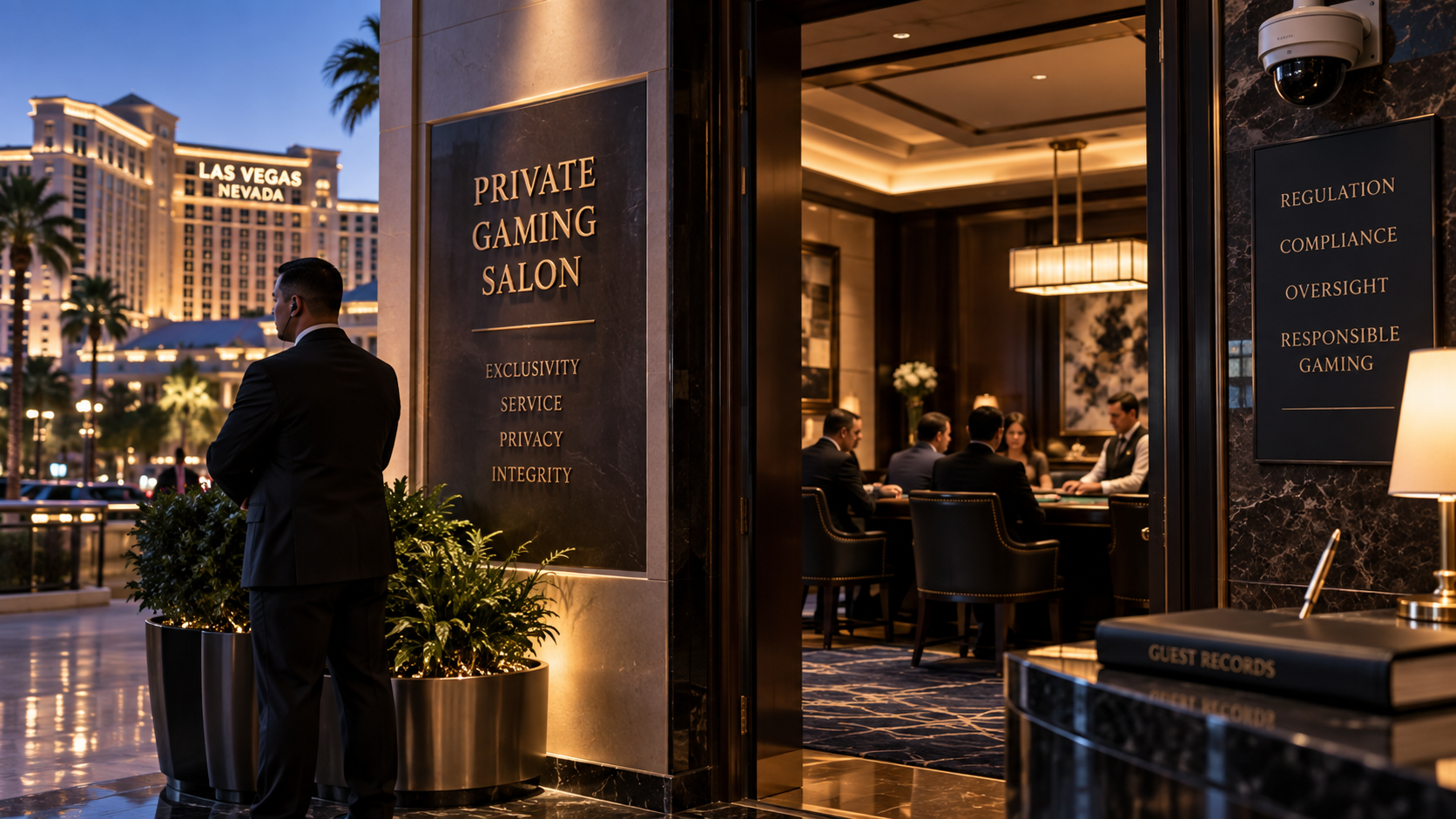
The Nevada Gaming Commission approved a targeted amendment to Regulation 5.200 on September 17, 2026, narrowing the guest logging requirement for private gaming salons to focus on guests who actually place wagers. The change follows concerns from casino-industry representatives that the broader requirement introduced in 2025 was burdensome, while one commissioner questioned whether reducing the scope could create a compliance gap.
The amendment applies to Nevada's regulated private gaming salons, specialized gaming areas operated by licensed resort properties. It does not change Nevada's separate rules for online interactive gaming.
Key Facts
| Detail | Confirmed information |
| Regulator | Nevada Gaming Commission |
| Regulation | Regulation 5.200 |
| Approval date | September 17, 2026 |
| Affected facilities | Private gaming salons |
| Main change | Guest logging requirement narrowed to wagering guests |
| Previous rule | Applied to salon patron guests more broadly |
| Wagering guests | Logging requirement remains |
| Effective status | Amendment adopted September 17, 2026 |
| Main issue debated | Compliance burden versus oversight |
| Online casino rules changed? | No |
Nevada Changes Regulation 5.200
The Nevada Gaming Commission's latest action makes a relatively small textual change to the state's gaming-salon rules.
The Commission added the word “wagering” twice to the relevant provision, narrowing the logging requirement to the name of a guest who wagers when that guest enters or leaves a gaming salon.
The Nevada Gaming Control Board's official history of adopted regulations records September 17, 2026 as the adoption date for the latest version of Regulation 5.200.
That distinction matters because the amendment does not remove the logging requirement for people who actually wager inside the salon.
Instead, it changes which guests have to be included in the required record.
Why Nevada Changed the Guest Logging Requirement
The latest amendment follows a broader revision of gaming-salon rules adopted in September 2025.
According to John Michela, senior deputy attorney general with the Nevada Attorney General's Office, the 2025 requirement covered all guests of salon patrons rather than only guests who placed wagers.
Michela told the Commission that implementation had proven burdensome and that the Gaming Control Board's enforcement division did not need records documenting the movements of every person entering and leaving the salons.
The industry therefore requested a narrower requirement focused on wagering guests.
The regulatory change reflects that request while retaining a recordkeeping requirement for guests who participate in wagering.
Commissioner Raises Concern About Oversight
The change was not approved without discussion.
Commissioner George Markantonis questioned whether narrowing the logging requirement could make it more difficult to monitor people entering private gaming salons.
His concern centered on guests who may not be known to casino surveillance personnel or the casino marketing staff responsible for private gaming areas.
Markantonis ultimately voted in favor of the amendment.
The discussion illustrates the regulatory balance involved in private gaming salons: operators want requirements that can be implemented efficiently, while regulators remain responsible for maintaining oversight of activity taking place in restricted gaming environments.
The commission's decision does not establish that the amendment creates a loophole. Rather, the concern was raised during the regulatory debate and was considered before the amendment was approved.
The Wagering Guest Requirement Remains
One important detail is that the amendment does not eliminate logging for guests who wager.
Virginia Valentine, president and CEO of the Nevada Resort Association, told the Commission that retaining the requirement for wagering guests was significant because it continues to provide a level of regulatory oversight.
The distinction is therefore between:
- A guest who enters a salon but does not wager.
- A guest who actually participates in wagering.
Under the amended rule, the latter remains subject to the relevant logging requirement.
That makes the development a targeted compliance adjustment rather than a broad removal of guest controls.
Background: Nevada's Gaming Salon Rules Changed in 2025
The latest amendment follows a much larger revision of Regulation 5.200 in September 2025.
The 2025 amendment changed several aspects of Nevada's private gaming salons, including the financial criterion for admission.
The standard financial requirement was reduced from $300,000 to $20,000. The official 2025 regulatory document confirms the $20,000 criterion for games other than poker.
The changes also added poker as an eligible salon game.
Under the amended rules, poker players must have at least a $10,000 buy-in, while a poker game cannot begin with less than $20,000 in total buy-ins.
The broader 2025 changes were designed to update rules originally developed for a much narrower high-value customer segment.
From $500,000 to $20,000
Nevada's gaming-salon framework dates to 2001.
The original financial threshold was $500,000. Regulators later reduced it to $300,000 in 2008, before the 2025 amendment lowered the standard to $20,000.
The evolution shows that the September 2026 amendment is part of a longer process of changing how Nevada regulates private gaming spaces.
However, the latest change is substantially narrower than the 2025 overhaul.
What Are Private Gaming Salons?
Private gaming salons are specialized areas within certain Nevada resort casinos where gaming can be conducted under rules designed to accommodate patrons seeking privacy.
The regulatory framework is an exception to Nevada's general policy that licensed casino gaming is conducted in areas open to the public.
The Nevada Gaming Commission and Gaming Control Board have maintained separate rules governing these spaces for decades. The original Regulation 5.200 was adopted in the early 2000s and has subsequently been amended several times.
The salons are therefore part of Nevada's land-based regulated casino system.
They should not be confused with:
- Regulated online casinos.
- Offshore online casinos.
- No-KYC crypto casinos.
- Online sportsbooks.
- Sweepstakes casinos.
The latest amendment does not change Nevada's online casino licensing framework.
What the Change Means for Casino Operators
For casino operators that maintain private gaming salons, the immediate change is primarily administrative.
Operators no longer need to apply the same guest logging requirement to every salon guest if that person does not wager, based on the amended rule.
The requirement remains relevant to guests who actually place wagers.
The change therefore reduces the amount of guest information that must be recorded while preserving a regulatory record for people participating directly in gaming.
The practical impact will depend on how individual licensees implement the amended requirement through their internal controls, surveillance and salon procedures.
What It Means for Salon Guests
For guests, the amendment may mean less recordkeeping when they accompany a salon patron but do not participate in wagering.
However, the change does not mean that private gaming salons have become unregulated or that guests can enter without controls.
Casino operators continue to operate under Nevada's licensing, surveillance and internal-control requirements.
A person who wagers remains within the scope of the relevant logging requirement.
Responsible-Gambling and Compliance Context
The amendment concerns regulatory recordkeeping, not gambling limits or an expansion of online casino access.
Nevada's regulated casino environment includes separate rules concerning surveillance, internal controls and responsible-gambling programs. Regulation 5.200 should therefore be viewed within that broader compliance framework.
The amendment also does not make gambling risk-free or change the financial risks associated with casino wagering.
For U.S. readers researching online gambling, it is also important not to interpret a change affecting Nevada's private physical gaming salons as evidence that an online casino is authorized in Nevada.
What Happens Next?
The latest amendment has been adopted, with the Nevada Gaming Control Board's official regulatory history recording September 17, 2026 as the adoption date.
The next practical stage will be implementation by Nevada casino licensees operating gaming salons.
Regulators will also continue to oversee compliance with the amended Regulation 5.200.
The larger question is whether Nevada will make additional changes to gaming-salon rules after the substantial 2025 overhaul. No further amendment should be treated as confirmed unless the Nevada Gaming Commission or Gaming Control Board announces it.
For now, the change is specific: guest logging in private Nevada gaming salons has been narrowed to focus on wagering guests, while the logging requirement for those guests remains in place.
FAQ
The Nevada Gaming Commission amended Regulation 5.200 on September 17, 2026, narrowing the guest logging requirement to guests who wager in private gaming salons.
Yes. Guests who wager remain subject to the applicable logging requirement. The amendment narrows the requirement rather than eliminating it.
No. The amendment concerns private gaming salons operated by licensed Nevada resort properties under Regulation 5.200. It does not amend Nevada's interactive gaming regulation.
The previous major revision was adopted in September 2025. It reduced the standard financial admission criterion from $300,000 to $20,000 and added poker under specific buy-in requirements.
The 2025 Regulation 5.200 amendment established a $20,000 financial criterion for admission for games other than poker, subject to the regulation's provisions and possible regulatory adjustments.