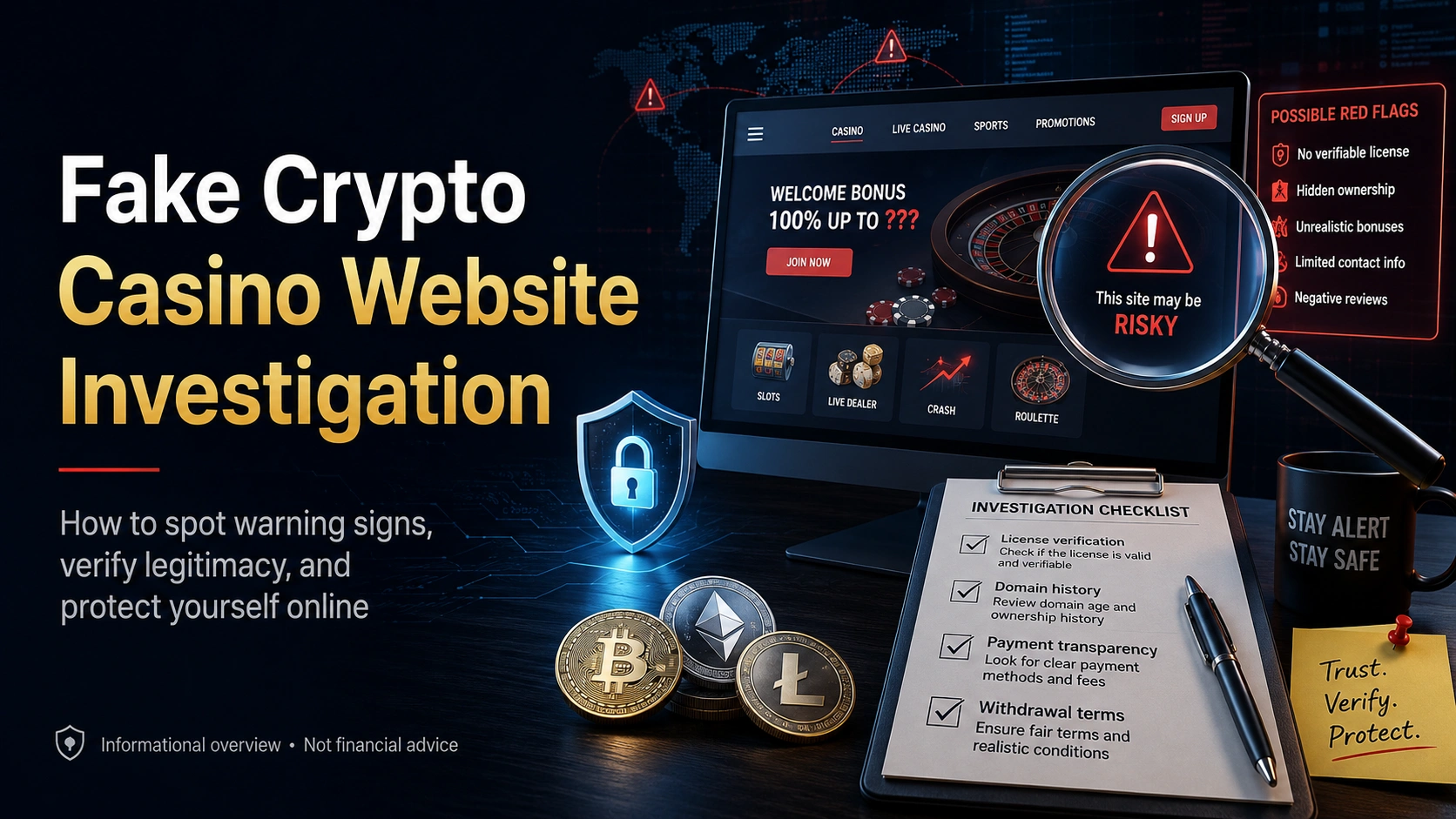

A fake crypto casino can look remarkably convincing. A professional design, HTTPS connection, recognizable game graphics, customer-support widget and even a gambling-license badge do not prove that the company behind the website is genuine.
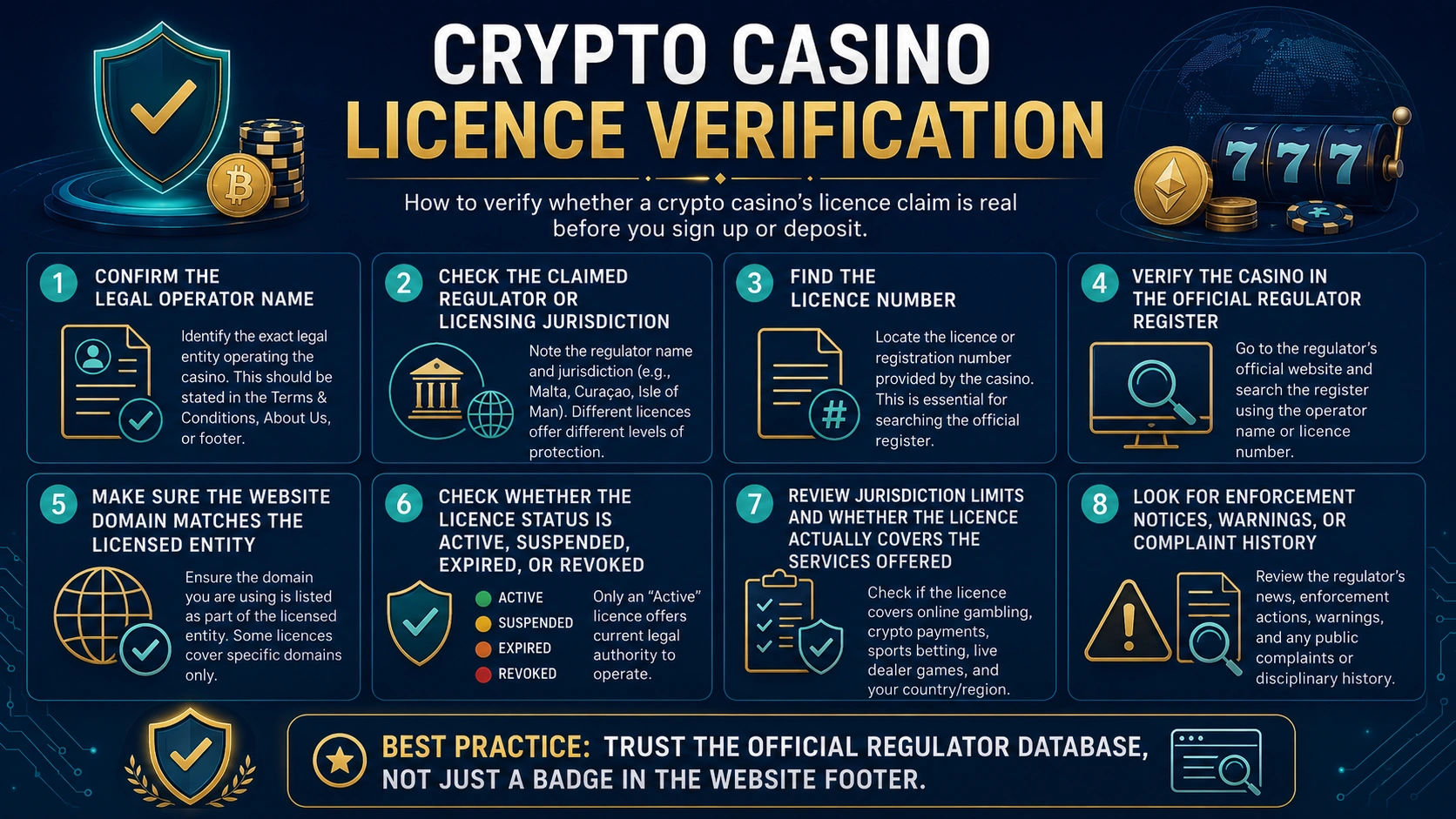
The most reliable way to identify a fake crypto casino is to verify things the website cannot credibly verify for itself: the legal operator, exact domain, gambling licence, current regulatory status, withdrawal rules and independent complaint history.
Some warning signs are even stronger. Stop immediately if a casino asks you to send additional cryptocurrency to “verify” your wallet, unlock a withdrawal, pay a tax before releasing winnings or reactivate your balance. Similar advance-fee patterns repeatedly appear in cryptocurrency-fraud complaints documented by U.S. regulators.
Crypto requires extra caution because transactions are generally difficult to reverse once confirmed. The FTC specifically warns that cryptocurrency payments usually do not provide the same dispute protections as credit-card payments.
This guide explains how to investigate a casino before sending crypto—and what to do if you have already interacted with a suspicious platform.
Important: Being offshore, using cryptocurrency or advertising “no KYC” does not automatically make a casino fake. Conversely, being accessible in the United States does not prove that a casino is authorized where you live. Fraud, licensing and legal availability are separate questions.
Quick Answer: The Biggest Fake Crypto Casino Red Flags
Treat these as serious warning signs:
| Warning Sign | Risk Level | Why It Matters |
| Requires another crypto deposit to withdraw | Critical | Matches common advance-fee scam behavior |
| Requires a “tax” or “unlock fee” before releasing funds | Critical | Additional payments may simply lead to more demands |
| Requests your wallet seed phrase or private key | Critical | Anyone with it can control the wallet |
| Website impersonates a known casino or regulator | Critical | You may be dealing with a phishing site |
| Licence cannot be verified independently | High | A footer badge can be copied |
| Licence belongs to another domain/company | High | Suggests impersonation or misleading licensing |
| Legal operator cannot be identified | High | Accountability and complaint options become unclear |
| Withdrawal rules change after you win | High | Moving conditions deserve immediate investigation |
| Huge balance appears after a free promo code | High | Can be bait for a later payment demand |
| Celebrity endorsement exists only in an ad | High | Images and videos can be fabricated or AI-generated |
| Bonus/KYC terms are unavailable before deposit | High | Operator can move the goalposts later |
| Domain is very new despite claims of a long history | Moderate–High | Strong inconsistency, but domain age alone is not proof |
One warning sign can justify further investigation. Multiple high-risk indicators should be taken much more seriously.
Why Fake Crypto Casino Websites Can Look Legitimate
Fraudulent websites do not need sophisticated casino operations to look convincing.
A scammer can reproduce:
- a casino-style homepage;
- slot graphics;
- live-chat windows;
- cryptocurrency balances;
- withdrawal screens;
- countdown timers;
- customer reviews;
- licensing logos;
- celebrity photographs;
- fake news articles;
- “provably fair” language;
- claimed transaction statistics.
The screen you see is controlled by the website operator.
An account displaying $25,000 does not prove that $25,000 exists in a segregated casino account, wallet or payment system.
California’s DFPI specifically warns about imposter websites and notes that fraudulent platforms can create convincing interfaces and artificial gains.
That leads to the first principle of casino due diligence:
Do not ask whether the website looks real. Ask which important claims you can verify somewhere the casino does not control.
Four Hard-Stop Indicators
Some signs deserve much more weight than design quality, reviews or website age.
1. You Must Deposit More Crypto to Withdraw Existing Funds
This is one of the strongest warning signs.
The wording varies:
- verification deposit;
- wallet verification payment;
- account activation;
- liquidity requirement;
- security deposit;
- withdrawal unlock;
- AML deposit;
- VIP upgrade;
- gas deposit.
The underlying structure is the same:
“Send us new money before we release money that supposedly already belongs to you.”
U.S. cryptocurrency-fraud complaints repeatedly document platforms displaying apparently valuable balances and then demanding additional fees before withdrawals. Paying the first fee may simply produce another requirement.
A legitimate casino can have published withdrawal fees, minimum withdrawal amounts or verification procedures. That is different from requiring an unrelated additional cryptocurrency payment to release an existing balance.
2. The Casino Says You Must Pay “Tax” Directly to It to Unlock a Withdrawal
Stop before sending more money.
A message such as:
“Your winnings are frozen until you send 15% tax in cryptocurrency.”
should be treated as a serious fraud indicator unless independently verified through a legitimate legal/tax process.
The DFPI tracker includes numerous consumer complaints describing fraudulent crypto platforms that demanded supposed taxes, commissions, security deposits or other charges before releasing funds.
Never assume that an official-sounding word such as tax, AML, compliance or blockchain verification makes a payment request legitimate.
3. Support Requests a Seed Phrase or Private Key
A casino does not need your wallet’s seed phrase or private key to send a legitimate cryptocurrency withdrawal.
Those credentials can provide control over your funds.
If “support” asks for:
- 12- or 24-word recovery phrase;
- private key;
- wallet backup phrase;
- screenshot containing recovery words;
do not provide them.
Similarly, be cautious about requests to install remote-control software, wallet “verification” tools or unknown browser extensions.
4. The Site’s Identity Cannot Be Verified Independently
If the website says it is operated by Example Gaming B.V., licensed under ABC123, do not accept that statement because it appears in the footer.
Verify it elsewhere.
NoKYCCasino.us provides a detailed crypto casino licence verification process covering the legal company, licence number, regulator, exact domain, current status and enforcement history.
The critical principle is:
Never let a casino be the only source proving its own legitimacy.
12 Warning Signs of a Fake Crypto Casino
1. The Licence Badge Cannot Be Independently Verified
A regulatory logo is just an image until the regulator confirms it.
Record:
- legal company name;
- casino brand;
- licence number;
- regulator;
- exact domain;
- licence type;
- status;
- expiry date where applicable.
Then visit the regulator independently.
Do not rely on a validation page hosted by the casino itself.
This is a real problem rather than a hypothetical one. The Malta Gaming Authority maintains an unauthorized-URL register and continued issuing warnings in 2026 concerning websites making false or misleading regulatory claims and sites impersonating licensed operators.
2. The Licence Exists—but It Belongs to Somebody Else
This is more deceptive than having no licence at all.
A fake casino might copy:
- a legitimate company’s licence number;
- a regulator seal;
- another casino’s corporate name;
- an old authorization;
- an expired credential.
Finding the licence number in a database is therefore only half the task.
Ask:
Does the regulator connect this exact domain to this exact operator?
A genuine licence for:
examplecasino.com
does not automatically validate:
example-casino-vip.com
The spelling matters.
The extension matters.
The domain matters.
3. Nobody Can Identify the Company Behind the Casino
A brand is not a legal entity.
Before depositing, look for the operator in:
- Terms and Conditions;
- Privacy Policy;
- licensing section;
- corporate disclosure;
- complaint procedure.
You should be able to determine who actually operates the website.
A casino that provides only:
“Crypto Casino © 2026”
without an identifiable company deserves additional scrutiny.
No identifiable operator also creates a practical problem if something goes wrong: who exactly owes the withdrawal?
4. The URL Is a Look-Alike Domain
Inspect the domain character by character.
Common impersonation techniques include:
- extra hyphens;
- missing letters;
- swapped letters;
- different TLDs;
- added words such as “vip,” “official” or “claim”;
- subdomains designed to disguise the real root domain.
The FBI warns that criminals can use search ads and very similar or slightly misspelled URLs to direct victims to sophisticated phishing sites that mimic legitimate companies.
Do not assume the first sponsored search result is the official casino.
If you already know the real domain, type it directly or use a previously verified bookmark.
5. A Celebrity Casino Promotion Cannot Be Confirmed Elsewhere
Celebrity faces are not evidence.
Fake promotions can use:
- AI-generated videos;
- edited screenshots;
- cloned social profiles;
- fabricated news articles;
- hacked accounts;
- voice cloning.
The FBI’s July 2026 alert specifically notes the use of AI-generated videos and spoofed websites to make fraud appear credible.
If an advertisement claims that a well-known person launched or endorsed a casino, verify the claim through that person’s verified channels and credible independent reporting.
Do not rely on the advertisement that introduced the claim.
6. A Promo Code Instantly Creates an Implausibly Large Withdrawable Balance
A dangerous scam pattern looks like this:
- User sees social-media casino promotion.
- Promo code supposedly credits a large balance.
- Games appear unusually easy to win.
- User requests withdrawal.
- Platform says the account must first be “verified.”
- Verification requires a real cryptocurrency deposit.
At that point the supposed casino balance is bait.
The economically important transaction is the real crypto being requested from the victim.
A legitimate promotion should have clearly available terms explaining:
- eligibility;
- wagering requirements;
- maximum bets;
- restricted games;
- withdrawal rules;
- expiry;
- maximum cashout.
“Free $5,000—withdraw instantly” with no meaningful conditions deserves skepticism.
7. Withdrawal Requirements Appear Only After You Try to Cash Out
A verification request is not automatically evidence of fraud.
Legitimate operators can require KYC, age checks, payment ownership verification or compliance reviews.
The red flag is the contradiction.
For example:
Before deposit:
“No verification ever.”
After win:
“Deposit $300 to verify your wallet.”
Those are materially different claims.
Readers specifically evaluating no-verification marketing should understand what no KYC actually means: no routine upfront document check does not necessarily mean the operator can never perform a later identity or risk review.
Look for the rules before funding the account.
8. Support Keeps Moving the Withdrawal Goalposts
One requirement becomes another:
- Upload ID.
- Send verification deposit.
- Upgrade account.
- Pay processing fee.
- Pay tax.
- Pay blockchain fee.
- Add funds to improve account status.
- Wait for another review.
The important signal is not simply that a withdrawal is delayed.
Real withdrawals can be delayed by:
- documented KYC;
- bonus disputes;
- security reviews;
- incorrect wallet information;
- blockchain congestion;
- manual processing.
The scam pattern is unplanned payment demands that keep changing after each requirement is satisfied.
9. “Provably Fair” Is Used as a Trust Badge for the Entire Casino
Provably fair technology has a narrower purpose.
A genuine implementation may help verify information used to generate an individual game result.
It does not prove:
- the operator is licensed;
- the website is the genuine domain;
- withdrawals will be honored;
- bonus rules are reasonable;
- customer funds are safe;
- account security is strong;
- the operator is legal in your state.
NoKYCCasino.us’s broader guide to crypto casino safety and red flags explains why licensing, withdrawals, operator identity, game integrity and account security need to be evaluated separately.
A “provably fair” logo is therefore not an all-purpose safety certificate.
10. The Casino Wants You to Connect a Wallet and Sign Something You Do Not Understand
Wallet connection is not always harmless.
A malicious site may attempt to obtain permissions that allow tokens to be moved.
The FBI has documented cryptocurrency fraud where users were encouraged to connect wallets to fraudulent applications and approve permissions that ultimately allowed scammers to drain assets.
Before signing:
- read what the wallet says is being approved;
- check the domain again;
- reject unexplained permissions;
- never sign because support says “this verifies your wallet”;
- avoid using a wallet containing long-term savings for speculative sites.
A wallet signature is not equivalent to entering an email address.
11. All Reputation Evidence Comes From the Casino or Affiliate Pages
Testimonials are weak evidence.
Fake sites can create their own:
- five-star reviews;
- “recent winner” feeds;
- comments;
- review websites;
- comparison pages;
- awards;
- news articles.
Search the exact domain, not just the brand.
Useful searches include:
- [domain] scam
- [domain] complaint
- [domain] withdrawal
- [legal company] licence
- [domain] regulator
Look for repeated complaint patterns rather than one angry review.
Examples that deserve closer investigation include multiple unrelated users describing:
- the same withdrawal fee;
- identical verification deposit;
- changing account terms;
- frozen balances;
- disappearing customer support.
Reviews can guide investigation.
They should not replace regulator verification.
12. Website Claims Contradict the Domain’s History
Domain information is contextual evidence.
Suppose a casino claims:
“Trusted by players since 2018.”
but its current domain appears to have been registered a few days ago.
That contradiction requires an explanation.
Possible legitimate reasons exist:
- rebranding;
- domain migration;
- acquisition;
- change of TLD.
So a young domain does not automatically prove fraud.
Likewise, an old domain does not prove safety. Domains can change ownership or be compromised.
The meaningful issue is the inconsistency between the site’s claims and independently observable history.
What Does NOT Prove a Crypto Casino Is Legitimate?
This section may prevent as many mistakes as the red flags.
HTTPS
The padlock means the connection between your browser and the site is encrypted.
It does not tell you whether the website owner is honest.
Scam websites can use HTTPS too.
Professional Design
Templates can make a new website look established within hours.
Design quality is not regulatory evidence.
Lots of Games
Copied graphics or embedded content do not prove the operator has a legitimate supplier relationship.
A Licence Logo
Verify it independently.
A “Provably Fair” Badge
Verify the actual game mechanism. It does not prove operator reliability.
Hundreds of Positive Reviews
Determine whether the reviews are independent, authentic and spread across time.
A Successful Small Withdrawal
This is useful information, but it is not definitive proof.
Fraud schemes outside gambling have been documented allowing small withdrawals before victims committed significantly larger sums.
A small withdrawal can reduce the amount initially exposed.
It cannot guarantee a future large withdrawal.
A Large Social-Media Following
Followers, likes, comments and screenshots can be purchased, automated, fabricated or created through compromised accounts.
Search Ranking
A website appearing near the top of Google does not mean a regulator has verified it.
The FBI specifically warns about fraudulent sponsored search results used to impersonate legitimate companies.
A Five-Minute Crypto Casino Verification Process
Before registering or transferring funds, work through these checks in order.
Step 1: Verify the Exact Domain
Write down the domain you are visiting.
Check:
- spelling;
- TLD;
- hyphens;
- added words;
- unusual subdomains.
If you reached the website through an ad, message, QR code, Telegram group or social post, independently find the claimed operator.
Step 2: Identify the Legal Operator
Open the site’s:
- Terms;
- Privacy Policy;
- About page;
- licence section.
Record:
Company:
Licence number:
Regulator:
Registered jurisdiction:
Casino domain:
If you cannot identify the legal entity, stop.
Step 3: Verify the Licence Outside the Casino
Go to the regulator’s official website yourself.
Check:
- company;
- licence number;
- authorization type;
- exact URL;
- current status;
- issue/expiry data;
- enforcement history.
Do not trust a screenshot.
Do not trust a PDF hosted exclusively by the casino.
Do not trust a static seal.
Step 4: Check Whether the Casino Is Authorized Where You Are
For U.S. users, offshore licensing and U.S. authorization are different questions.
A casino can hold a genuine overseas licence and still lack authority to accept wagers in a particular state.
Michigan illustrates the distinction clearly. In April 2026, the Michigan Gaming Control Board announced that it had issued cease-and-desist orders to 45 offshore gambling operators that it said were offering online gambling to Michigan residents without the required state licence.
NoKYCCasino.us covers the broader state-level distinction in its guide to whether no-KYC casinos are legal in the United States.
Accessibility is not authorization.
Step 5: Read the Withdrawal Terms Before Deposit
Find the answers to:
- Minimum withdrawal?
- Maximum withdrawal?
- Daily/weekly/monthly limits?
- Processing period?
- Network fees?
- KYC triggers?
- First-withdrawal review?
- Bonus restrictions?
- Same-wallet requirement?
- Restricted states/countries?
- Complaint procedure?
If deposits are explained across an entire page but withdrawal rules are virtually absent, investigate further.
Legitimate KYC vs a Fake “Verification Deposit”
This distinction is crucial for no-KYC readers.
A legitimate verification request may involve:
- government-issued ID;
- age verification;
- proof of address;
- selfie/liveness check;
- payment-method ownership;
- source-of-funds information;
- account-security review.
Whether those requirements are appropriate depends on the operator, licence and circumstances.
A suspicious “verification deposit” involves:
“Send us 100/250/$500 in additional cryptocurrency so we can verify that your wallet belongs to you.”
That is fundamentally different.
The request increases the amount of money the user has at risk without independently proving ownership or identity.
If support then says the first payment was insufficient and another is required, stop sending funds.
How Fake Crypto Casino Withdrawal Scams Work
A common scam funnel is psychologically effective because it delays the moment when real money is demanded.
Phase 1: Acquisition
Victim finds the casino through:
- TikTok;
- Instagram;
- Discord;
- Telegram;
- YouTube;
- search advertisement;
- fake news article;
- celebrity promotion;
- hacked social profile.
Phase 2: Free Balance
Promo code adds a large apparent balance.
No money has yet been lost, which lowers suspicion.
Phase 3: Easy Gambling
The user appears to win.
The balance may rapidly increase.
Phase 4: Withdrawal Attempt
The user now believes they have money worth protecting.
Phase 5: Payment Demand
Support explains that the withdrawal requires:
- verification deposit;
- tax;
- wallet activation;
- security check;
- account upgrade.
Now the victim sends real cryptocurrency.
Phase 6: Moving Requirements
Another obstacle appears.
This is why the correct response to a suspicious withdrawal charge is not:
“Maybe one more payment will release everything.”
It is:
“Can this requirement be verified independently, and was it disclosed before the deposit?”
Fake Casino Websites Can Also Be Phishing Sites
Not every fake casino waits for a deposit.
Some want:
- email/password combinations;
- exchange credentials;
- wallet permissions;
- private keys;
- identification documents;
- banking information.
That means you can suffer harm even without gambling.
Use a unique password for casino accounts.
Enable 2FA where available.
Do not reuse your exchange or email password.
Never give customer support remote access to your device.
Never send a seed phrase.
If an unexpected support representative contacts you, close the conversation and contact the operator through a verified channel you locate independently.
What to Do Before Depositing Cryptocurrency
Use the following sequence.
Verify
- Exact domain.
- Legal operator.
- Licence.
- Licence status.
- Domain coverage.
- U.S. state authorization.
Read
- Withdrawal terms.
- KYC policy.
- Bonus rules.
- Restricted jurisdictions.
- Complaint procedure.
Secure
- Use a unique password.
- Enable 2FA.
- Do not expose your savings wallet unnecessarily.
- Verify the blockchain network.
- Save the deposit address.
- Record the TXID.
Preserve
Save copies of:
- Terms;
- bonus rules;
- withdrawal policy;
- licence details;
- relevant support conversation.
Web pages can change.
Your evidence should not depend entirely on the operator keeping an old version available.
Limit Exposure
Do not keep more cryptocurrency on a gambling platform than you intend to risk.
This is good security practice even when there is no evidence of fraud.
It also aligns with broader responsible gambling controls: set a fixed entertainment budget and do not chase money already lost.
What to Do If You Think You Used a Fake Crypto Casino
The correct action depends on what you exposed.
If You Only Visited the Website
If you did not:
- download anything;
- enter credentials;
- connect a wallet;
- sign a transaction;
- upload ID;
- send cryptocurrency,
close the site and avoid returning through the same advertisement or link.
If You Entered a Password
If that password was reused anywhere else:
- Change it on the real accounts.
- Secure your email account first.
- Enable multi-factor authentication.
- Watch for password-reset attempts.
If You Connected a Wallet
Review whether you signed or approved anything.
If you granted suspicious token permissions, revoke those permissions through trusted wallet/blockchain tools.
Do not interact further with the suspicious site.
If You Shared a Seed Phrase or Private Key
Assume that wallet’s security is compromised.
Move remaining assets to a newly created secure wallet using trusted software and a clean device, and stop using the exposed recovery phrase.
Changing the wallet application’s password does not make an exposed seed phrase secret again.
If You Sent Cryptocurrency
Stop sending more.
Then preserve:
- exact website URL;
- screenshots;
- wallet addresses;
- transaction hashes;
- amount and cryptocurrency;
- timestamp;
- chat messages;
- email addresses;
- usernames;
- advertisements;
- claimed licence;
- any payment demand.
Contact the cryptocurrency exchange or service used to send the funds and report the destination address as potentially fraudulent.
The FTC advises crypto-scam victims to report suspicious activity and also contact the cryptocurrency company used to send the payment.
For U.S. internet fraud, a detailed IC3 report can include website information, receiving cryptocurrency addresses and transaction information.
Beware of the Second Scam: “Crypto Recovery Services”
Someone may contact you after you post about losing cryptocurrency and say:
“We traced the wallet.”
“Our hacker can reverse the transaction.”
“Pay our recovery fee first.”
“We work with the FBI.”
Do not let urgency created by the first loss cause a second one.
The FBI warned again in July 2026 that scammers were impersonating IC3 and targeting previous fraud victims with supposed recovery assistance, AI-generated promotional material and spoofed government websites. The FBI specifically states that IC3 does not charge victims to recover funds.
Type official government addresses yourself rather than following links sent by an alleged recovery specialist.
A Practical Fake Crypto Casino Evidence Scorecard
Use this to decide whether further investigation is necessary.
| Check | Positive Evidence | Negative Evidence |
| Legal operator | Company independently identifiable | No company named |
| Licence | Regulator independently confirms it | Static/unverifiable badge |
| Exact domain | Domain appears in regulator records where available | Different or misspelled domain |
| Licence status | Current and active | Expired/revoked/unknown |
| U.S. availability | State regulator confirms authorization | Accessible but not authorized |
| Withdrawal terms | Published before deposit | New rules after winning |
| KYC | Clear trigger/process | Contradictory or endless demands |
| Withdrawal payment | Ordinary disclosed fee structure | New deposit required to release funds |
| Wallet security | No secret credentials requested | Seed phrase/private key requested |
| Support | Verified official channel | Telegram/DM-only or unsolicited support |
| Bonus | Clear written conditions | Huge free balance with no rules |
| Reputation | Long, mixed, independent history | Only promotional five-star material |
| Domain history | Consistent with company claims | Newly created but claims years of operation |
| Responsible gambling | Limits/self-exclusion/support | No player-protection mechanisms |
No score can provide a 100% guarantee.
The goal is to replace trust in marketing with independently verifiable evidence.
Final Pre-Deposit Checklist
Before sending crypto, confirm:
- The URL is the correct domain.
- The legal company is identifiable.
- The gambling licence exists.
- The licence belongs to that company.
- The licence covers the relevant domain where the regulator publishes domain information.
- The licence is current.
- You checked regulator enforcement notices.
- You checked U.S. state authorization separately.
- Withdrawal rules are visible.
- KYC rules are visible.
- Bonus rules are visible.
- No additional crypto payment is required merely to “verify” a wallet.
- Support does not request seed phrases or private keys.
- The site does not encourage bypassing geographic restrictions.
- Independent complaints do not show a recurring withdrawal-fee pattern.
- You have saved important terms and transaction information.
- You have set a gambling budget before depositing.
If several answers remain unclear, there is no reason to rush.
Cryptocurrency will still exist after you finish checking the website.
Conclusion
The hardest fake crypto casinos to identify are not poorly designed websites.
They are sites that reproduce the signals of legitimacy without the underlying evidence: copied licences, professional interfaces, fabricated balances, impressive bonuses, fake reviews and familiar branding.
That is why visual inspection is not enough.
Verify:
domain → operator → regulator → licence → current status → U.S. authorization → withdrawal terms → wallet security.
And remember the strongest practical warning sign:
If a website says you must send more cryptocurrency to release money already displayed as yours, stop and verify the demand independently before risking another dollar.
A genuine licence, HTTPS certificate, successful small withdrawal or provably fair game can provide useful information. None of them alone guarantees that every future withdrawal will be honored.
Research first. Send cryptocurrency second.
FAQ
Start by identifying the legal operator and gambling licence, then verify both independently through the regulator. Match the exact domain, check current licence status, read withdrawal and KYC rules and investigate repeated complaints.
A licence badge displayed only on the casino website is not sufficient evidence.
An additional cryptocurrency payment demanded solely to “verify” an account or unlock existing winnings should be treated as a serious fraud warning sign.
Identity verification may legitimately require documents or payment-ownership checks. That is different from sending more money to release money supposedly already in the account.
Yes.
HTTPS encrypts data transmitted between your browser and the website. It does not prove that the person operating the website is honest, licensed or financially reliable.
It can copy a licence number, company name or regulator logo.
That is why you should check the regulator’s own database and verify that the licence belongs to the correct legal company and, where available, the exact casino domain.
No.
It is a useful data point, but it is not conclusive evidence. Fraud schemes have been documented in which a small initial withdrawal helped build confidence before significantly larger deposits were encouraged.
No.
“No KYC” generally describes an onboarding or verification policy. It does not by itself establish whether the operator is legitimate, safe, licensed or legally available where the user lives.
Likewise, a casino can advertise no routine upfront verification while reserving the right to conduct risk-based verification later.
Stop sending additional payments, save every TXID, wallet address, screenshot and communication, notify the exchange or service used to send the crypto and report the incident through legitimate government reporting channels.
Do not pay a third party an upfront fee based solely on a promise that it can recover the cryptocurrency.
Simply connecting is not always equivalent to giving control of funds, but malicious sites can request dangerous signatures or token approvals.
Read every wallet prompt. Do not approve unexplained permissions, and never enter a recovery phrase or private key into a casino website.