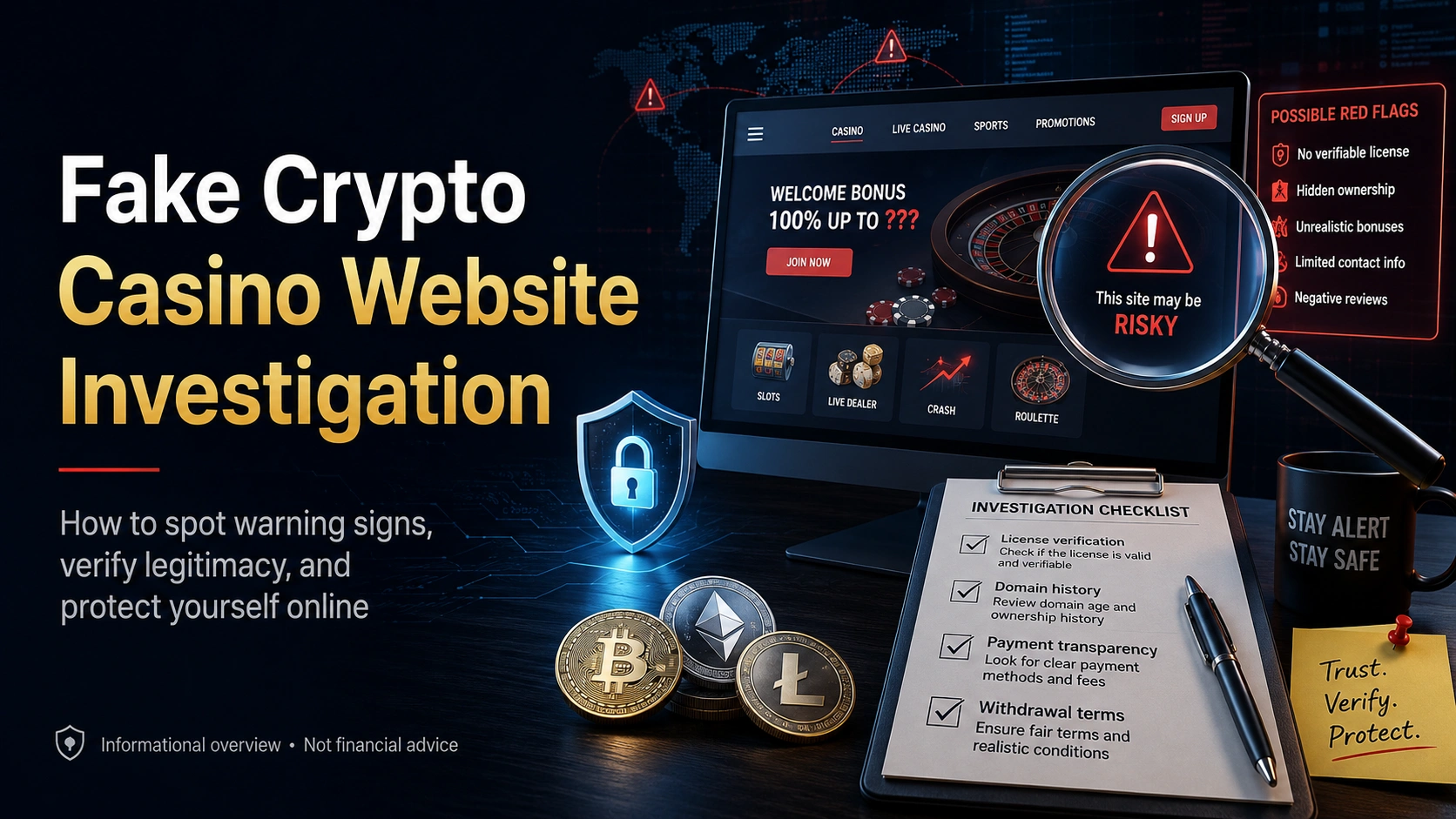

A crypto casino licence should never be accepted at face value.
A casino footer can display a regulator’s name, licence number and official-looking seal in seconds. What matters is whether the regulator itself confirms that the correct legal company holds an active consumer-facing licence covering the exact website you are about to use.
For U.S. players, there is an additional check before any offshore licence verification: determine whether the operator is authorized where you are physically located. A Curaçao, Malta, Estonia, Kahnawà:ke or other foreign credential does not replace authorization required under U.S. state law. Michigan, for example, explicitly distinguishes its authorized operators from offshore platforms operating outside its state framework. Are No-KYC Casinos Legal in the United States? explains that jurisdictional distinction in more detail.
A practical verification process is therefore:
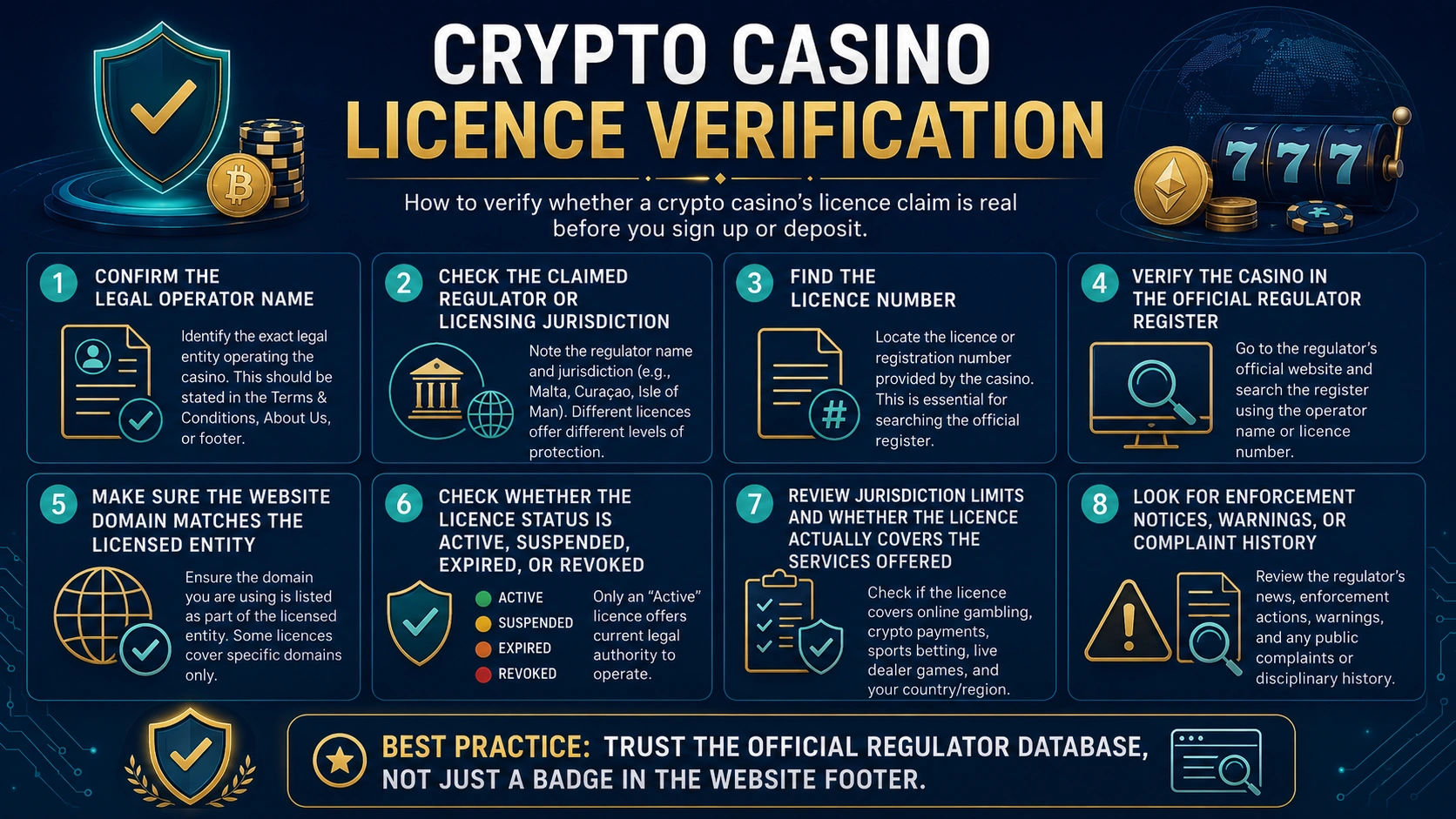
location → regulator → legal operator → licence number → licence type → exact domain → current status → enforcement history → complaint rights
Do those checks before depositing cryptocurrency, not after a withdrawal problem appears.
What Is a Crypto Casino Licence?
The term crypto casino licence is convenient shorthand, but it can create the wrong impression.
There is no single worldwide licence called a “Bitcoin casino licence” or “crypto casino licence.”
In many jurisdictions, the operator holds an ordinary remote-gambling or online-gaming licence and is then permitted—subject to the applicable rules—to use cryptocurrency or other approved payment methods.
Malta illustrates the distinction. The Malta Gaming Authority requires a B2C Gaming Service Licence for covered remote gaming activities and separately treats payment methods as an operational matter requiring regulatory handling. Its annual reporting has also discussed regulatory policy around distributed-ledger technology and cryptocurrencies.
Curaçao similarly licenses online gaming, while also supervising its gaming industry for AML/CFT compliance. The licence is for the gambling operation; accepting Bitcoin, USDT or another digital asset does not create a separate exemption from gambling regulation.
For players, the better question is therefore:
What gambling licence does this crypto casino hold, and does that licence actually cover this operator and website?
Why a Casino Licence Badge Is Not Proof
The seal in the footer is where verification starts—not where it ends.
A dishonest site could potentially:
- Copy a regulator’s logo.
- Copy another operator’s licence number.
- Display an expired licence.
- Claim a B2B supplier licence as though it were a consumer casino licence.
- Use the name of a licensed company that does not operate that domain.
- Link the badge to a page hosted by the casino itself.
- Display an outdated sublicence.
- Describe company incorporation as a gaming licence.
Current regulator activity shows why independent checking matters. The Malta Gaming Authority was still publishing warnings in 2026 about unauthorized URLs and websites impersonating licensed operators.
The rule is simple:
Never let the casino verify itself.
How to Verify a Crypto Casino Licence in 9 Steps
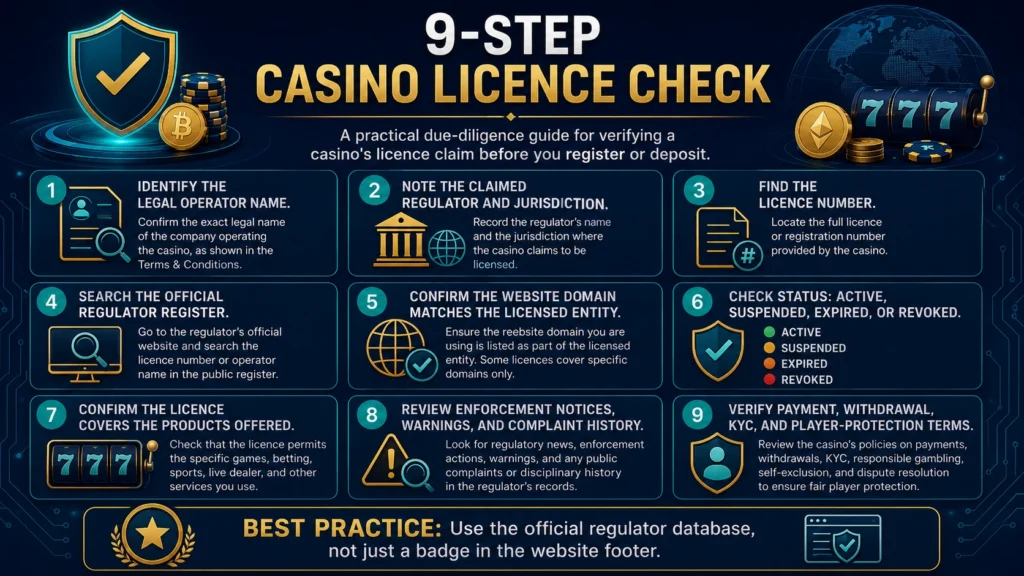
Step 1: Check Your Own Jurisdiction First
For a U.S. reader, licence verification starts with where you are physically located.
A casino may hold a valid licence overseas while lacking authorization to offer real-money online casino gaming in your state.
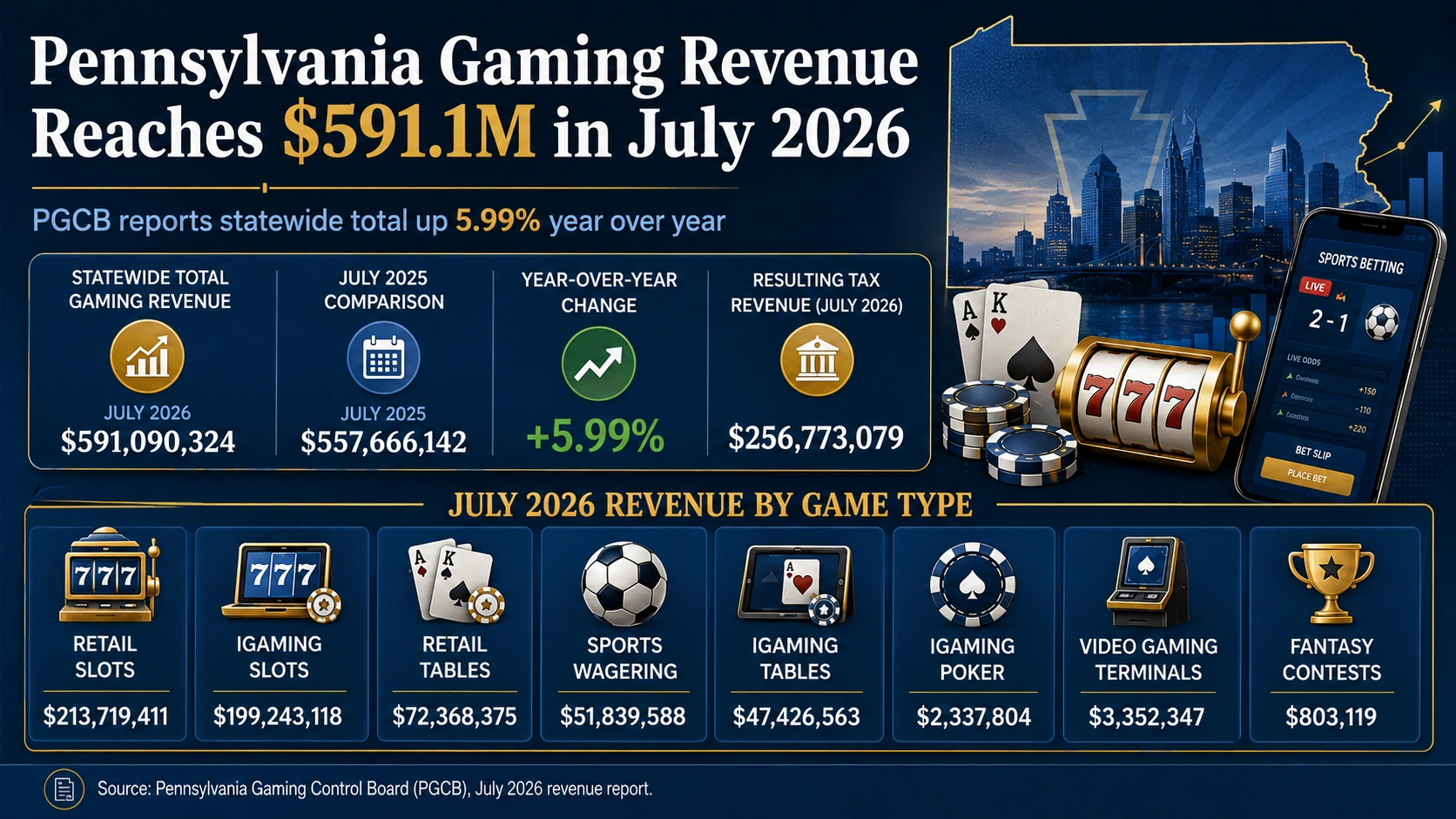
State regulators publish their own authorized-operator information. The Pennsylvania Gaming Control Board, for example, specifically tells users to verify that a site appears among its regulated online gaming operators before wagering.
Michigan similarly states that gambling is generally illegal unless specifically authorized and maintains information identifying legal gaming providers.
Therefore, do not translate:
“Licensed offshore”
into:
“Legal for me in the United States.”
They answer different questions.
Step 2: Find the Claimed Legal Operator and Regulator
Scroll to the casino’s footer, Terms and Conditions, About page or licensing section.
Record:
- Regulator name.
- Licence number.
- Legal company name.
- Company registration number, if provided.
- Casino brand.
- Website domain.
- Licence or seal link.
Do not search only the casino’s brand name.
A brand such as “Example Casino” may be operated by a company called something completely different, such as Example Holdings B.V.
The regulator usually licenses the legal entity, not merely the marketing name.
If the casino refuses to identify its operating company or claimed regulator, that is a material red flag.
Step 3: Open the Regulator’s Website Yourself
Do not rely entirely on the licence badge link.
Open a new browser tab and search for the regulator independently. Confirm that you are on the regulator’s actual domain.
This prevents a casino from directing you to:
- A fake validation page.
- A cloned regulator website.
- An old licence validator.
- A page it controls itself.
For Curaçao, for example, the current regulator is the Curaçao Gaming Authority (CGA), which describes itself as the regulator of the online gaming industry under the National Ordinance on Games of Chance.
For Pennsylvania, the official source is the Pennsylvania Gaming Control Board.
For Malta, the Malta Gaming Authority maintains its own searchable licence register.
The regulator—not an affiliate review—is the primary source for the licence claim.
Step 4: Search the Official Register
Search using as many identifiers as the regulator permits:
- Licence number.
- Legal company name.
- Casino brand.
- Domain.
- Registration number.
A useful public register should let you determine whether the operator exists within that regulatory framework.
For example, Estonia’s Tax and Customs Board publishes a current list of legal gambling operators showing the operator, brand, website and licence information.
The Malta Gaming Authority’s licence register can be searched by licensee name, authorization status, URL and gaming service.
The Kahnawà:ke Gaming Commission publishes interactive-gaming permit holders and operates a Logo Certification Program intended to let users verify whether a site displaying its logo is actually licensed.
If you cannot independently connect the casino to the claimed regulator, stop before depositing.
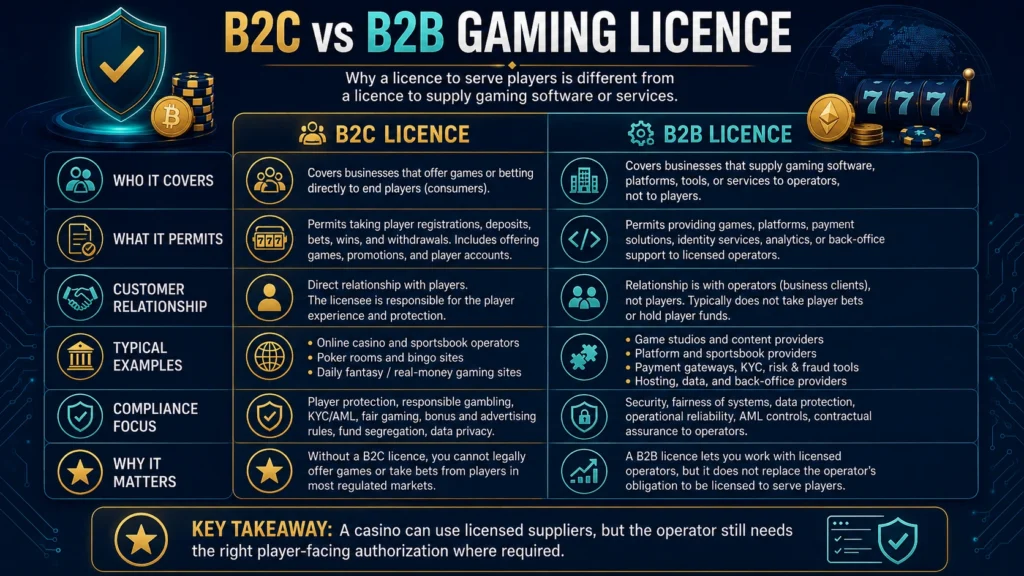
Step 5: Check Whether the Licence Is B2C or B2B
This is one of the most overlooked checks.
B2C generally means business-to-consumer: the licence relates to an operator providing gambling to players.
B2B generally means business-to-business: the licence may cover software, gaming technology, infrastructure or another supplier activity.
A B2B licence does not automatically establish that the holder is licensed to take your casino wagers.
The current Curaçao Gaming Authority register makes this distinction explicit. Its August 14, 2026 registry identifies each listed licensee as B2C or B2B alongside the licence number, company registration number, issue date and expiry date.
This creates an important anti-fraud question:
Is the company operating the consumer casino actually listed as B2C, or has the site displayed a supplier credential?
Do not assume every certificate containing a regulator’s name authorizes consumer gambling.
Step 6: Match the Exact Website Domain
Finding the company in a database is not enough.
The regulator’s records or verification system should establish a connection between the licence and the exact domain you are visiting whenever that information is available.
Check carefully for:
- .com versus .io.
- Extra hyphens.
- Different country extensions.
- Misspellings.
- Mirror sites.
- Subdomains.
- “VIP” or alternate versions of an established brand.
This matters because scam sites can impersonate legitimate brands.
The MGA’s current register specifically supports searching by URL, and the regulator has warned consumers about sites impersonating licensed operators.
A licence belonging to:
realcasino.example
does not automatically validate:
realcasino-vip.example
even when the branding looks identical.
Verify the domain, not just the logo.
Step 7: Check Issue Date, Expiry and Current Status
Licensing is not permanent.
An operator can:
- Let a licence expire.
- Surrender it.
- Have it suspended.
- Have it revoked.
- Remain under regulatory assessment.
- Move to a different licensed entity.
Curaçao provides a useful current example.
Its August 14, 2026 online-gaming register contains licence numbers, company names, B2C/B2B classification, company-registration numbers, issue dates, expiry dates and status information. The CGA itself cautions that licence status can change and that the overview should not be treated as an absolute guarantee of current validity.
That means checking the register once is not the end of the process.
Step 8: Search the Regulator’s Enforcement History
Next, look for:
- Revocations.
- Suspensions.
- Fines.
- Warnings.
- Licence restrictions.
- Public statements.
- Voluntary terminations.
Curaçao now publishes a separate enforcement register. Its July 10, 2026 version lists numerous licences whose status had been revoked, demonstrating why finding an old licence number elsewhere on the internet is not enough.
The Malta Gaming Authority likewise publishes enforcement actions alongside its licence register.
The Kahnawà:ke Gaming Commission also publishes current regulatory notices; for example, it announced the voluntary termination of one Client Provider Authorization in July 2026.
The practical rule is:
Verify both the licence register and the enforcement record.
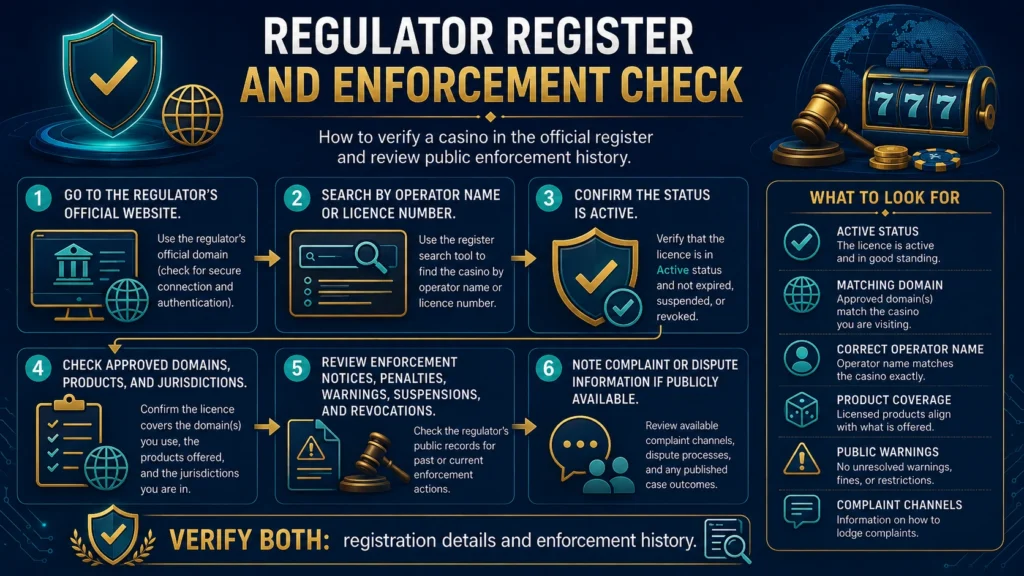
Step 9: Check What Happens if You Have a Dispute
A licence has far more value when it creates a meaningful complaint or dispute process.
Before depositing, determine:
- Must you complain to the casino first?
- Can the regulator review the issue?
- Is there an approved alternative dispute resolution provider?
- Can the regulator order compensation?
- Are there filing deadlines?
- What records will you need?
The Kahnawà:ke Gaming Commission states that player protection is a primary function of its interactive-gaming system and maintains a dispute-resolution process for players using its permit holders.
Curaçao’s current framework also includes certified alternative-dispute-resolution providers. The CGA’s July 2026 certificate list includes multiple approved ADR entities alongside certified test laboratories such as GLI, eCOGRA, BMM Spain and Gaming Associates Europe.
For a U.S.-regulated example, Pennsylvania provides an official complaint/dispute procedure for patrons of regulated gaming operators.
A licence badge is much less useful if you cannot determine who will hear your complaint when the casino disagrees with you.
How to Verify a Curaçao Casino Licence in 2026
Curaçao deserves special attention because older online guides still describe the former master-licence and sublicense system.
The current system is different.
The Curaçao Gaming Authority now regulates online gaming under the National Ordinance on Games of Chance and publishes its own licence register.
A practical Curaçao check looks like this:
1. Record the licence number and legal entity
Get both from the casino’s current Terms or footer.
2. Open the CGA website independently
Navigate to the licence register rather than trusting a casino-hosted validation page.
3. Find the legal entity
Compare:
- Licence number.
- Company name.
- Registration number.
- Licence type.
- Dates.
4. Confirm it is B2C
If you are verifying a casino that accepts wagers directly from players, do not rely on a B2B supplier listing as proof of the casino’s operating licence.
5. Check expiry/status
The CGA’s current register includes time-sensitive licence information.
6. Check the enforcement register
A licence may once have existed but subsequently have been revoked.
7. Verify the complaint route
Determine which complaint/ADR process applies before depositing.
This method is much stronger than searching Google for:
“[Casino name] Curaçao licence”
Search-engine results can preserve old information long after regulatory status changes.
What About Malta, Estonia and Kahnawà:ke?
Different regulators expose licence information differently.
| Jurisdiction / Regulator | Useful Verification Feature | What to Check |
| Curaçao Gaming Authority | Online licence + enforcement registers | Company, number, B2C/B2B, dates, status |
| Malta Gaming Authority | Searchable licensee register | Licensee, authorization status, URL, gaming service |
| Estonian Tax and Customs Board | Legal gambling operator list | Operator, brand, website, permit |
| Kahnawà:ke Gaming Commission | Permit-holder list + certification logo | Permit holder and verified licensed site |
| U.S. state regulators | State-authorized operator lists | Whether exact operator is authorized in that state |
The quality of the verification process matters more than the presence of an impressive-looking seal.
A Special 2026 Caution About Anjouan Licence Claims
This area deserves more caution than most current casino guides provide.
The website AnjouanGaming.com currently describes itself as the internet-gaming regulatory authority for the Autonomous Island of Anjouan and maintains a public register for B2C and B2B licence claims.
However, the legal authority behind the broader Anjouan licensing structure has been seriously disputed.
A 2024 GIABA mutual evaluation, whose findings were reviewed and endorsed by the FATF, states that gambling and other games of chance are prohibited in the Union of the Comoros under Article 201 of the Penal Code.
An Australian Broadcasting Corporation investigation published in December 2025 reported that the Central Bank of the Comoros had described several supposed Anjouan regulatory structures and firms selling licences as “fictitious structures.”
Le Monde reported in February 2026 that the Anjouan Offshore Finance Authority had previously been described as fictitious by the Central Bank of the Comoros and questioned the legal validity of the internet-gambling licensing ecosystem associated with it.
The Anjouan Gaming website disputes that characterization and continues to assert that its licences operate under a valid legal framework.
For readers, the correct conclusion is not to decide the disputed constitutional/legal question themselves.
It is this:
An Anjouan licence claim is currently a contested credential and should not be treated as equivalent to an uncontested government-regulator verification simply because the operator appears in the Anjouan website’s own register.
That is an important difference from many current ranking articles that present Anjouan as a straightforward alternative licensing jurisdiction.
Does a Licence Mean the Casino Is Safe?
No.
A valid licence is useful evidence of regulatory oversight.
It is not a guarantee of:
- Future payout approval.
- Perfect cybersecurity.
- Good customer service.
- Favorable bonus terms.
- Zero account disputes.
- Zero KYC.
- Solvency forever.
- Legality in every country or U.S. state.
Think of licensing as one layer of due diligence.
| Question | Can a Valid Licence Answer It Alone? |
| Does a regulator recognize this operator? | Yes, if independently verified |
| Is the licence currently active? | Usually, through regulator records |
| Does it cover this exact website? | Sometimes—verify domain |
| Is it B2C? | Check licence scope |
| Is the casino legal in my U.S. state? | No |
| Will every withdrawal be paid instantly? | No |
| Will I never be asked for KYC? | No |
| Are the bonus terms good? | No |
| Is every game provably fair? | No |
| Has the operator never had complaints? | No |
This is why How Safe Are No-KYC Crypto Casinos? recommends evaluating licensing alongside withdrawal rules, security, game integrity and responsible-gambling protections.
Can a Licensed Crypto Casino Still Ask for KYC?
Yes.
Licence verification and identity verification answer different questions.
A regulator can require or permit operators to conduct:
- Age verification.
- Identity verification.
- Sanctions screening.
- Transaction monitoring.
- Source-of-funds checks.
- Enhanced due diligence.
Curaçao’s regulator describes itself as the AML/CFT supervisor for its gaming industry.
CGA guidance for crypto-gambling operators also addresses transaction monitoring, sanctions exposure, source-of-funds verification and enhanced due diligence where risk is elevated.
Therefore, a casino advertising “no KYC” should not be interpreted as promising that a licence prevents it from ever requesting documents.
The site’s guide to why no-KYC casinos still ask for verification explains how registration policy and later risk-based verification can differ.
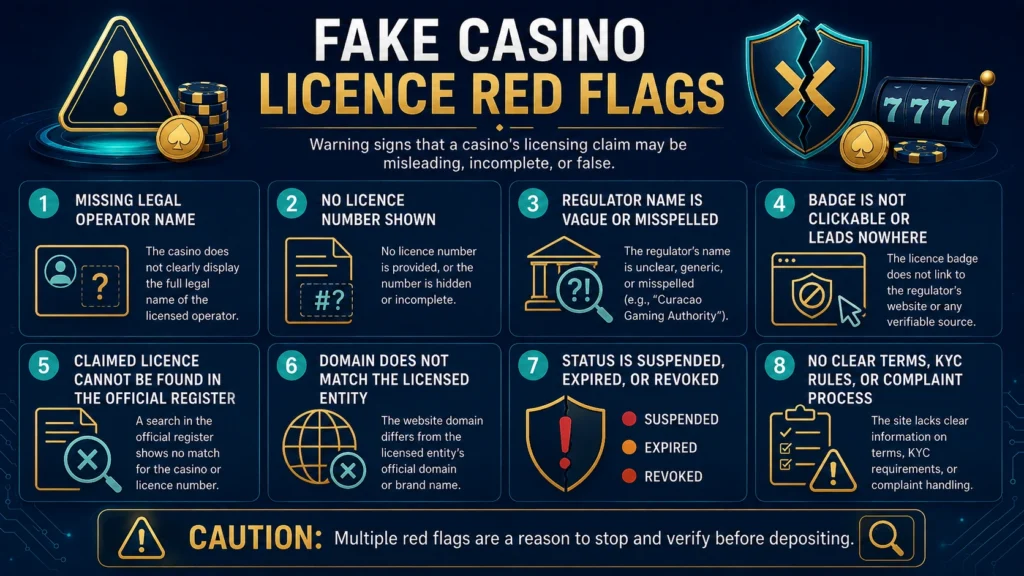
Common Crypto Casino Licence Red Flags
The Regulator Cannot Be Independently Found
If the only information about the supposed regulator appears on casino or licence-selling websites, investigate further.
The Licence Badge Links Back to the Casino
Independent verification should lead to regulator-controlled information, not simply another page on the casino’s domain.
No Legal Company Is Named
A brand without a clearly identifiable operator is difficult to verify.
The Number Exists but Belongs to Another Company
Copied licence numbers are not evidence of authorization.
The Company Matches but the Domain Does Not
A real company may have multiple approved brands, but the exact website still needs to be linked to the authorization where the regulator publishes domains.
A B2B Licence Is Presented as a Casino Operator Licence
Supplier authorization is not automatically permission to take consumer wagers.
The Licence Has Expired or Been Revoked
Always verify current status.
The Casino Uses Old Curaçao Sublicence Terminology as Current Proof
Curaçao now operates through its current CGA framework. Historical references should not substitute for present registry verification.
“Licensed” Is Mentioned With No Regulator
That statement is effectively unverifiable until a specific regulator and legal entity are provided.
Company Registration Is Presented as Gambling Regulation
A certificate showing that a company exists is not necessarily a licence to operate gambling.
You must verify what the document actually authorizes.
Crypto-Specific Checks After the Licence Is Verified
Even a genuine gambling licence does not eliminate cryptocurrency-specific operational risk.
Before depositing, check the casino’s payment terms.
Confirm the Exact Cryptocurrency
Bitcoin, ETH, USDT and USDC are different assets.
Confirm the Blockchain Network
Stablecoins can exist on several networks.
“USDT supported” is incomplete if the casino does not identify whether it accepts TRC20, ERC20, Solana or another network.
Check Minimum Deposits
An on-chain transfer can succeed while being below the casino’s automatic-crediting minimum.
Read Withdrawal Limits
Look for:
- Minimum withdrawal.
- Daily/weekly/monthly limits.
- Fees.
- Manual approval.
- KYC clauses.
- Maximum cashout terms linked to bonuses.
Save the Transaction Hash
A TXID can help distinguish a blockchain problem from a casino-account crediting problem.
Check Custody
Do not leave more cryptocurrency inside a casino account than you intend to use.
Licence verification reduces one category of uncertainty; it does not eliminate ordinary digital-asset custody risk.
A 60-Second Licence Triage
If you do not have time for the full investigation yet, at minimum answer these questions before sending funds:
- Who is the legal operator?
- Which regulator supposedly licenses it?
- Can I find that operator on the regulator’s own website?
- Is the licence B2C and current?
- Does the exact casino domain match?
- Is the licence suspended or revoked?
- Is the casino authorized where I am located?
If any answer is unclear, do not treat the licence claim as verified.
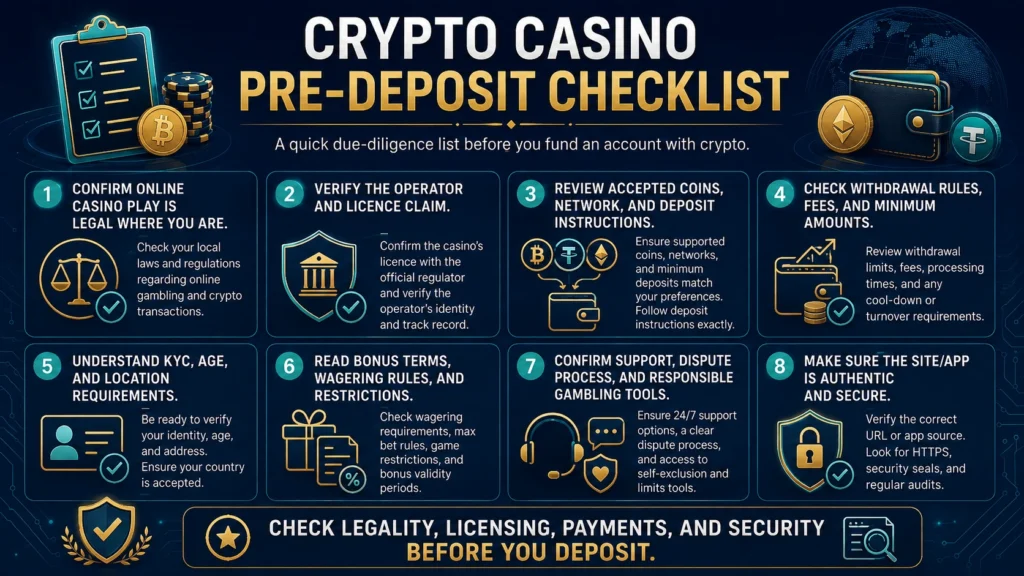
Full Pre-Deposit Crypto Casino Licence Checklist
- Identify the casino’s legal operator.
- Record the claimed regulator.
- Record the licence number.
- Open the regulator’s website independently.
- Search the official register.
- Match the legal company.
- Confirm the exact domain.
- Confirm the licence is B2C if the casino deals directly with players.
- Check issue and expiry dates.
- Check current licence status.
- Search the regulator’s enforcement register.
- Read the complaint/ADR procedure.
- Check the casino’s KYC policy.
- Check restricted jurisdictions.
- Verify U.S. state authorization separately.
- Review withdrawal limits and fees.
- Verify the exact cryptocurrency network.
- Save screenshots or PDFs of important terms before depositing.
- Check independent complaint patterns after regulatory verification.
- Set gambling limits before funding the account.
Bottom Line
A crypto casino licence is useful only when you can independently connect it to the casino you are actually using.
Do not stop at the licence seal.
Verify:
the regulator → legal company → licence number → B2C authority → exact domain → current status → enforcement record → complaint process → your local jurisdiction.
For U.S. readers, the local-jurisdiction check is especially important. A genuine overseas licence can establish that an operator participates in a foreign regulatory framework, but it does not automatically make the casino authorized in your state.
And remember that cryptocurrency does not change the basic regulatory question.
Bitcoin, USDT or another digital asset is a payment method. The gambling operator still needs whatever gambling authorization is applicable to its activity and market.
A licence problem is easier to address before the first deposit than after a withdrawal is already disputed.
FAQ
Find the legal operator, regulator and licence number on the casino, then independently visit the regulator’s official website and search its licence database.
Confirm the company, licence status, licence type and exact domain. Then check the regulator’s enforcement history rather than relying only on the casino’s footer seal.
Curaçao has a current formal online-gaming regulatory framework under the Curaçao Gaming Authority. The CGA publishes an online-gaming licence register as well as an enforcement register.
For a consumer casino, verify that the operator is listed appropriately as B2C and check its current status and dates.
B2C means business-to-consumer.
It generally indicates authorization related to providing gaming services directly to players.
B2B means business-to-business and may cover suppliers such as software or technology companies. A casino should not rely on a supplier-only B2B credential as proof that it is licensed to take consumer wagers.
No.
A foreign licence and U.S. state authorization are separate issues.
For example, Pennsylvania and Michigan maintain their own regulated online-gaming frameworks and operator information. A foreign credential does not replace any state authorization required where the player is located.
The status deserves substantial caution.
AnjouanGaming.com currently maintains a licensing register and says it operates under Anjouan law. However, investigations by ABC Australia and Le Monde have reported that the Central Bank of the Comoros previously characterized important entities associated with the offshore licensing structure as fictitious or lacking recognized legal existence. The licensing website disputes that characterization.
Because of that unresolved conflict, an Anjouan listing should be treated as a contested credential, not automatically equated with an uncontested government gambling licence.
No.
A licence can provide regulatory oversight and potentially a complaint mechanism, but it cannot guarantee the outcome of every withdrawal or dispute.
Review the casino’s withdrawal terms, KYC provisions and complaint process separately.
Yes.
“No KYC” often describes the onboarding model rather than an unconditional promise never to verify a player. A licensed operator may still perform identity, transaction-risk or source-of-funds checks where its terms and regulatory obligations permit. Why Do No-KYC Casinos Still Ask for Verification? covers those triggers in more detail.
No.
A logo can be copied.
The strongest evidence comes from the regulator itself: locate the company in its public records, confirm the exact website and licence type, and check the current status and enforcement history.