
Federal regulators and lawmakers are increasingly drawing a line between conventional prediction markets and event contracts that resemble slot machines, roulette, blackjack and other casino games, raising a new question about how far the fast-growing prediction-market sector can expand in the United States.
The Commodity Futures Trading Commission’s June 12 proposed rule says event contracts based entirely on random chance would be highly likely to be considered contrary to the public interest. At the same time, several bills introduced in Congress would go further by expressly prohibiting federally registered platforms from listing contracts tied to casino-style games.
The developments do not mean nationwide casino-style prediction markets have been launched, nor has Congress enacted a federal ban. Instead, regulators, lawmakers and gaming-industry groups are attempting to define the boundary before such products become widespread.
Key Facts
| Detail | Confirmed Status |
| CFTC prediction-market proposal | Published June 12, 2026 |
| Public-comment deadline | July 27, 2026 |
| CFTC view on pure-chance games | Highly likely to be contrary to the public interest |
| H.R. 7477 introduced | February 10, 2026 |
| S. 4160 introduced | March 23, 2026 |
| H.R. 9856 introduced | July 22, 2026 |
| Federal casino-style contract ban enacted? | No |
| Broad U.S. rollout of casino-style prediction contracts confirmed? | No |
Sources: CFTC and U.S. Government Publishing Office.
What Does “Casino-Style” Mean?
Unlike traditional political, economic or sports prediction contracts, the term “casino-style” is being used by lawmakers to describe contracts connected to outcomes normally associated with gambling games.
Rep. Dina Titus’ Fair Markets and Sports Integrity Act, introduced on February 10, defines casino-style games as games commonly found in casinos, including slots, blackjack, roulette, craps, poker, bingo and lotteries, including digital or simulated versions.
The newer House Prediction Markets Are Gambling Act, introduced by Nevada Reps. Steven Horsford and Mark Amodei on July 22, takes a similar approach. Its definition includes slot games, video poker, blackjack, roulette, craps, other casino table games, bingo, lotteries and simulations.
If H.R. 9856 became law in its current form, contracts relating to those games could not be listed or traded through a registered entity covered by the Commodity Exchange Act. The bill also states that it would not override state laws regulating or prohibiting such contracts.
For now, however, the measure remains proposed legislation.
CFTC Draws a Distinction Around Pure Chance
The CFTC’s own approach is more nuanced than the congressional proposals.
Its June rulemaking would create a framework for deciding when event contracts involving specified activities should be considered contrary to the public interest. The Commission does not propose an automatic blanket ban on every product categorized as gaming.
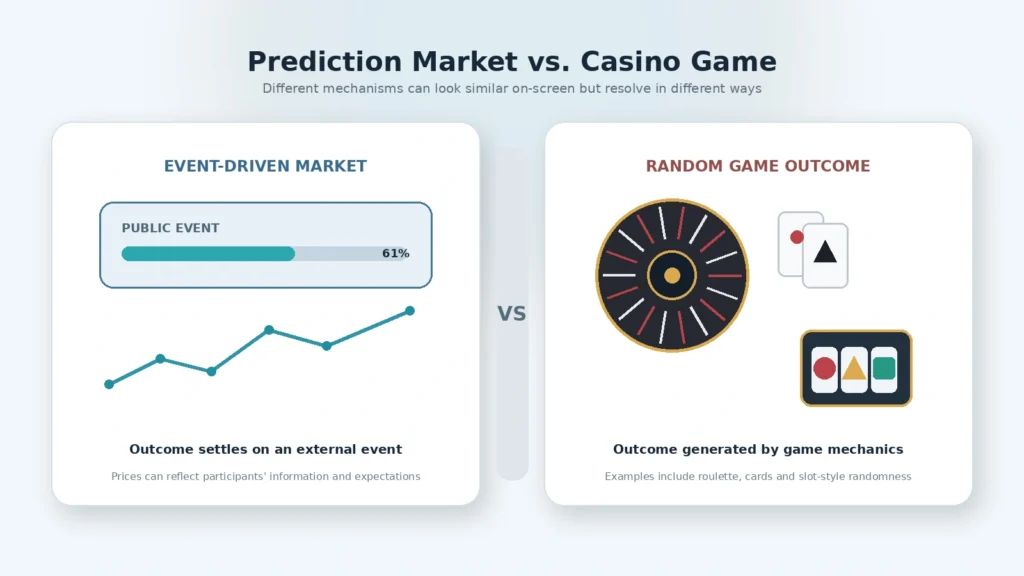
The clearest regulatory warning concerns games whose outcomes depend entirely on chance.
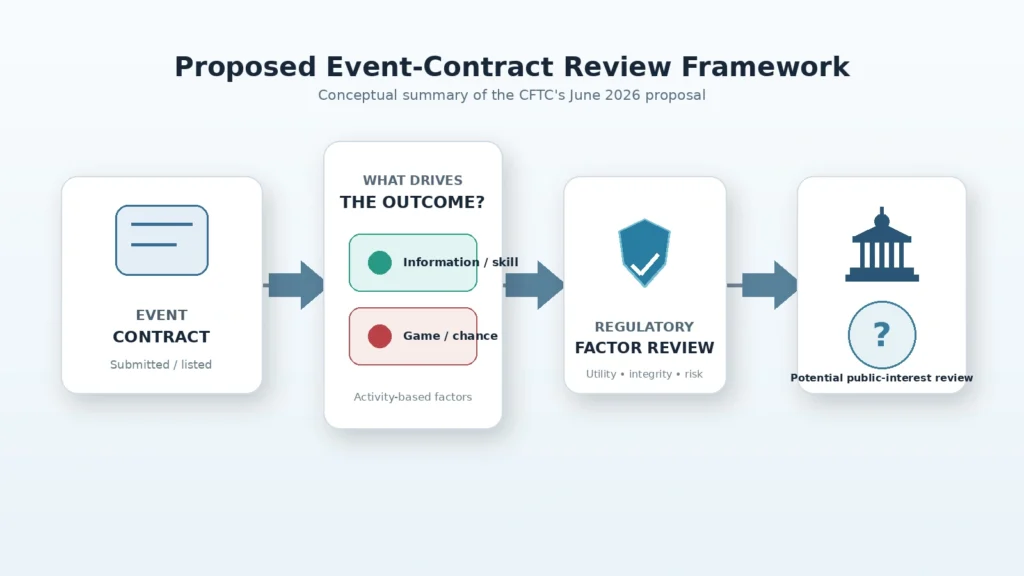
The CFTC says contracts based solely on luck would likely lack the information-aggregation or price-discovery value associated with prediction markets. Under its proposed factors, that makes such contracts highly likely to be found contrary to the public interest.
That reasoning would be particularly relevant to products tied directly to random outcomes such as a roulette spin or a conventional slot result.
The proposal treats certain sports contracts differently. Contracts settling on broad results such as final scores, win-loss outcomes, tournament progression or objectively verifiable statistics may weigh against a finding that the product is contrary to the public interest.
The distinction shows why sports prediction contracts and casino-style contracts should not automatically be treated as the same regulatory category.
Prediction-Market Industry Supports a Traditional Casino-Game Boundary
One of the most significant findings from the regulatory record is that major prediction-market interests themselves have not publicly argued for permission to offer traditional casino games.
In an April 30 comment filed with the CFTC, the Coalition for Prediction Markets supported defining “gaming” to cover traditional casino-style games.
The coalition said it does not support listing contracts on traditional casino games such as slot machines, roulette or table games, while arguing that other event contracts traded on federally regulated derivatives markets should remain within the CFTC framework.
That position complicates suggestions that companies such as Kalshi or Crypto.com are necessarily preparing to turn prediction exchanges into online casinos.
The coalition’s filing instead seeks a formal distinction between traditional casino gambling and event markets it argues serve price-discovery or information functions.
Why Casino Regulators Are Still Concerned
Despite that industry position, state gaming officials and casino-industry representatives are warning that product design could blur the line.
SBC Americas reported on August 11 that Nevada Gaming Control Board Chairman Mike Dreitzer told attendees at the July NCLGS Summer Meeting that he had previously seen a five-reel product presented like an online slot but driven by prediction contracts.
The report does not identify the product or provide independent documentation establishing its scale, commercial availability or regulatory status.
The claim is therefore important as an illustration of the regulator’s concern, but it should not be treated as evidence that nationwide slot-style prediction markets are already operating.
The broader concern is that an event-contract settlement mechanism could potentially be wrapped in an interface designed to resemble conventional gambling.
That would raise questions not only about federal commodities regulation but also about state gaming laws, taxation, licensing, age controls and responsible-gambling protections.
Congress Has Multiple Bills Targeting the Issue
Federal lawmakers are taking two principal approaches.
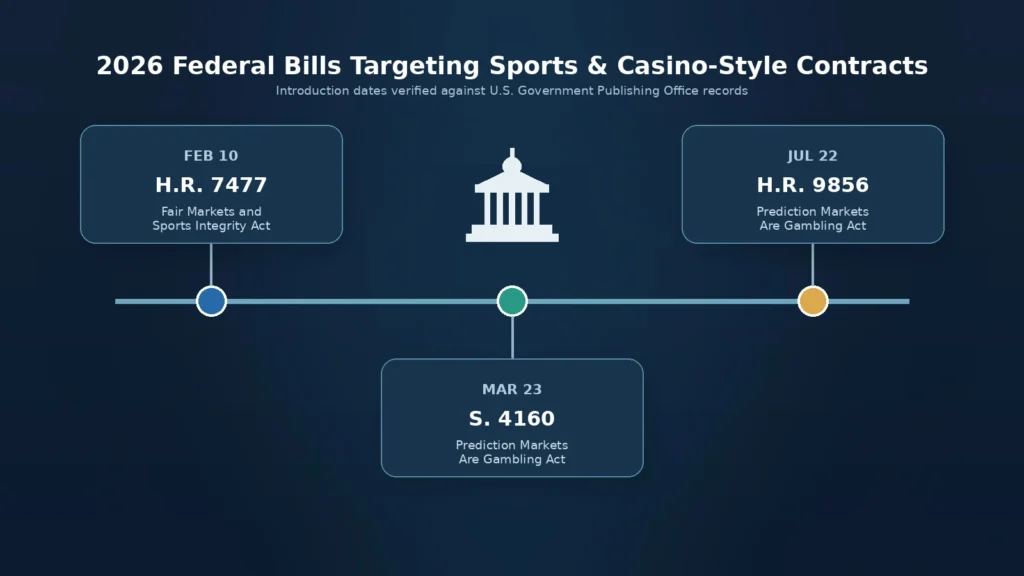
Titus’ H.R. 7477 would amend the Commodity Exchange Act to prevent registered entities from listing, facilitating or clearing contracts based on sporting events or casino-style games. It was introduced February 10 and referred to the House Agriculture Committee.
A Senate bill using the title Prediction Markets Are Gambling Act, S. 4160, was introduced on March 23 by Sen. Adam Schiff, with Sens. John Curtis and Catherine Cortez Masto listed as cosponsors in the official record.
The House version, H.R. 9856, followed on July 22 from Horsford and Amodei. It would explicitly bar sports and casino-style contracts from registered prediction-market venues.
None of these measures had become law as of August 11.
The existing legal framework therefore remains contested while the CFTC continues its rulemaking process and courts address disputes over sports event contracts.
Why Online Casino Revenue Is Part of the Debate
The concern has significant financial implications because regulated iGaming remains limited to a relatively small number of U.S. markets while generating substantial revenue and tax receipts.
American Gaming Association figures show regulated U.S. iGaming generated $10.74 billion in revenue during 2025, an increase of 27.6%, and produced approximately $2.59 billion in gaming taxes.
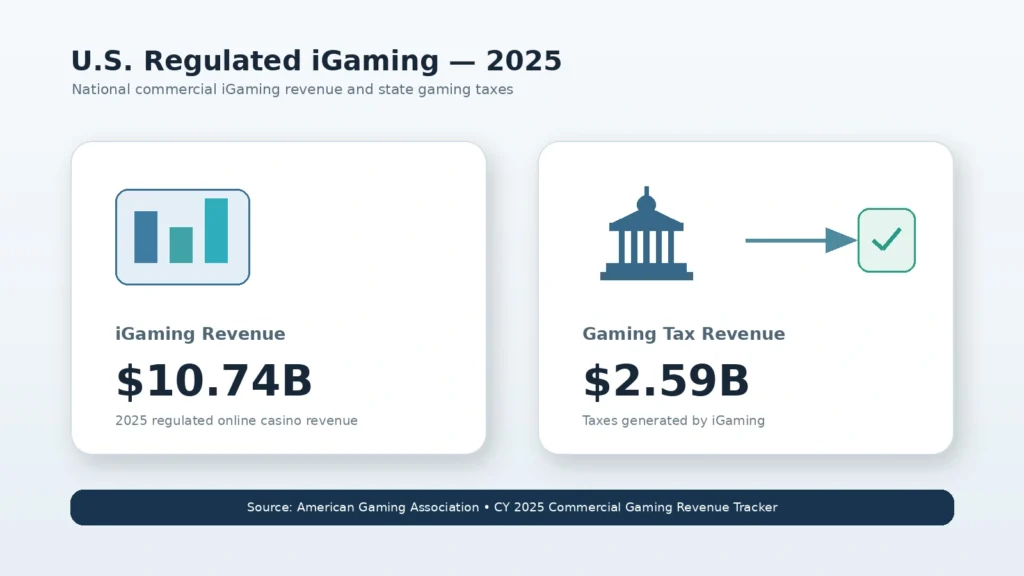
State-regulated sports betting generated $16.96 billion in revenue from $166.94 billion in handle and paid $3.71 billion in gaming taxes in the same year.
By May 2026, iGaming generated another $1.03 billion for the month, up 14.7% year over year.
Those figures explain why state regulators and gaming-industry organizations are sensitive to any product that could potentially recreate casino-style gambling outside existing state licensing and tax structures.
However, the AGA is itself an industry advocacy organization, and its policy position on prediction markets should be distinguished from a neutral regulatory determination.
Prediction Markets Are Not No-KYC Casinos
For NoKYCcasino.us readers, another important distinction is that a federally regulated prediction exchange is not automatically equivalent to a no-KYC or offshore casino.
Prediction markets operating through CFTC-regulated entities sit inside a U.S. financial-regulatory structure. That does not remove account, customer-identification or compliance obligations.
Similarly, a product being accessible online does not make it legally equivalent to a state-authorized online casino.
NoKYCcasino.us’ guide to whether no-KYC casinos are legal in the United States explains the broader distinction between online availability and state authorization.
The site’s recent report on IG Group’s proposed Underdog acquisition also explains the federally regulated FCM, DCM and clearing infrastructure that can sit behind U.S. prediction-market products.
Are Casino-Style Prediction Markets Actually Next?
At this stage, the most accurate answer is possibly—but not as a confirmed industry-wide development.
There is evidence that regulators and lawmakers view the possibility seriously enough to address it explicitly. There is also secondary reporting that at least one Nevada regulator has seen a slot-like product using prediction contracts.
But the CFTC’s current proposal pushes strongly against contracts determined entirely by random chance, and the Coalition for Prediction Markets has itself backed a boundary excluding traditional casino games.
That means the next stage of the debate is likely to focus as much on product design and definitions as on whether an exchange simply labels something a prediction contract.
A conventional roulette outcome wrapped in an event-contract structure could face a very different regulatory analysis from a market predicting a sporting result or economic event.
What Happens Next?
The CFTC’s public-comment period on its June proposal closed on July 27, 2026. The published measure remains a proposed rule, meaning its language is not yet a final regulatory standard.
Congressional proposals including H.R. 7477, S. 4160 and H.R. 9856 also remain pending rather than enacted.
The next important developments will be any final CFTC rule, movement on the federal bills, new court decisions on prediction-market jurisdiction, and—most importantly—whether registered exchanges actually seek to list contracts tied directly to traditional casino outcomes.
Until then, claims that casino-style prediction markets are certain to become nationwide online casinos go beyond what the evidence currently supports.
FAQ
No nationwide rule gives casino-style prediction contracts automatic legal approval. The CFTC is considering a proposed framework under which contracts based entirely on random chance would be highly likely to be found contrary to the public interest, while Congress is considering separate legislation that would explicitly prohibit casino-style contracts.
No. The June 12, 2026 CFTC document is a proposed rule, not a final blanket ban. It proposes factors for reviewing contracts and takes a particularly negative preliminary position toward games determined entirely by random chance.
The bills generally include slot machines, blackjack, roulette, craps, poker or video poker, bingo, lotteries and simulated versions of those games. Exact wording differs slightly between the measures.
That has not been established. The Coalition for Prediction Markets told the CFTC that it does not support listing contracts on traditional casino games such as slots, roulette and table games.
State gaming officials argue that products resembling gambling but offered through federally regulated prediction markets could bypass state licensing, taxation and gaming-control systems. The extent to which federal commodities law preempts state gaming law remains the subject of active litigation and legislation.