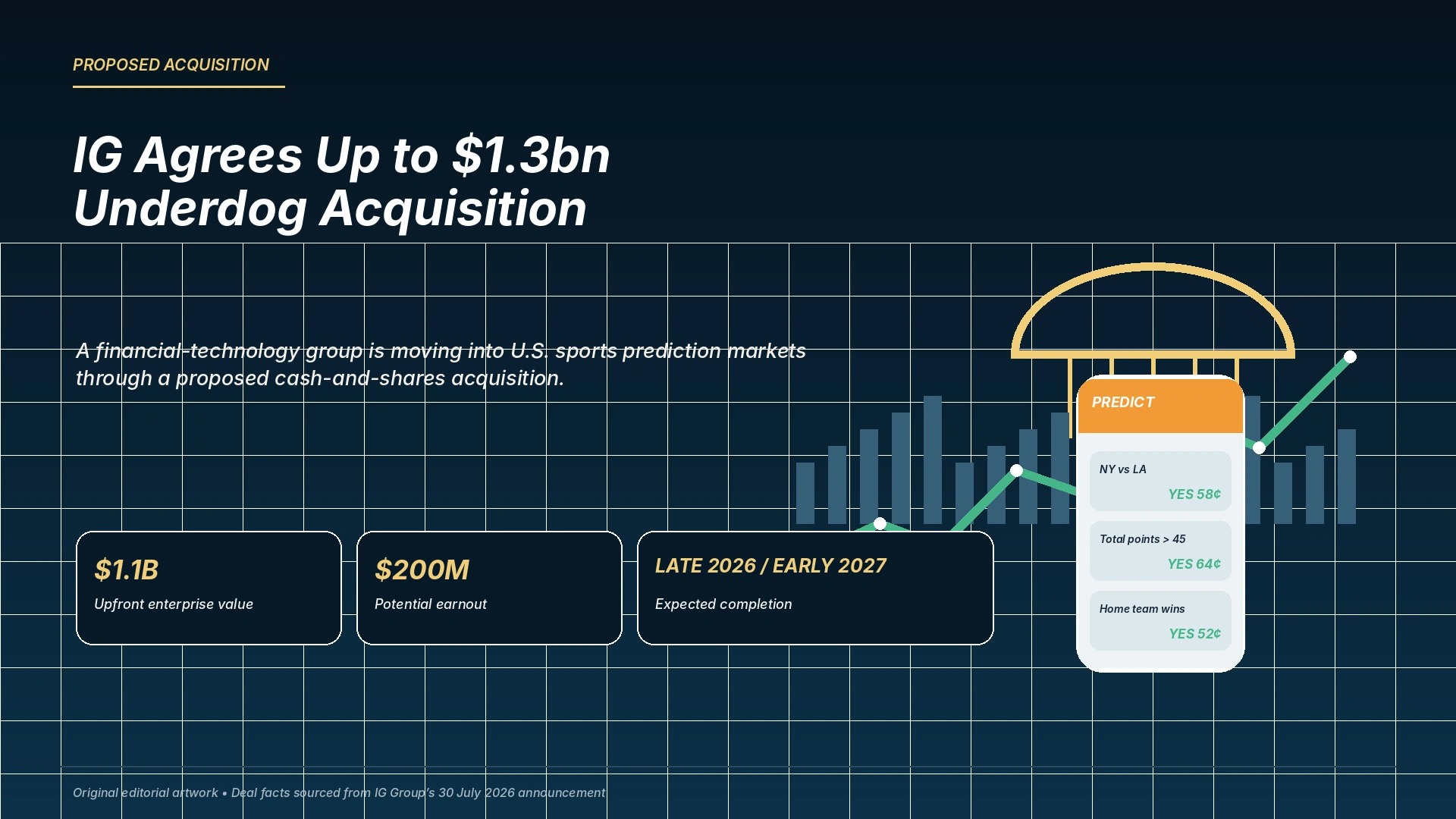

IG Group has agreed to acquire U.S. daily fantasy sports and prediction-market operator Underdog for consideration of up to approximately $1.3 billion. Announced on July 30, the proposed acquisition would add Underdog’s large sports audience and an integrated federally regulated brokerage, exchange and clearing structure to IG’s U.S. business, but it remains subject to regulatory and antitrust conditions.
Key facts
| Detail | Confirmed Information |
| Announcement date | July 30, 2026 |
| Buyer | IG Group Holdings |
| Target | Underdog Sports Holdings |
| Upfront enterprise value | Approximately $1.1 billion |
| Maximum shareholder earnout | Approximately $200 million |
| Maximum shareholder consideration | Approximately $1.3 billion |
| Estimated upfront equity value | Approximately $963 million |
| Expected upfront cash payment | Approximately $380 million |
| New IG shares | Approximately 24.1 million |
| Underdog debt to be refinanced | Approximately $160 million |
| Separate employee incentive plan | Up to $850 million |
| Expected completion | Late 2026 or early 2027 |
| Current status | Proposed and awaiting conditions and approvals |
Sources: IG’s official acquisition announcement and transaction presentation.
How the $1.3 billion deal is structured
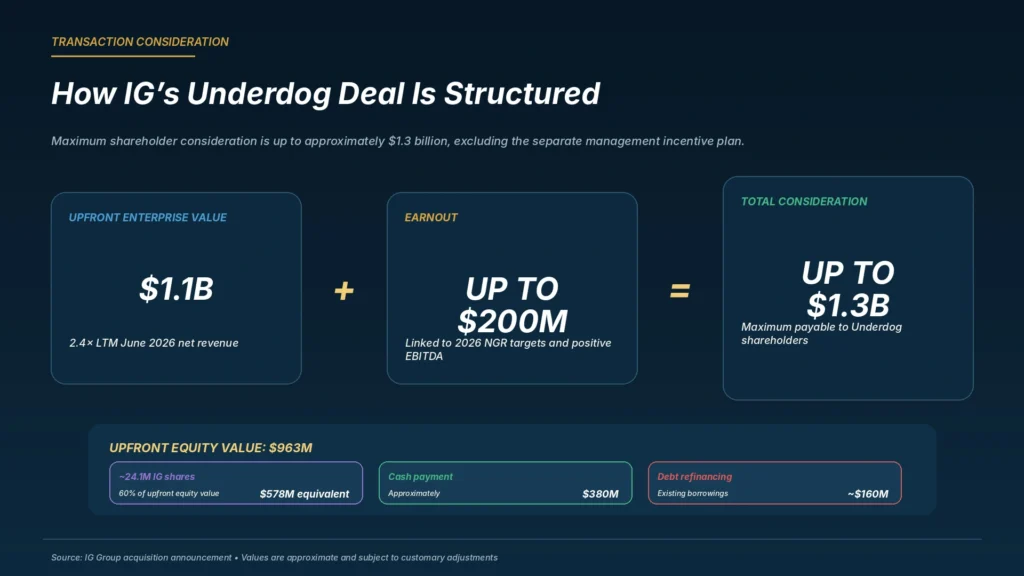
The headline value is a maximum rather than a fixed payment.
IG will initially acquire Underdog at an enterprise value of approximately $1.1 billion. Adjustments for cash, debt, debt-like items and working capital produce an estimated upfront equity value of approximately $963 million.
Approximately 60% of the upfront consideration is expected to be settled through the issue of around 24.1 million IG shares. The remaining portion includes an estimated $380 million cash payment. IG also intends to refinance approximately $160 million in existing Underdog borrowings.
The additional earnout can reach approximately $200 million. It is conditional on Underdog generating positive EBITDA in 2026 and scales between net gaming revenue of $533 million and $600 million.
That means Underdog shareholders will not automatically receive the full $1.3 billion.
Management could receive additional performance payments
The transaction also includes a separate management incentive plan for eligible Underdog employees.
That plan could produce payments of up to $850 million, but it sits outside the acquisition consideration paid to shareholders. The maximum requires Underdog to deliver at least $400 million of EBITDA in 2028 and $700 million in 2029.
IG expects the management payments to be funded from Underdog’s earnings. Its investor presentation uses a midpoint of $425 million rather than the $850 million maximum when illustrating the plan.
The distinction is important: $1.3 billion is the maximum consideration for Underdog shareholders, not the maximum possible future amount associated with the transaction and employee incentives.
What IG is acquiring
Underdog was founded in 2020 as a daily fantasy sports company and subsequently moved into federally regulated event contracts.
IG’s presentation reports:
● More than 11 million registered users.
● More than five million funded accounts.
● Approximately 950,000 monthly active users.
● More than 60% of monthly active users under age 30.
● $466 million in last-12-month net revenue through June 2026.
These figures are company-provided operating metrics and should not be described as independently audited market data.
The acquisition would materially change IG’s U.S. exposure. The company estimates that its U.S. revenue would more than double and its U.S. monthly active customer count would rise by more than ten times. On a pro forma 2025 basis, the U.S. would represent approximately 40% of group revenue, compared with 22% before the acquisition.
Why the regulatory stack matters
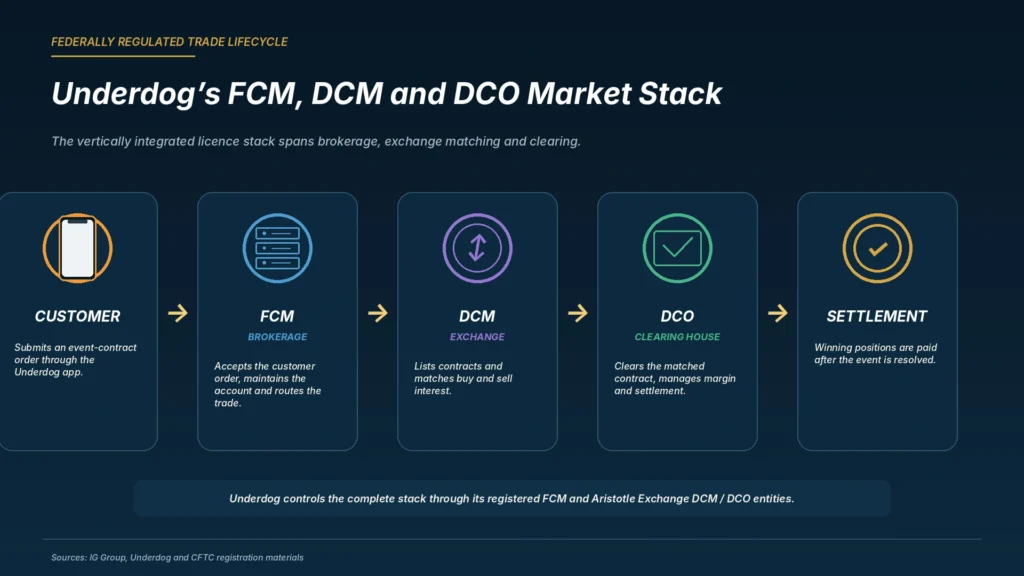
A central part of IG’s case is Underdog’s integrated prediction-market infrastructure.
The structure includes:
● FCM — Futures commission merchant: The brokerage layer that maintains customer relationships and routes orders.
● DCM — Designated contract market: The federally designated exchange where contracts can be listed and matched.
● DCO — Derivatives clearing organization: The clearing entity that holds collateral and settles contracts.
UDM LLC operates as Underdog Predict’s registered FCM. Aristotle Exchange DCM appears in the CFTC’s designated-contract-market records, while Aristotle Exchange DCO appears in the regulator’s registered clearing-organization directory.
Underdog told the CFTC in April that it acquired the Aristotle exchange and clearing entities during spring 2026.
Owning all three layers can give Underdog greater control over:
● Product design.
● Order routing.
● Trading fees.
● Exchange economics.
● Clearing and settlement.
● Compliance systems.
● Integration with its existing fantasy-sports app.
It can also reduce reliance on a third-party exchange, although Underdog may continue routing some contracts to external venues.
In regulatory terminology, these are registrations and designations rather than ordinary state casino licenses. IG uses “license stack” as a convenient description of the combined infrastructure.
The deal is not only about regulatory access
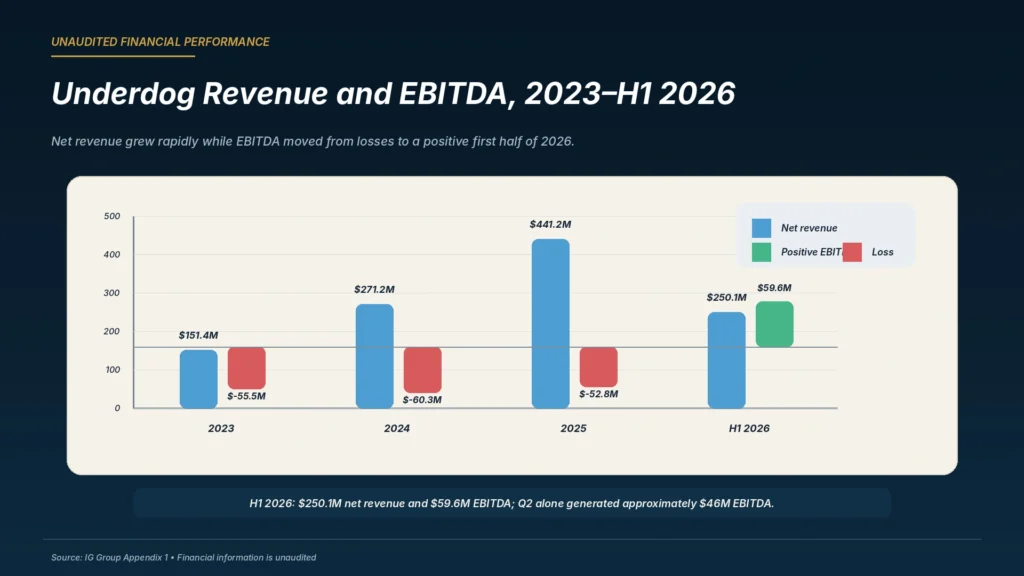
The original “license stack, not earnings” framing understates Underdog’s financial performance.
IG’s historical table shows:
| Period | Net Revenue | EBITDA |
| 2023 | $151.4 million | -$55.5 million |
| 2024 | $271.2 million | -$60.3 million |
| 2025 | $441.2 million | -$52.8 million |
| H1 2026 | $250.1 million | $59.6 million |
Source: IG Group; figures are unaudited and stated under U.S. GAAP.
Underdog moved into positive EBITDA during 2026 after three loss-making full years. IG separately reported that the company generated $46 million of EBITDA during Q2 alone.
Based on the $466 million last-12-month revenue figure, the $1.1 billion upfront enterprise value represents approximately 2.4 times revenue.
The price therefore reflects several assets:
1. A growing DFS business.
2. Positive recent EBITDA.
3. A large, younger customer base.
4. Customer-acquisition and media capabilities.
5. A registered brokerage.
6. A designated exchange.
7. A registered clearing organization.
8. Potential expansion beyond sports event contracts.
The relative value assigned to each component has not been disclosed.
Prediction markets are becoming Underdog’s main volume source
Underdog initially offered event contracts through an arrangement with Crypto.com Derivatives North America before building out its own regulated infrastructure. Its current disclosures state that some transactions may still be routed to third-party exchanges.
IG’s presentation indicates that prediction markets generated 54% of Underdog’s handle through June 2026, compared with 14% during 2025. The remaining 46% was associated with DFS and legacy products.
The company says its full exchange offering and greater internalization of exchange economics are scheduled to develop further during 2026.
Those figures show a rapid product shift, but handle is not the same as revenue or profit. Event contracts can produce high notional trading volume while generating only a smaller fee on each transaction.
IG sees a bridge between sports and financial trading
IG operates retail trading and investment platforms, including tastytrade in the United States. It believes Underdog can provide a customer funnel from fantasy sports and sports event contracts into financial-market products.
IG’s customer research says:
● 58% of surveyed Underdog customers had traded individual stocks.
● 46% had previously traded cryptocurrency.
● 42% expressed interest in funding an Underdog wallet with cryptocurrency.
The underlying Underdog survey was conducted in September 2025, before its prediction-market launch, while broader market findings came from a July 2026 survey. These results indicate customer overlap but do not guarantee that users will adopt IG’s other products.
IG also says the exchange infrastructure could eventually support contracts linked to cryptocurrency prices, financial markets, economic data, politics and cultural events. No detailed launch dates or final product plans have been announced.
Crypto-referenced event contracts would be financial derivatives. They would not be crypto casino games and would not necessarily involve deposits made in cryptocurrency.
State and federal regulators remain divided
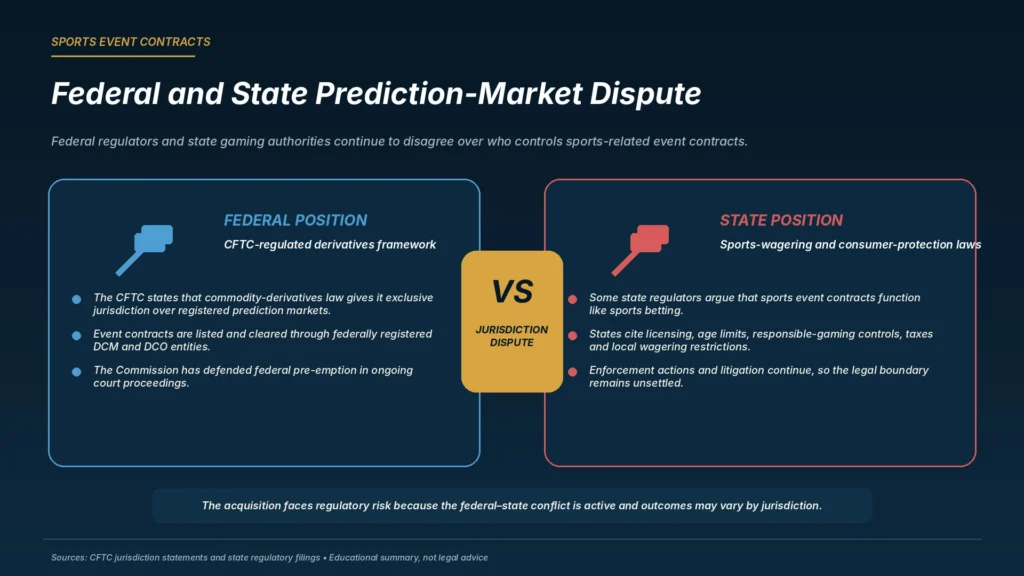
The largest strategic uncertainty is not whether the CFTC-regulated entities exist. It is whether states can apply gambling laws to sports event contracts offered through federally regulated exchanges.
IG’s presentation says exchange-traded sports contracts face challenges from 16 states. That figure is IG’s assessment and should be attributed to the company.
The legal landscape currently contains decisions pointing in different directions.
In April, the U.S. Court of Appeals for the Third Circuit held that Kalshi was likely to succeed in arguing that the Commodity Exchange Act gives the CFTC exclusive jurisdiction over its sports event contracts, limiting New Jersey’s ability to apply state gambling law in that case.
A federal district court in New York reached the opposite preliminary conclusion on July 7. It denied Kalshi’s request to block state enforcement after finding that the company had not shown it was likely to succeed on its argument that New York’s gambling laws were federally preempted. (U.S. District Court for the Southern District of New York)
New York’s attorney general filed a separate action against Kalshi on July 31, alleging that its sports prediction markets constitute illegal, unlicensed gambling under state law. (New York State Attorney General)
Those disputes and rulings concern Kalshi rather than Underdog, but their outcomes could affect the entire sports-event-contract sector.
IG’s performance-based deal structure reduces some financial exposure if growth is weaker than expected. It does not remove the possibility of:
● State injunctions.
● Product restrictions.
● Increased compliance costs.
● Geographic exclusions.
● Changes in federal rules.
● Delays in regulatory approval.
● Lower trading volume.
The company has not guaranteed that Underdog will continue offering every product in every current jurisdiction.
Prediction markets are not traditional sportsbooks
Although sports event contracts can resemble bets from a user’s perspective, their legal and commercial structure differs from state-regulated sports wagering.
A traditional sportsbook:
● Sets or manages its prices.
● Acts as principal against the customer.
● Earns a hold from wagers.
● Operates through state sports-betting licenses.
An exchange-based prediction market:
● Lists contracts tied to future outcomes.
● Matches participants or uses market makers.
● Typically earns transaction or exchange fees.
● Operates through a federal derivatives framework.
IG’s presentation emphasizes this distinction, but state authorities dispute whether the difference in structure should prevent gambling-law enforcement.
Underdog also retains its daily fantasy sports business, where users enter contests based on athlete performance. DFS, event contracts and sports betting should not be presented as interchangeable products.
What the acquisition means for Underdog users
There is no immediate operational change because the acquisition has not closed.
IG says Underdog will continue operating as a standalone brand with separate products, platforms and leadership. Jeremy Levine is expected to remain CEO of Underdog and report to Breon Corcoran following completion.
No immediate change has been announced to:
● Existing fantasy entries.
● Customer balances.
● Prediction-market positions.
● Withdrawal procedures.
● Product availability.
● Age or location restrictions.
Underdog’s official disclosures state that event-contract trading involves significant risk and may not be appropriate for everyone. Users can lose the full cost of a contract and any applicable fees.
The acquisition does not convert Underdog into a no-KYC platform. Its prediction-market activity sits within regulated U.S. financial-market infrastructure and remains subject to applicable identity, account, residence and compliance requirements.
Governance and financing considerations
IG CEO Breon Corcoran was an early investor in Underdog and owns approximately 0.34% of its fully diluted share capital through preferred shares and options acquired before he joined IG.
IG says Corcoran disclosed the interest to the board and recused himself from formal approval of the acquisition. He is expected to receive the same consideration as other holders of the relevant security classes.
The deal will also increase IG’s debt and share count.
IG has secured a bridge facility of up to $950 million and expects pro forma gross leverage to remain below two times EBITDA at the end of 2026 before declining later. The company paused its share-buyback program but maintained its dividend policy.
These are management targets and depend on transaction timing, business performance and financing conditions.
What happens next?
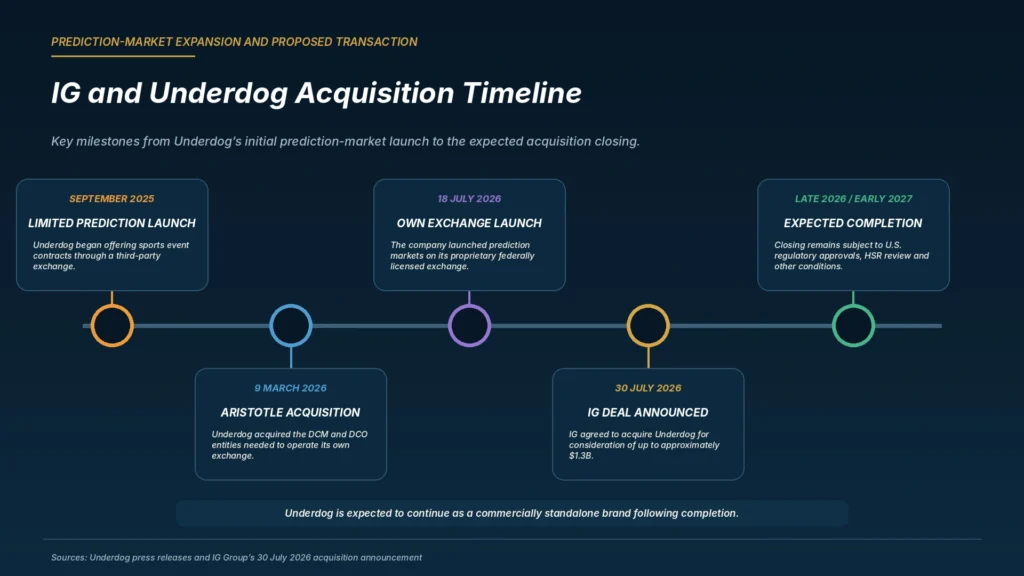
IG expects completion in late 2026 or early 2027.
The stated conditions include:
● Relevant U.S. regulatory approvals.
● Hart-Scott-Rodino antitrust clearance or expiration of the waiting period.
● Confirmatory due diligence.
● Completion of definitive documentation.
IG has not publicly listed every agency action required for the change in control of Underdog’s registered entities.
Because the structure includes an FCM, DCM and DCO, market participants will watch for any relevant CFTC and National Futures Association filings or approvals, alongside the federal antitrust process.
IG is also scheduled to provide more detail about its strategy, capital-allocation framework and guidance on October 22, 2026.
Until the closing conditions are satisfied, the accurate description is that IG has agreed to a proposed acquisition. Underdog remains separately owned, and the $1.3 billion maximum remains partly dependent on future financial performance.
FAQ
No. IG announced the proposed acquisition on July 30, 2026, but expects completion in late 2026 or early 2027, subject to U.S. regulatory, antitrust and other conditions.
Not necessarily. The upfront enterprise value is approximately $1.1 billion. A further earnout of up to approximately $200 million depends on Underdog’s 2026 revenue and positive EBITDA.
No. It is a separate incentive plan for eligible Underdog employees and is not consideration paid to Underdog’s selling shareholders. The maximum requires substantial EBITDA performance in 2028 and 2029.
It is a three-part regulated structure covering brokerage, exchange and clearing. UDM operates as an FCM, while the Aristotle entities provide the DCM and DCO components.
Underdog reported positive EBITDA in H1 2026 after losses during 2023–2025. It generated $59.6 million in H1 EBITDA on $250.1 million of net revenue, according to IG’s unaudited transaction presentation.
That is disputed. Underdog operates through federally regulated market entities, but multiple states argue that sports event contracts fall under state gambling laws. Courts have not produced a uniform nationwide resolution.
Underdog offers daily fantasy sports and event contracts rather than a conventional state-licensed sportsbook product. It previously had limited sportsbook activity, but IG’s transaction presentation lists no current online sports-betting presence.
No crypto casino acquisition was announced. IG identified possible future contracts referencing cryptocurrency and customer overlap with crypto traders, but those would be financial event contracts rather than casino games.