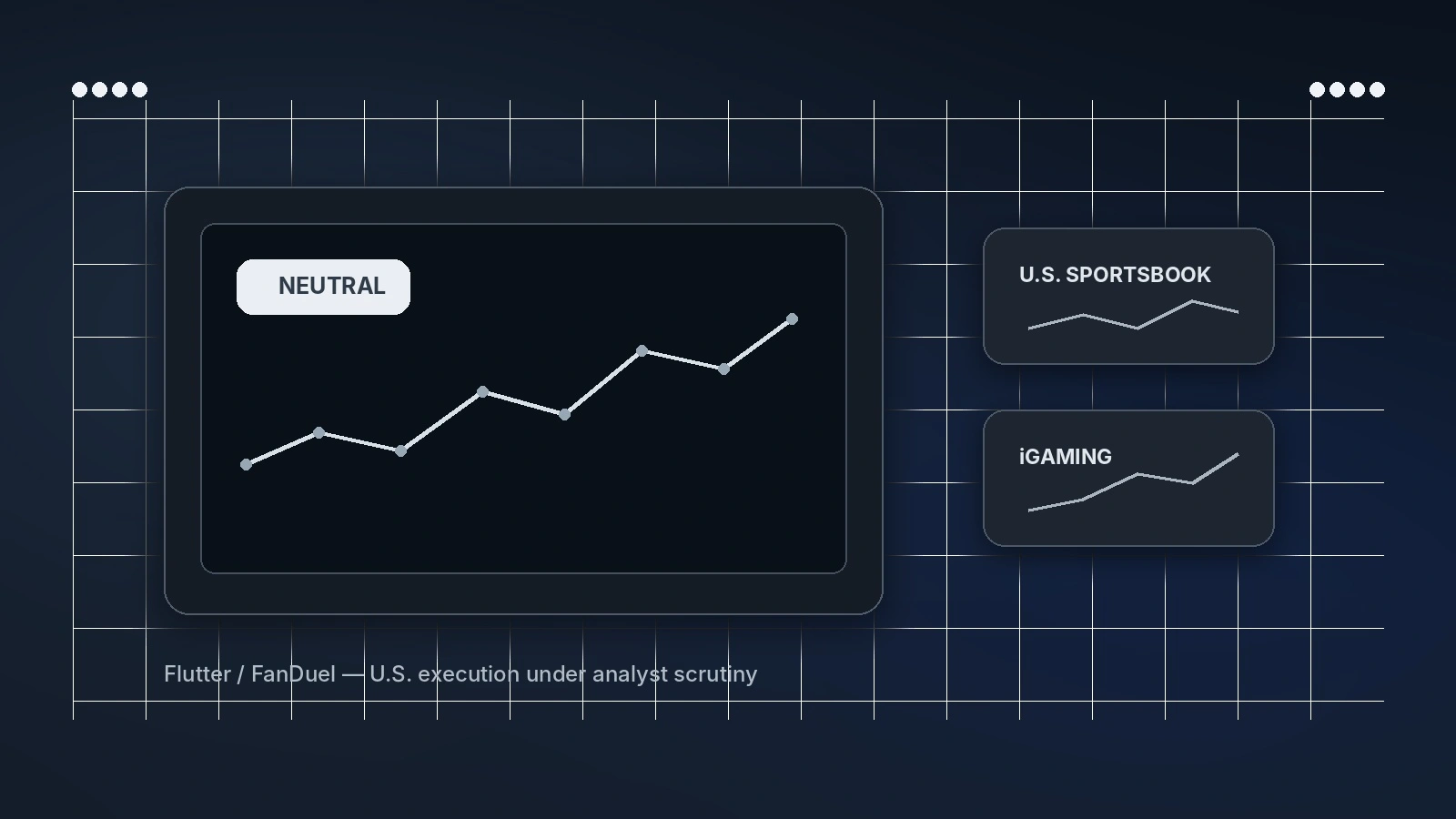

J.P. Morgan has initiated coverage of Flutter Entertainment with a Neutral rating and a $114 price target, taking a cautious view of the FanDuel parent as it works to improve U.S. sportsbook performance, invests in prediction markets and prepares for a change at the top of the company.
The August 12 analyst initiation follows a second quarter in which Flutter’s overall revenue increased, but U.S. sportsbook revenue and adjusted EBITDA declined sharply. FanDuel nevertheless retained a 39% U.S. sportsbook gross-gaming-revenue share, according to the company’s own figures.
The result is a more complicated picture than a simple loss of market leadership: FanDuel remains a major U.S. operator, but investors are looking for evidence that Flutter can restore stronger sportsbook growth while managing prediction-market investment, increased customer incentives and a leadership transition.
Key Facts
| Detail | Confirmed Information |
| Company | Flutter Entertainment plc |
| U.S. brand | FanDuel |
| Analyst | Daniel Politzer, J.P. Morgan |
| Rating | Neutral |
| Price target | $114 |
| Analyst-note date | August 12, 2026 |
| Q2 group revenue | $4.326B, +3% |
| Q2 U.S. revenue | $1.683B, -6% |
| U.S. sportsbook revenue | -15% YoY |
| U.S. iGaming revenue | +14% YoY |
| FanDuel sportsbook GGR share | 39% |
| U.S. adjusted EBITDA | $119M, -70% |
| Incoming Flutter CEO | Dan Taylor, Oct. 1, 2026 |
JPMorgan Takes a Wait-and-See Position on Flutter
The J.P. Morgan analyst initiation places much of the focus on execution in the United States rather than questioning whether Flutter still has meaningful scale.
Daniel Politzer initiated coverage with a Neutral rating and set a $114 price target. CDC Gaming reported that the analyst wants to see stronger U.S. operational and financial execution before adopting a more constructive position.
That view follows a substantial decline in Flutter’s share price from its previous highs. J.P. Morgan’s analysis, as reported by Investing.com, said Flutter was down 54% year to date at the time of the note and approximately 68% below its 52-week peak.
Those figures describe historical stock performance rather than a forecast of what happens next. Likewise, J.P. Morgan’s $114 target represents one analyst’s valuation assessment and should not be interpreted as a guaranteed future share price.
Flutter’s Q2 Results Explain the Cautious View
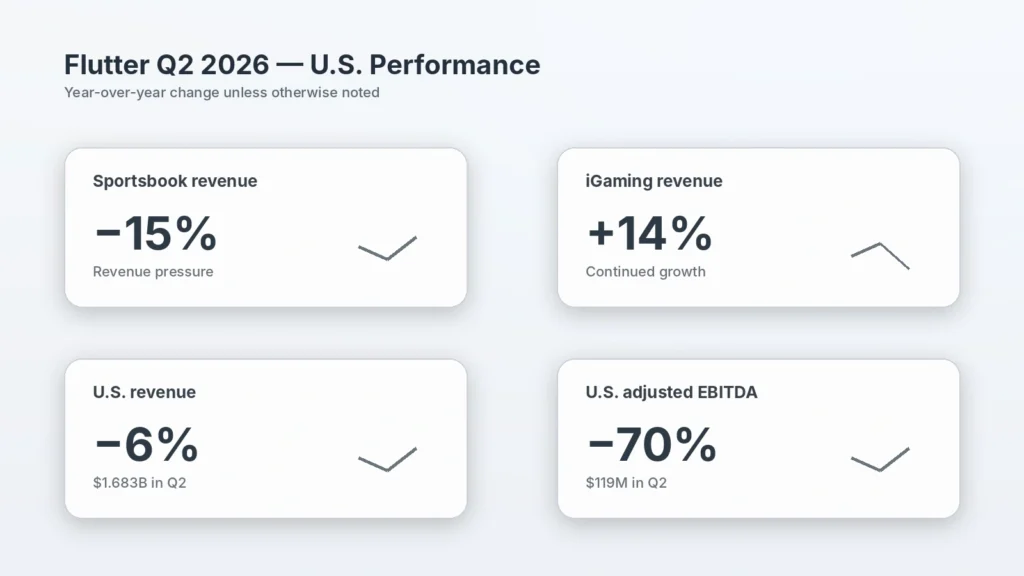
The financial backdrop helps explain why the analyst initiation is more cautious than bullish.
In its Q2 2026 earnings release, Flutter reported group revenue of $4.326 billion, up 3% from the corresponding quarter in 2025. However, group adjusted EBITDA declined 45% to $508 million.
The U.S. segment was under greater pressure.
Revenue fell 6% to $1.683 billion, with sportsbook revenue declining 15%. By contrast, iGaming revenue increased 14% to $577 million, demonstrating that weakness was concentrated more heavily in sports betting rather than across Flutter’s entire U.S. digital business.
U.S. adjusted EBITDA declined 70% to $119 million.
Flutter attributed the quarter to a combination of factors including adverse year-over-year sports results, investment in prediction markets and new states, and increased spending intended to strengthen FanDuel’s sportsbook proposition.
FanDuel Still Holds a 39% Sportsbook GGR Share
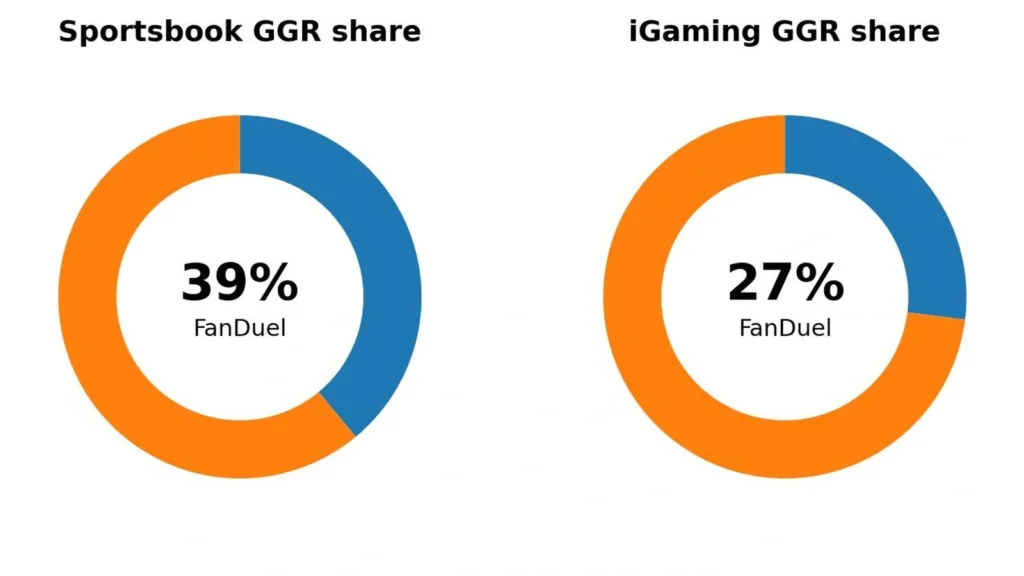
The analyst concern should not be confused with evidence that FanDuel has lost its position as one of the dominant regulated sportsbooks in the United States.
Flutter reported a 39% sportsbook GGR market share for FanDuel in Q2 and continued to characterize the business as holding the No. 1 U.S. sportsbook position.
J.P. Morgan’s analysis reportedly views that share as having declined from a higher previous level, but Flutter’s publicly available Q2 release does not provide the same 47% starting figure cited in secondary reporting.
For publication purposes, the defensible primary-source figure is therefore 39% current GGR share, while any historical 47%-to-39% comparison should remain attributed to J.P. Morgan rather than presented as Flutter’s own disclosure.
Flutter Plans More Investment to Restore Sportsbook Momentum
Flutter is not treating the weaker sportsbook performance as something that should correct automatically.
Its revised 2026 outlook incorporates approximately $385 million of net revenue investment and $270 million of adjusted EBITDA investment aimed at strengthening FanDuel’s proposition and accelerating sportsbook momentum.
The company has said underlying sportsbook trends improved quarter over quarter and that it plans additional investment in customer value and product competitiveness during the second half.
Whether that spending translates into improved handle, market share and profitability is one of the key questions behind J.P. Morgan’s wait-and-see stance.
Prediction Markets Add Another Competitive Variable
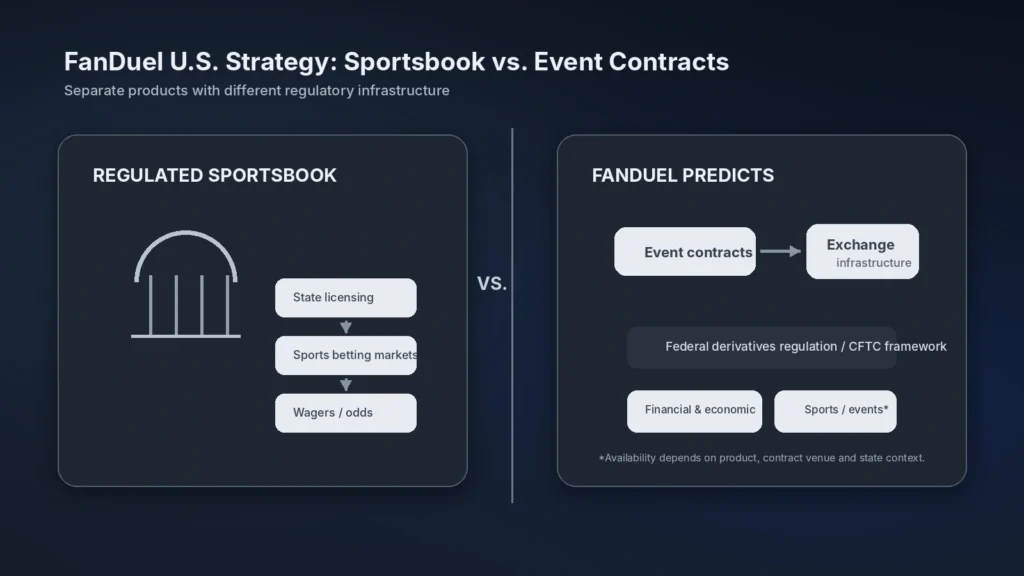
Prediction markets have become another element of Flutter’s U.S. strategy and another source of uncertainty for sportsbook investors.
Flutter said FanDuel Predicts generated no material revenue during Q2. It expects gross revenue during the second half of 2026 to be offset by customer-acquisition investment before the business contributes more substantially in 2027.
At the same time, Flutter sees an opportunity on the infrastructure side. Its market-making operation is now expected to produce approximately $50 million of revenue in 2026, including $6 million generated in Q2.
That creates a two-sided strategic question.
Prediction markets can compete with conventional sportsbook products, particularly in jurisdictions where state-regulated online sports betting is unavailable. But Flutter may also be able to participate directly through FanDuel Predicts and its own market-making capabilities.
NoKYCcasino.us recently examined the wider regulatory issue in its report on casino-style prediction markets and CFTC scrutiny, where the central question remains how far federally regulated event-contract markets can move toward products traditionally governed by state gambling rules.
The regulatory outcome therefore matters to Flutter both as an incumbent sportsbook operator and as a participant in prediction markets.
Leadership Changes Add to the Execution Test

Flutter is also managing significant leadership changes.
Amy Howe left FanDuel on May 6, 2026. Under the company’s FanDuel leadership transition, President Christian Genetski assumed responsibility for leading the U.S. business.
There is an important distinction regarding Flutter’s group leadership.
Peter Jackson remains Group CEO as of August 13. Under the company’s announced Flutter CEO succession plan, he will step down on September 30 and remain an adviser through year-end. Dan Taylor becomes Group CEO on October 1, 2026.
That corrects some secondary reporting that describes both Jackson and Howe as having already exited their respective companies.
Taylor is already Flutter President as well as CEO of the international division and has been involved in FanDuel’s sportsbook improvement plan. Flutter said that plan was showing encouraging early signs when the succession announcement was made.
Flutter Cuts 2026 Guidance
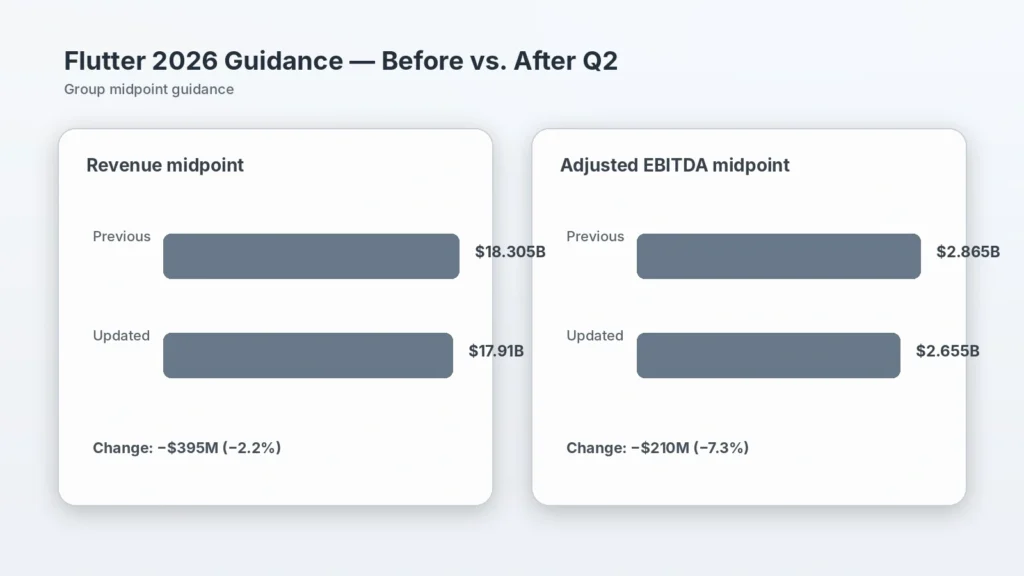
Flutter’s updated guidance is another reason analyst attention has moved toward execution.
The company lowered its full-year group revenue midpoint by $395 million to $17.91 billion and reduced its adjusted EBITDA midpoint by $210 million to $2.655 billion.
For the U.S. business, Flutter now expects approximately $7.4 billion in 2026 revenue and $760 million of adjusted EBITDA.
The company said the outlook incorporates several moving parts, including sportsbook investment, prediction-market market making, operating efficiencies and the impact of changes to the NFL schedule.
That does not mean the company expects the underlying business to deteriorate indefinitely. Flutter also said early third-quarter trading was ahead of expectations.
However, the lowered full-year outlook means analysts now have a lower financial baseline against which to judge the recovery.
iGaming Provides a Stronger Part of the U.S. Picture
One part of Flutter’s U.S. business continued to expand during the weaker sportsbook quarter.
U.S. iGaming revenue increased 14% to $577 million, while direct casino average monthly players increased 26%.
Flutter reported a 27% U.S. iGaming GGR market share, alongside its 39% sportsbook position.
That diversification matters because FanDuel is not solely a sportsbook company in states where regulated online casinos are permitted.
It also illustrates why sportsbook weakness should not automatically be generalized to Flutter’s entire U.S. online-gaming operation.
International Revenue Rises but Profitability Faces Pressure
Flutter’s international operations provided revenue growth but did not fully offset the profitability pressure elsewhere.
International revenue increased 10% to $2.643 billion, while adjusted EBITDA declined 19% to $476 million.
Flutter attributed the adjusted EBITDA decline to factors including higher U.K. taxes and FIFA World Cup marketing expenditure.
The company has begun another phase of its cost-transformation program and is targeting $500 million of gross savings by 2029, intended to help absorb inflation, known tax increases and future investment requirements.
Why the Story Matters for the U.S. Betting Market
Flutter’s situation provides a useful snapshot of how the competitive landscape around regulated U.S. online betting is changing.
FanDuel remains a large operator, but market leadership alone does not guarantee stable revenue growth or margins.
Operators are simultaneously managing:
- Stronger promotional competition.
- Unpredictable sports results.
- Rising taxes in some jurisdictions.
- Investment in prediction markets.
- Customer-acquisition costs.
- Regulatory uncertainty.
- Pressure to improve profitability.
The company’s response is to increase investment rather than simply defend margins in the short term.
For J.P. Morgan, the open question is whether that spending produces measurable improvement.
What Happens Next?
The next important corporate milestone is September 30, 2026, when Peter Jackson is scheduled to step down as Flutter CEO.
Dan Taylor takes control on October 1, placing responsibility for Flutter’s next phase—including FanDuel’s U.S. recovery and prediction-market strategy—under new group leadership.
Investors will also be watching future reporting for evidence that FanDuel’s sportsbook market share, revenue growth and adjusted EBITDA stabilize following the increased second-half investment.
FanDuel Predicts is another metric to watch. Flutter itself says Q2 revenue was not material, making it too early to treat the product as either a major success or failure.
J.P. Morgan’s Neutral initiation therefore reflects uncertainty rather than a conclusion that FanDuel has lost its competitive position.
Flutter still reports leadership-scale U.S. market shares and strong iGaming growth, but its ability to convert that position into improved sportsbook performance and profitability is now the central execution test.
Responsible Gambling Context
FanDuel operates regulated gambling products in approved U.S. jurisdictions, while prediction markets operate under a different and still-contested regulatory framework.
Regardless of product structure, gambling and event-contract trading can involve financial loss. Readers looking for information on setting limits, recognizing problematic behavior and accessing support can review NoKYCcasino.us’ responsible gambling resources.
FAQ
J.P. Morgan initiated Flutter Entertainment at Neutral on August 12, 2026, with a $114 price target. The target represents the analyst’s valuation estimate, not a guaranteed future share price.
The analyst is looking for stronger operational and financial execution in the United States. Flutter’s Q2 U.S. revenue fell 6%, sportsbook revenue declined 15% and U.S. adjusted EBITDA fell 70%, although iGaming revenue increased 14%.
Flutter says no. The company reported a 39% sportsbook GGR market share in Q2 2026 and continued to identify FanDuel as the No. 1 U.S. sportsbook by that measure.
Yes, as of August 13, 2026. Jackson is scheduled to step down on September 30, with Dan Taylor becoming Group CEO on October 1.
No. Flutter said FanDuel Predicts produced no material revenue during Q2 2026 and expects second-half gross revenue to be offset by customer-acquisition investment before increasing in 2027.