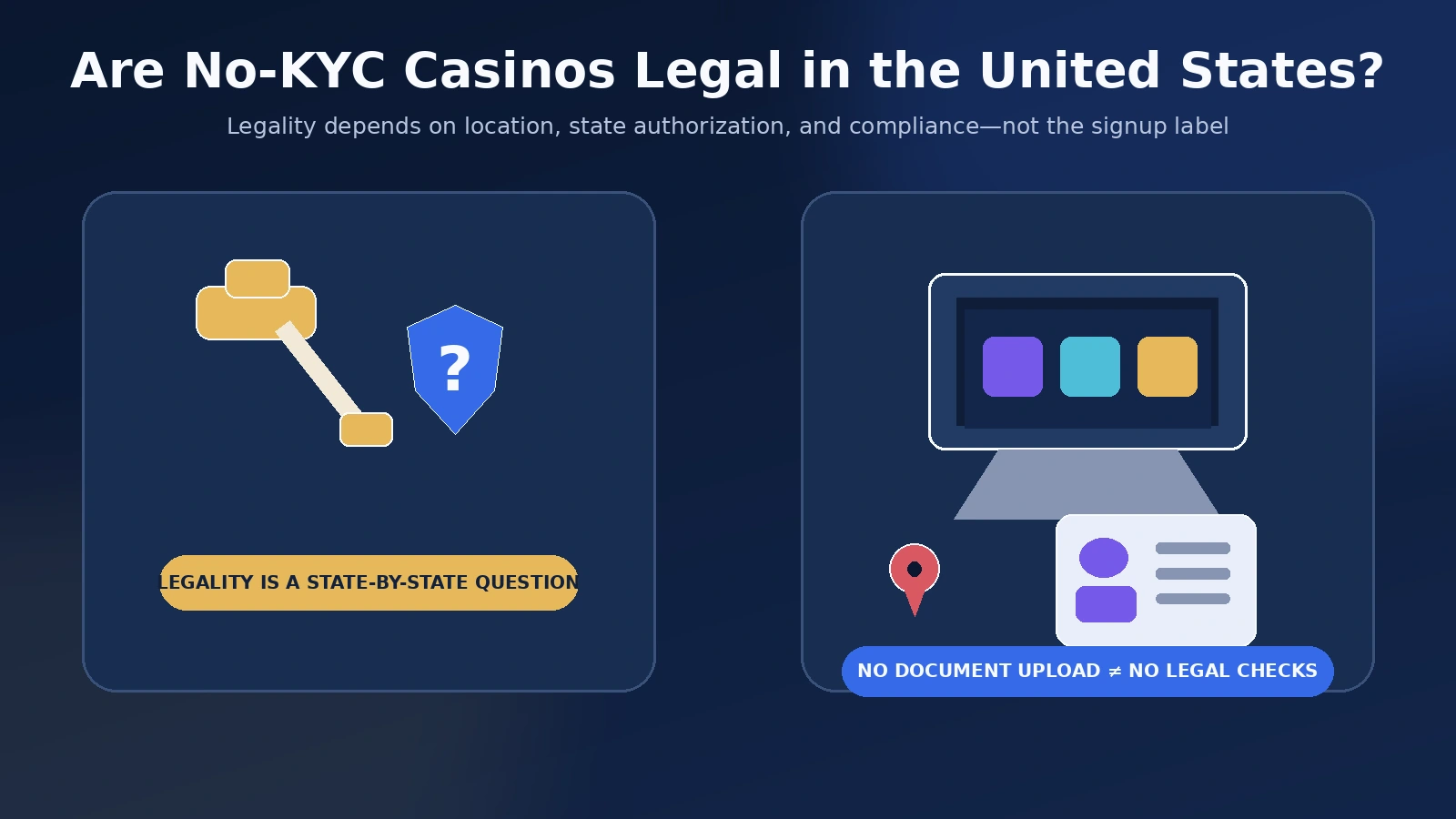

A casino is not legal in the United States simply because it advertises “no KYC,” accepts cryptocurrency or holds an offshore license. For real-money online casino play to be part of a regulated U.S. market, the activity generally must be authorized by the state where the player is physically located, and the operator must be approved by that state’s regulator.
That means a genuinely anonymous casino that does not verify a player’s age, identity or location will generally not satisfy the requirements imposed on licensed U.S. online casinos.
Some websites described as no-KYC casinos may be lawfully licensed in Curaçao or another foreign jurisdiction. However, a foreign license does not automatically authorize the casino to accept wagers in New Jersey, Michigan, Pennsylvania or any other U.S. state. For Curaçao-licensed operators, the Curaçao Gaming Authority’s current online-gaming license conditions require compliance with applicable laws in the jurisdictions where remote games of chance are offered.
This distinction is easy to miss because an offshore casino may be technically accessible from the United States even when it is not part of any state-regulated market. Accessibility is not proof of legal authorization.
Legal notice: Gambling laws differ by state and can change. This article provides general information and is not legal advice. Check your state gaming regulator or consult a qualified attorney for guidance on a specific situation.
Key Takeaways
- “No KYC” is a marketing description, not a special legal status under U.S. gambling law.
- Legal online casino gaming depends heavily on the law of the state where the wager is placed.
- A foreign or offshore license does not replace a U.S. state license.
- Licensed U.S. casinos must verify matters such as age, identity and physical location.
- A casino can offer document-free registration while still performing electronic identity checks in the background.
- Cryptocurrency does not turn an otherwise unauthorized wager into a legal one.
- A VPN can change the location shown to a website, but it does not change the player’s actual legal location.
- Gambling winnings remain reportable even when the casino does not issue a tax document or pays in cryptocurrency.
What Does “No KYC Casino” Actually Mean?
KYC stands for Know Your Customer. It refers to procedures used to establish who a customer is and assess risks involving underage access, fraud, money laundering, sanctions, account misuse or stolen payment methods.
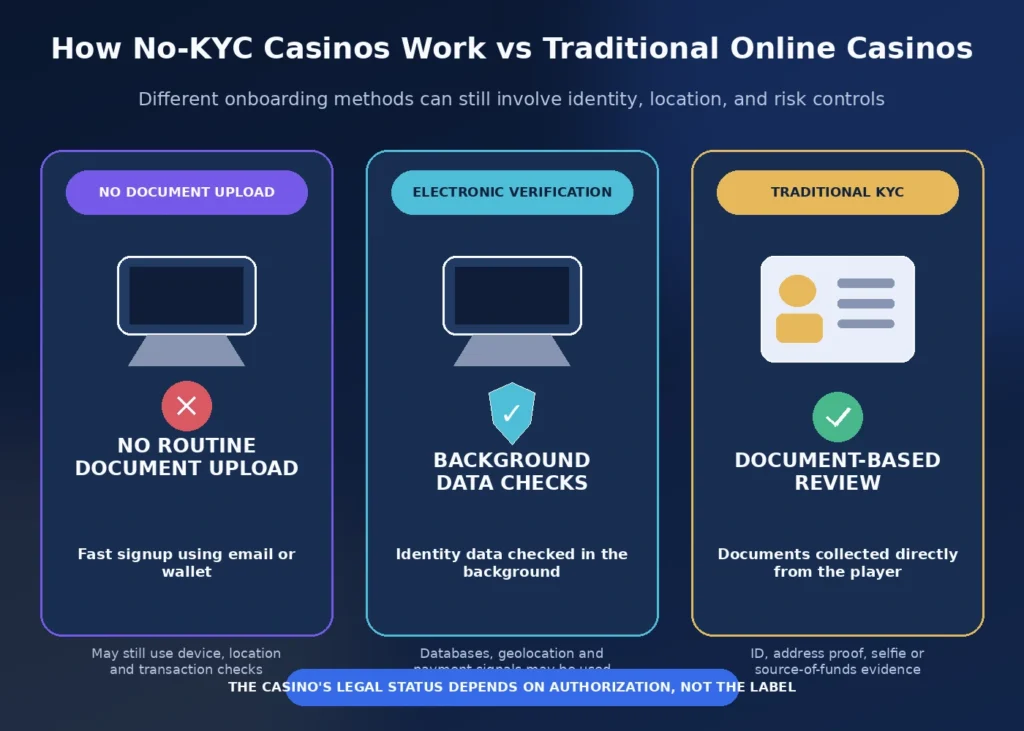
“No KYC” can mean several different things in casino marketing:
| Claim | What it may mean in practice |
| No document upload | Identity may still be checked through databases or other electronic sources |
| No KYC at registration | Verification can still be requested before a withdrawal |
| Crypto-only registration | The casino may collect wallet, IP, device and transaction information |
| Wallet connection only | The wallet acts as an account identifier, but blockchain activity may still be screened |
| Anonymous casino | The player may be pseudonymous rather than genuinely anonymous |
| No KYC under normal limits | Risk-based verification may apply to large or unusual transactions |
| True no KYC | No meaningful identity or age verification, which generally conflicts with regulated U.S. online casino requirements |
A casino should not be described as completely anonymous merely because it does not ask for a passport during registration. It may still monitor IP addresses, devices, wallet activity, payment patterns and account behavior.
For a broader explanation of these operating models, see what no KYC actually means.
The Three-Part Test for Casino Legality
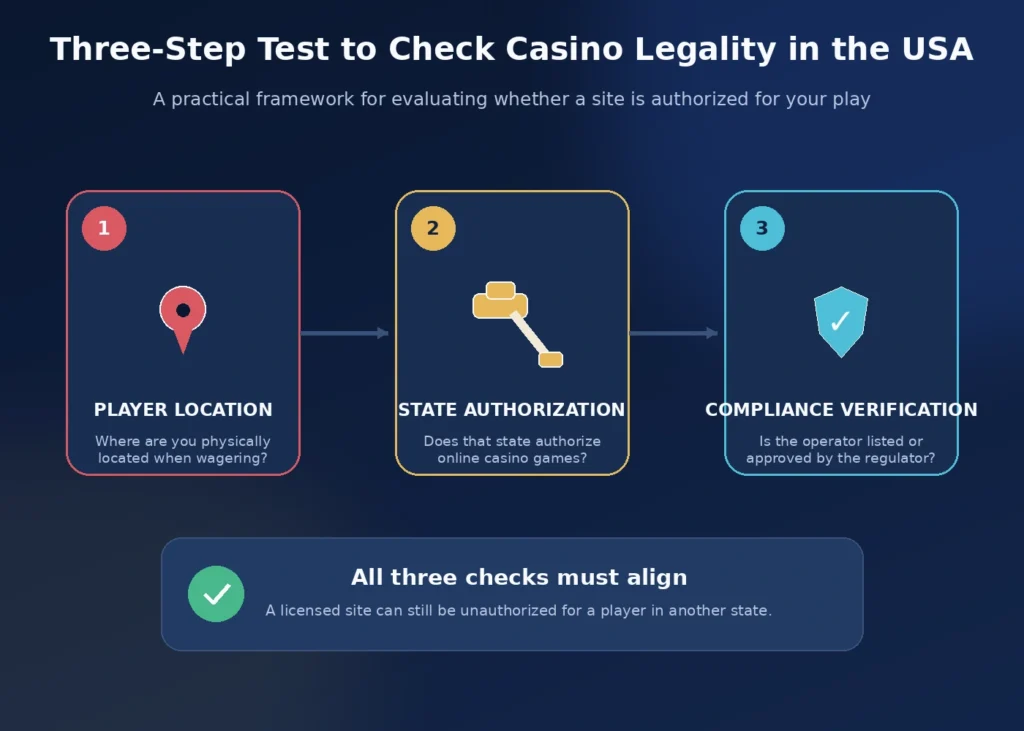
A practical way to evaluate a casino is to ask three questions.
1. Where is the player physically located?
U.S. online casino law is location-based. The relevant location is normally where the player is physically present when placing a wager, not merely:
- The address registered on an account.
- The state that issued the player’s identification.
- The location of a bank or crypto exchange.
- The country where the casino’s company is incorporated.
- The location selected in a VPN application.
Federal law’s intrastate gambling provisions specifically contemplate age and location controls designed to block minors and people located outside the authorizing state.
2. Is the exact operator authorized in that location?
A familiar brand name or a license seal is not enough.
The player should be able to find the operator on the official list maintained by the state’s gaming regulator. Pennsylvania, for example, directs consumers to verify operators through the Pennsylvania Gaming Control Board before wagering.
The verification should cover:
- The operator’s legal entity.
- The brand or “skin.”
- The correct website or mobile application.
- The type of gambling authorized.
- The state in which the player is located.
A sports-betting license does not necessarily authorize casino slots or table games. Similarly, a poker authorization should not be treated as approval for a full online casino.
3. Does the operator apply the required compliance controls?
Legal U.S. platforms typically verify:
- Legal name.
- Date of birth.
- Age eligibility.
- Residential information.
- Physical location when wagering.
- Exclusion or self-exclusion status.
- Payment ownership or validity where required.
- Fraud and suspicious transaction indicators.
New Jersey’s internet gaming regulations, for example, require a patron file, identity verification, age verification and safeguards against prohibited participation. They also permit remote multi-source authentication, meaning a player may sometimes be verified without manually uploading identity documents.
That leads to an important distinction:
A casino can be “no document upload” without being no KYC.
A licensed platform may verify a player electronically and only request documents if the automated check fails or further investigation is required.
Where Are Real-Money Online Casinos Legal in the United States?
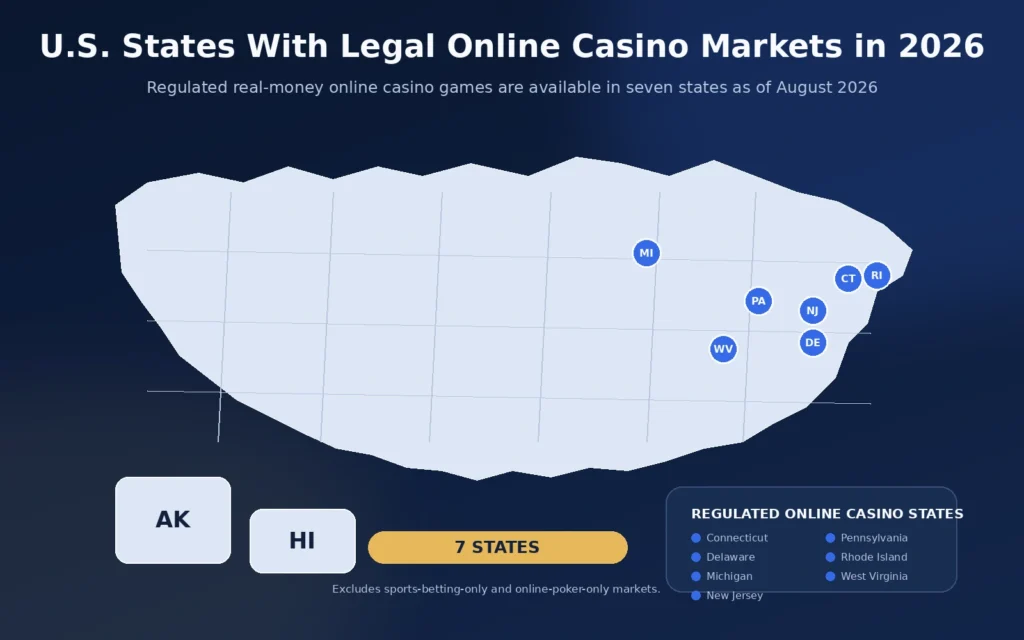
As of August 7, 2026, full real-money online casino markets were live in a limited number of states:
| State | General market position |
| Connecticut | Regulated online casino gaming is live |
| Delaware | Regulated online casino gaming is live |
| Michigan | Regulated online casino gaming is live |
| New Jersey | Regulated online casino gaming is live |
| Pennsylvania | Regulated online casino gaming is live |
| Rhode Island | Regulated online casino gaming is live |
| West Virginia | Regulated online casino gaming is live |
| Maine | Authorized; rulemaking and licensing were still in progress as of August 7, 2026 |
The American Gaming Association’s State of the States 2026 identifies seven states with lawful online casinos: Connecticut, Delaware, Michigan, New Jersey, Pennsylvania, Rhode Island and West Virginia. Maine became the next state to enact authorizing legislation in January 2026, but its market was not yet live as of August 7, 2026.
The fact that a state permits one form of gambling does not mean it permits all forms. A state can allow:
- Retail casinos but not online casino games.
- Online sports betting but not online slots.
- Tribal casino gaming but not commercial internet casinos.
- Online poker but not a full online casino.
- Lotteries or charitable gaming while restricting other gambling.
Readers researching no-KYC casinos for U.S. players should therefore check the law of the state where they will actually place the wager.
How Federal and State Gambling Laws Work Together
There is no single federal rule that makes every form of online gambling either legal or illegal across the entire country.
Instead, several layers can apply:
- State gambling statutes.
- State gaming regulations and licensing rules.
- Tribal gaming law and compacts.
- Federal payment restrictions.
- Federal anti-money-laundering rules.
- Laws addressing interstate gambling activity.
- Sanctions and financial-crime requirements.
Under the Unlawful Internet Gambling Enforcement Act framework, “unlawful Internet gambling” depends on whether the wager violates applicable federal or state law where it is initiated, received or made. The statute also excludes qualifying intrastate gambling when the activity is expressly authorized by the state and includes appropriate age, location and data-security controls.
A related provision, 31 U.S.C. § 5363, prohibits a person in the business of betting or wagering from knowingly accepting certain payments connected to unlawful internet gambling.
The practical result is that state authorization remains crucial. An operator cannot normally avoid a state’s licensing system merely by:
- Hosting servers overseas.
- Accepting Bitcoin instead of dollars.
- Registering the company abroad.
- Calling the platform decentralized.
- Using a foreign license.
- Avoiding conventional bank payments.
Why Licensed U.S. Casinos Cannot Be Completely No-KYC
Licensed U.S. online casinos are expected to prevent prohibited participation and detect financial crime. A platform that makes no effort to establish age, identity or location would struggle to meet those obligations.
KYC and related controls help operators:
- Prevent minors from gambling.
- Confirm that an account belongs to the registered player.
- Enforce state borders.
- Detect stolen identities and payment methods.
- Identify multiple-account or bonus abuse.
- Apply self-exclusion rules.
- Investigate suspicious transactions.
- Respond to regulatory or law-enforcement requests.
- Safeguard player accounts and withdrawals.
Federal casino anti-money-laundering rules require covered casinos to maintain compliance programs and procedures for obtaining and verifying identifying information when required.
FinCEN has also addressed internet casinos using convertible virtual currency. Its 2019 guidance on CVC business models explains that a U.S.-authorized casino with gross annual gaming revenue above $1 million falls within the federal regulatory definition of a casino for these purposes, while another gambling business accepting and transmitting cryptocurrency may still have obligations as a money transmitter.
“No ID requested during signup” should therefore not be interpreted as “the legal operator knows nothing about the customer.”
Does an Offshore License Make a No-KYC Casino Legal in the U.S.?
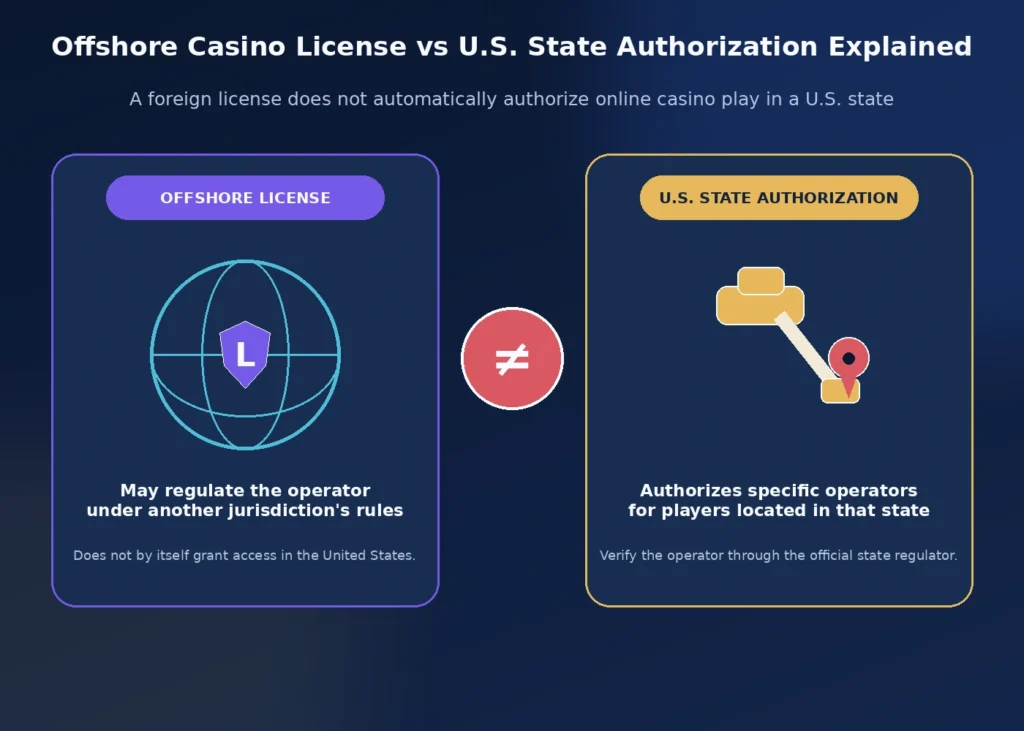
No. An offshore license only shows that an operator may have authorization under the issuing jurisdiction’s system. It does not grant permission to operate in every country or U.S. state.
For example, a Curaçao authorization may establish that the business is regulated under Curaçao’s gaming framework. It does not replace approval from the New Jersey Division of Gaming Enforcement, Pennsylvania Gaming Control Board or another U.S. authority.
Curaçao’s online-gaming license conditions require licensees to comply with applicable laws and regulations in the jurisdictions where they offer remote games of chance.
When evaluating an offshore license, distinguish these questions:
- Is the license genuine and current?
- Does it cover the actual player-facing domain?
- What games and services does it authorize?
- Does the regulator accept player complaints?
- Does the operator exclude prohibited jurisdictions?
- Is the operator separately authorized in the player’s U.S. state?
A genuine foreign license may be better than no identifiable licensing framework at all, but it does not establish U.S. legality.
Offshore Does Not Mean the Same Thing as Illegal Everywhere
An offshore casino may be lawfully incorporated and licensed where it is based. The problem is that online gambling involves more than the operator’s home jurisdiction.
A single transaction can involve:
- A player in one state.
- An operator in another country.
- Servers in a third jurisdiction.
- A game provider elsewhere.
- A crypto wallet or exchange in another country.
- Payment infrastructure subject to additional regulations.
The casino’s home license answers only part of the legal question. U.S. players still need to determine whether the operator is authorized where the wager originates.
Does Cryptocurrency Make a No-KYC Casino Legal?
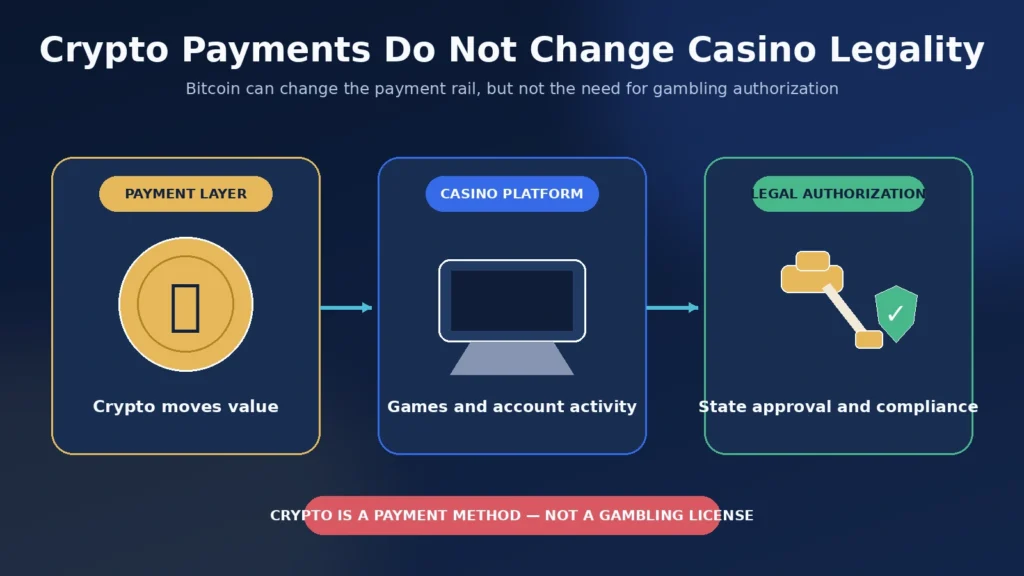
No. Cryptocurrency changes the payment method, not the underlying gambling law.
A wager that is unauthorized under applicable state law does not become authorized because it is funded with:
- Bitcoin.
- Ethereum.
- Litecoin.
- Solana.
- USDT.
- USDC.
- Monero.
- Another digital asset.
Crypto can affect privacy, speed, fees, volatility and transaction finality. It can also create additional compliance issues involving wallet screening, sanctions and source-of-funds reviews. It does not function as a substitute for a gaming license.
FinCEN’s guidance makes clear that accepting casino deposits and issuing payouts in convertible virtual currency can still fall within U.S. financial-regulatory frameworks.
Are Crypto Casino Transactions Anonymous?
Usually not in the absolute sense.
Most public blockchain transactions are pseudonymous. They may show wallet addresses rather than legal names, but the transaction history can remain publicly viewable.
A wallet can potentially be linked to an individual through:
- A regulated exchange account.
- Previous wallet transfers.
- IP or device information.
- Payment records.
- Withdrawal addresses.
- Blockchain-analysis tools.
- Information provided during a later verification check.
A casino may also collect technical information even when it does not request identity documents. “No KYC” should therefore not be interpreted as “no data collection” or “no transaction trace.” The distinction between no-KYC and anonymous crypto casinos is important because pseudonymity is not the same as guaranteed anonymity.
Does Using a VPN Make an Offshore Casino Legal?
No. A VPN does not change the law of the place where the player is physically located.
It can also create separate contractual risks. If an operator prohibits VPNs or players from a particular state, concealing location may breach its terms.
Possible consequences include:
- Login challenges.
- Additional verification.
- Account suspension.
- Withdrawal delays.
- Bonus cancellation.
- Closure of duplicate or restricted accounts.
- A dispute in which the player has limited regulatory recourse.
Regulated U.S. online casinos use geolocation controls to determine whether a wager is placed within the authorized state. The federal intrastate framework also expressly contemplates location verification.
The ability to bypass a location check does not create legal permission to wager.
Can U.S. Players Get in Trouble for Using Offshore Casinos?
The answer depends on the state, the type of gambling and the player’s conduct.
Federal payment law is heavily directed at gambling businesses and payment acceptance, but the definition of unlawful internet gambling depends on the federal and state law applicable to the wager.
State laws differ on whether and how they address:
- Placing an unlawful wager.
- Promoting or operating gambling.
- Facilitating payments.
- Possessing gambling records.
- Using false identity information.
- Evading location controls.
- Underage gambling.
- Fraud or bonus abuse.
For many users, the most immediate practical risks may be financial rather than criminal:
- No access to a local gaming complaint process.
- Difficulty enforcing a withdrawal claim.
- Account closure under restricted-country terms.
- Loss of bonus funds.
- Limited access to responsible-gambling protections.
- Confirmed crypto transfers can be difficult or impossible to reverse.
- Exposure to an operator with weak financial controls.
U.S. regulators continued taking action against illegal offshore sportsbooks and casinos during 2025, according to the American Gaming Association’s 2026 state report.
A player should not assume that low enforcement visibility is the same as legal authorization.
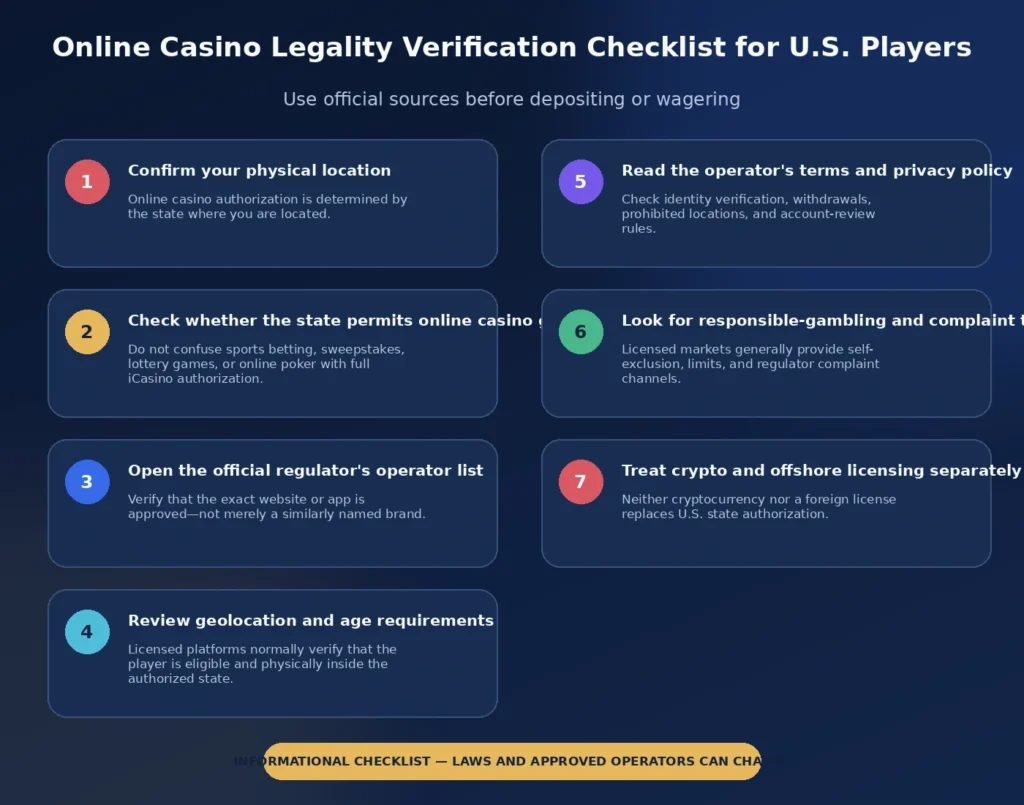
How to Check Whether an Online Casino Is Legal in Your State
Use this process before depositing.
Step 1: Confirm that online casino gaming is authorized
Visit the official gaming regulator’s website for the state where the wager will be placed.
Do not rely solely on:
- Affiliate reviews.
- Search-engine snippets.
- Casino advertising.
- App-store availability.
- Social-media claims.
- A foreign license badge.
Step 2: Find the official operator list
Look for sections such as:
- Authorized internet gaming sites.
- Licensed interactive gaming operators.
- Approved online casino operators.
- Licensee register.
- Authorized gaming applications.
Pennsylvania expressly encourages players to verify that a platform is regulated by the state gaming board.
Step 3: Match the exact brand and domain
Scammers may copy a licensed brand, logo or certificate. Confirm:
- Exact spelling.
- Correct domain.
- Mobile application publisher.
- Licensee name.
- Regulator-issued authorization.
Step 4: Confirm that casino games are covered
An operator may be authorized for sports betting but not online casino games. Check the product category.
Step 5: Review age and location requirements
Legal online casino markets generally require players to meet the state’s minimum age and be physically present inside the state when wagering. Connecticut’s statute, for example, requires online casino bettors to be at least 21 and physically present in the state.
Step 6: Read verification and withdrawal terms
Check whether the casino can request:
- Government-issued identification.
- Proof of address.
- A selfie or liveness check.
- Source-of-funds information.
- Payment ownership evidence.
- Wallet ownership confirmation.
- Additional documents during account recovery.
When comparing casinos that advertise no ID verification, distinguish no upfront document request from a guarantee that verification will never occur. The guide to why no-KYC casinos can still ask for verification explains common later-stage verification triggers.
Step 7: Check consumer-protection tools
Look for:
- Deposit and loss limits.
- Session reminders.
- Cooling-off periods.
- Self-exclusion.
- Account statements.
- Clear complaint procedures.
- Segregation or safeguarding of player funds.
- Withdrawal-status information.
New Jersey’s regulations include identity controls, patron-account records, responsible-gaming limits and requirements concerning the safeguarding of account funds.
Step 8: Verify the regulator’s complaint process
A legal U.S. operator normally sits within a state-supervised dispute structure. An offshore operator may require the player to use a foreign regulator, private dispute service or the operator’s internal support process.
Regulated U.S. Casinos vs Offshore No-KYC Casinos
| Factor | State-regulated U.S. casino | Offshore no-KYC casino |
| Local authorization | Listed by a state regulator | Usually not licensed by the player’s state |
| Age verification | Required | Policy varies |
| Location verification | Required for state-bound wagering | May be weak, absent or based on operator restrictions |
| Identity checks | Electronic or document-based KYC | May be delayed, conditional or absent |
| AML monitoring | Required within applicable regulatory framework | Depends on licensing and operation |
| U.S. complaint route | State regulator may accept complaints | Often no local regulatory complaint route |
| Self-exclusion | State or operator tools generally required | Availability and enforcement vary |
| Player-fund controls | State rules may impose safeguards | Depends on foreign rules and operator practices |
| Crypto availability | Limited and market-dependent | Common |
| Legal certainty for local play | Higher when officially licensed | Often uncertain or unauthorized locally |
| Transaction reversibility | Depends on payment method | Confirmed crypto transfers are generally difficult or impossible to reverse |
| Tax reporting obligation | Winnings are taxable | Winnings are still taxable |
The comparison does not mean every licensed casino is risk-free or every offshore casino behaves dishonestly. It shows that the regulatory protections and legal basis are different.
Are No-KYC Casino Winnings Taxable?
Yes. U.S. federal tax obligations do not disappear because a casino is offshore, does not request identification or does not issue a Form W-2G.
The IRS states that gambling winnings are fully taxable and must be reported, including winnings not reported to the player on Form W-2G.
Cryptocurrency creates an additional recordkeeping issue because the IRS treats digital assets as property rather than currency for federal tax purposes.
Taken together, the IRS guidance generally means a player receiving casino winnings in cryptocurrency should maintain records showing:
- Date received.
- Type and quantity of cryptocurrency.
- U.S.-dollar fair market value when received.
- Wallet transaction details.
- Amount originally deposited.
- Gambling wins and losses.
- Later sale, exchange or disposal of the cryptocurrency.
The gambling win and a later change in the crypto asset’s value may have separate tax consequences. State income-tax treatment can also differ. Consult a qualified tax professional for a specific filing position.
Maine’s 2026 Online Casino Law
Maine is a recent change in the U.S. online casino map.
Maine’s LD 1164 was enacted on January 11, 2026 and created a state-regulated framework under which the Wabanaki Nations may offer internet gaming through licensed operations.
This does not mean every casino website became legal in Maine immediately. As of August 7, 2026, the Maine Gambling Control Unit stated that internet-gaming applications were available to prepare but were not yet being accepted, while rulemaking was still underway. Operators therefore still need to satisfy the applicable licensing, partnership, technical and regulatory requirements before accepting lawful wagers.
The Maine development reinforces the central point of this article: legal online casino expansion occurs through explicit local authorization and regulation, not through a casino declaring itself no-KYC.
Are No-KYC Casinos Safe?
Safety and legality overlap, but they are not the same question.
A casino could hold a foreign license yet offer fewer protections than a U.S.-regulated operator. Conversely, the use of encryption or provably fair technology does not authorize an operator to serve a particular state.
Evaluate safety separately across these areas:
Licensing
Verify the license with the issuing regulator rather than trusting an image in the website footer.
Ownership
Look for a named legal company, registration information and a documented operating history.
Withdrawal rules
Check limits, pending periods, fees, verification triggers and bonus restrictions before depositing.
Player-fund protection
Determine whether the regulator requires segregated or safeguarded player balances.
Game integrity
Look for approved providers, independent testing and clearly documented provably fair methods where applicable.
Provably fair technology can help verify the generation of a particular game result. It does not prove that:
- The casino is legal in the player’s state.
- The operator can pay all withdrawals.
- The bonus terms are fair.
- The casino will never request KYC.
- The operator offers an effective complaint process.
Responsible-gambling tools
Prefer platforms with deposit limits, time limits, cooling-off controls and self-exclusion. The National Council on Problem Gambling’s Internet Responsible Gambling Standards address player assistance, self-exclusion, payments, informed decision-making and other protective measures.
Practical Checklist Before Using Any Casino
Before opening an account, confirm all of the following:
- Online casino games are legal in the state where play will occur.
- The exact operator and domain appear on the regulator’s approved list.
- The operator is licensed for casino gaming, not only sports betting.
- The minimum gambling age is satisfied.
- The verification policy is clearly explained.
- Restricted jurisdictions are disclosed.
- VPN use is not required to reach the platform.
- Withdrawal limits and KYC triggers are stated.
- Bonus terms are available before a deposit.
- Responsible-gambling controls are accessible.
- A formal complaint channel exists.
- Crypto network and wallet details are correct.
- Complete transaction and tax records will be retained.
A current comparison of no-KYC casinos may help readers compare features, but it should never replace checking the relevant state regulator.
Conclusion
A true no-KYC casino is generally incompatible with the identity, age, location and anti-money-laundering controls expected in regulated U.S. online casino markets.
A casino may be legally licensed offshore, accept cryptocurrency and allow registration without a document upload. None of those facts independently makes it legal for a person to wager from a particular U.S. state.
The clearest test is straightforward:
- Confirm that online casino gaming is authorized where the wager will be placed.
- Verify the exact operator through the official state regulator.
- Expect a lawful U.S. operator to perform some form of identity, age and location verification.
When an offshore site is accessible but absent from the state regulator’s approved list, players should not treat accessibility, crypto payments or an overseas license as evidence of local legality.
FAQ
There is no federal approval that makes no-KYC casinos legal across all states. Whether an online wager is unlawful depends partly on applicable federal and state law where it is initiated or received. State authorization and licensing are therefore central to legal online casino play.
Yes. A regulated casino may be able to verify a player electronically through approved databases or remote multi-source authentication without requiring an immediate document upload. That is still identity verification and should not be described as true no KYC. New Jersey expressly permits approved remote multi-sourced authentication.
The answer depends on the player’s state, the form of gambling and the conduct involved. An offshore license does not prove that the casino is authorized in the state where the wager is placed. Check state law and the official operator register rather than assuming that offshore access is permitted.
Not automatically. A Curaçao license concerns authorization under Curaçao’s regulatory system. The operator must still comply with the law in every country or state in which it operates, and it may need separate state authorization to legally serve U.S. players.
No. Bitcoin is a payment method. It does not override state gambling law, licensing rules, age restrictions or location requirements. FinCEN guidance also recognizes that internet casino activity involving convertible virtual currency can create U.S. financial-regulatory obligations.
Yes. Many operators use “no KYC” to mean no documents are requested during initial registration. Their terms may still permit verification for large withdrawals, account recovery, payment disputes, suspicious activity, sanctions screening, bonus abuse or regulatory compliance.
A VPN does not change the law of the place where the player is physically located. It may also violate the casino’s terms or trigger an account review. Players should not use a VPN as evidence that wagering is legally permitted.
Yes. The IRS requires taxpayers to report gambling winnings, including winnings that are not reported on Form W-2G. Payment in cryptocurrency or the absence of casino KYC does not remove that obligation.
As of August 7, 2026, live full online casino markets existed in Connecticut, Delaware, Michigan, New Jersey, Pennsylvania, Rhode Island and West Virginia. Maine enacted authorizing legislation in January 2026, but its market remained in rulemaking and pre-licensing implementation.
Recovery may be more difficult than with a state-regulated operator. A U.S.-licensed casino normally sits within a state complaint and enforcement system. An offshore casino dispute may instead depend on the foreign regulator, an alternative dispute service, the operator’s terms or private legal action.