
No-KYC and anonymous crypto casinos are often treated as the same thing, but they describe different privacy characteristics. Neither label is a standardized legal category, and neither guarantees that a platform cannot identify a user.
A no-KYC crypto casino usually means a platform does not require identity verification before users can register, deposit or start playing. An anonymous crypto casino focuses on reducing personal information exposure more broadly, including account details, payment methods, wallet connections and transaction privacy.
In simple terms:
No-KYC removes or reduces identity checks. Anonymous focuses on minimizing the connection between gambling activity and personal identity.
However, neither term automatically means complete privacy.
Cryptocurrency transactions, account activity and blockchain records can still create connections depending on the cryptocurrency used, wallet practices and the information shared during registration.
No-KYC vs Anonymous Crypto Casinos: Quick Comparison
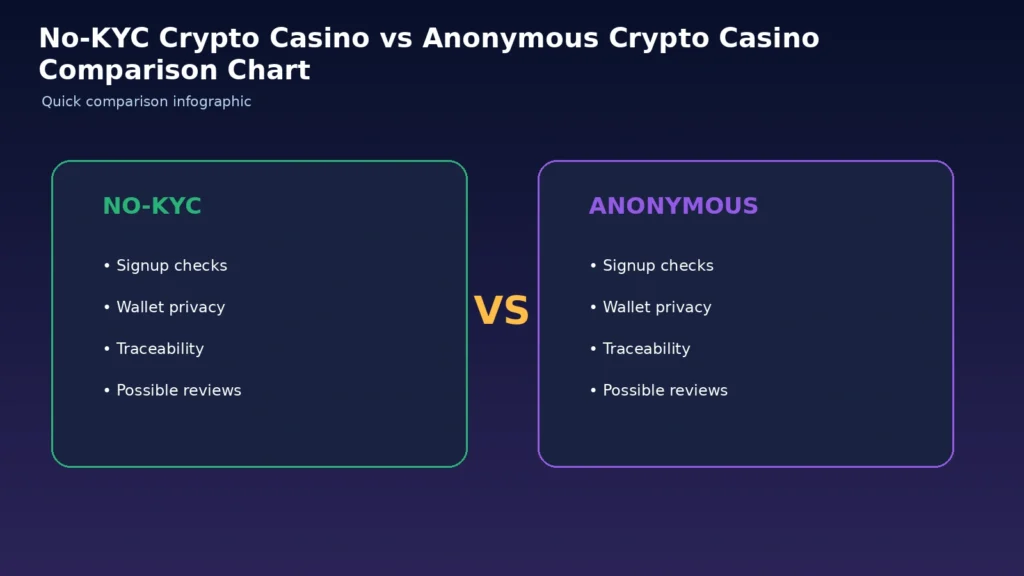
| Feature | No-KYC Crypto Casino | Anonymous Crypto Casino |
| Identity verification | Usually not required during signup | May be minimized, subject to the terms and applicable law |
| Personal information | May require email or basic details | May seek to reduce personal-data collection |
| Crypto payments | Commonly required | Often central to the privacy model |
| Wallet privacy | Depends on user behavior | Depends on the platform and user behavior |
| Blockchain privacy | Depends on cryptocurrency used | Depends on the asset, network and wallet use |
| Verification possibility | May happen later | May still occur under stated exceptions |
| Privacy level | Moderate to high, depending on the full setup | Potentially higher, but not guaranteed |
The key difference is that no-KYC is one privacy feature, while anonymity is a broader system.
What Does No-KYC Mean at a Crypto Casino?
KYC stands for Know Your Customer.
Traditional online casinos often require players to provide:
- Government-issued identification.
- Proof of address.
- Payment verification.
- Additional account information.
A no-KYC crypto casino may omit or delay routine identity-document checks, often while relying on cryptocurrency payments rather than conventional banking methods.
The typical process looks like this:
- Create an account.
- Deposit cryptocurrency.
- Play available games.
- Request withdrawals using crypto.
- Complete verification only if required by the operator.
The important point is that:
No-KYC does not always mean “verification can never happen.”
A casino may still request information because of:
- Large withdrawals.
- Security checks.
- Suspicious activity monitoring.
- Account ownership concerns.
- Compliance obligations.
- Bonus abuse investigations.
For regulated virtual-asset service providers, FATF guidance calls for customer due diligence, record keeping and suspicious-transaction reporting. Whether a particular casino, wallet or payment provider is covered depends on its role and jurisdiction.
How No-KYC Casinos Usually Work
Many no-KYC platforms rely on cryptocurrency payments because crypto can transfer value without exposing conventional bank-account details to the casino.
Instead of:
Bank account → Casino → Bank withdrawal
The process becomes:
Crypto wallet → Casino → Crypto wallet
This removes many traditional payment steps.
However, privacy depends on more than the casino’s registration process.
For example:
A player may use a no-KYC casino but:
- Purchase Bitcoin from a verified exchange.
- Use a personal email address.
- Use the same wallet everywhere.
- Connect the wallet to identifiable services.
In that situation, the casino may not request identity documents, but activity could still potentially be connected through external information.
Readers comparing platform policies can use the site’s guide to no-KYC casinos for US players as a starting point, but current operator terms and state regulator lists remain the controlling sources.
What Is an Anonymous Crypto Casino?
“Anonymous crypto casino” is a marketing description for a platform that aims to reduce personal-data exposure beyond the absence of routine KYC checks.
The goal is to reduce the amount of personal information connected to:
- Account creation.
- Payments.
- Wallet activity.
- Transaction history.
- Online identity.
True anonymity depends on multiple privacy layers working together.
A casino cannot create complete anonymity by itself.
The user’s own choices also matter.
The Different Layers of Crypto Casino Privacy
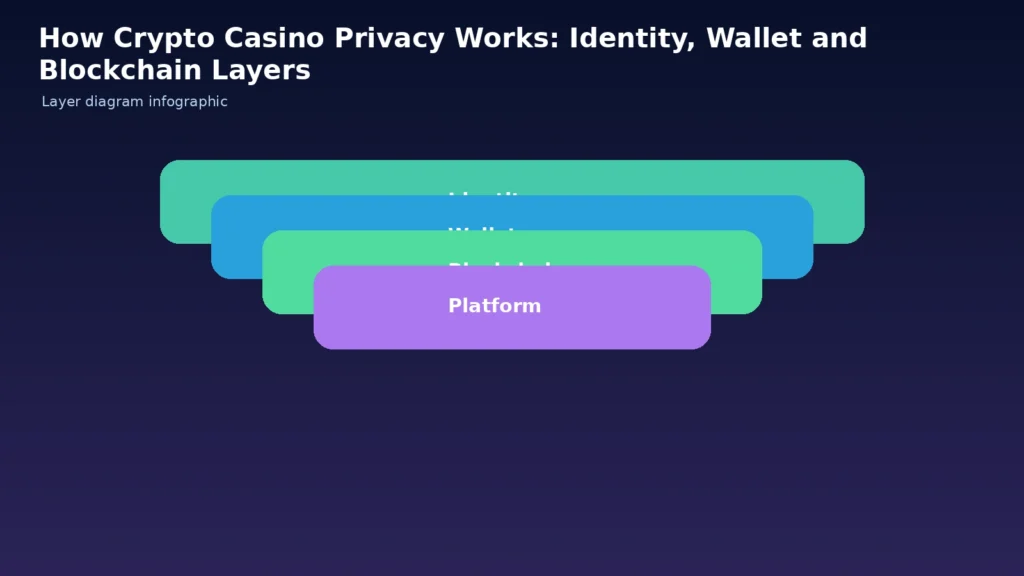
1. Identity Verification Privacy
The first layer is whether the platform requires personal documents.
A privacy-focused platform may avoid requesting:
- Passport details.
- Driver’s license information.
- Proof of address.
However, avoiding KYC does not automatically remove all possible identification methods.
2. Cryptocurrency Privacy
Different cryptocurrencies provide different levels of transaction visibility.
NIST describes public-blockchain users as pseudonymous because account identifiers and transactions can remain publicly visible.
Bitcoin transactions are recorded on a public blockchain.
Ethereum is also transparent at the base layer, and its on-chain data can be inspected through block explorers.
Anyone can inspect:
- Wallet addresses.
- Transaction amounts.
- Transaction history.
The wallet owner is not directly displayed, but blockchain analysis can sometimes connect addresses with real-world activity.
Monero’s official documentation states that its protocol hides the sender, receiver and transaction amount by default. That protocol-level privacy does not make a casino account, device, email address or wider activity automatically unidentifiable.
3. Wallet Privacy
The wallet used can affect privacy.
Better privacy practices may include:
- Separating casino activity from personal funds.
- Avoiding address reuse.
- Understanding wallet transparency.
- Checking what information a wallet provider collects.
A casino cannot protect privacy if a user creates obvious links through their own wallet activity.
4. Personal Information Exposure
Privacy can also be affected by:
- Email addresses.
- Usernames.
- Social media connections.
- Device information.
- Location data.
A casino requiring only an email address provides less anonymity than a platform requiring almost no identifying information.
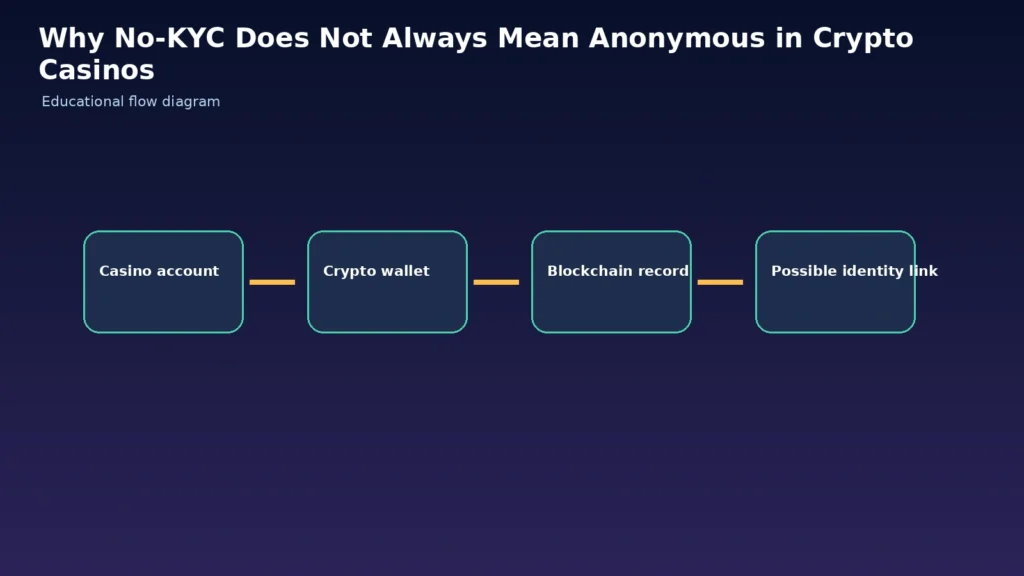
Why No-KYC Does Not Always Mean Anonymous
The biggest misunderstanding in crypto gambling privacy is assuming:
No identity verification = complete anonymity
That is not always accurate.
Consider two examples.
Example 1: No-KYC but Limited Privacy
A user:
- Creates a casino account with personal email.
- Buys Bitcoin from a regulated exchange.
- Sends Bitcoin from a known wallet.
The casino may not ask for identification, but several external connections exist.
Example 2: Stronger Privacy Approach
A user:
- Uses a privacy-focused cryptocurrency.
- Maintains separate wallet activity.
- Avoids unnecessary personal information.
- Uses a platform designed around privacy.
This provides a stronger privacy model.
The difference is the complete ecosystem, not only the casino’s KYC policy.
Three Levels of Privacy at Crypto Casinos
Not every crypto casino offers the same privacy experience. In practice, platforms generally fall into three broad categories.
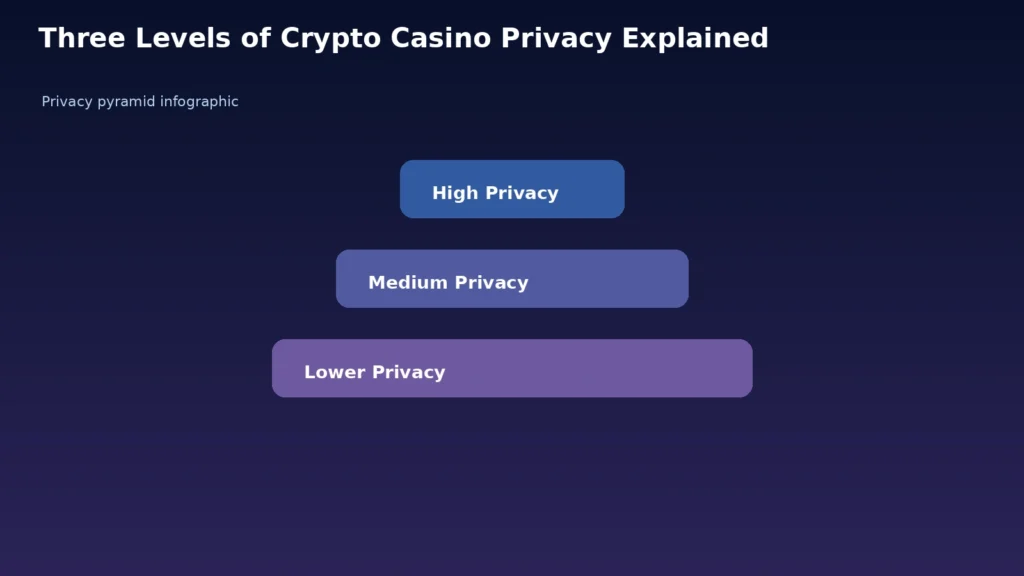
Level 1: Privacy-Focused or Anonymous Crypto Casinos
These platforms aim to minimize identity exposure as much as possible.
Typical characteristics may include:
- Minimal registration requirements.
- Cryptocurrency-only deposits and withdrawals.
- Reduced collection of personal information.
- Greater focus on wallet-based transactions.
- Support for privacy-focused payment methods.
However, privacy-focused does not mean risk-free.
Users should still evaluate:
- Operator reputation.
- Withdrawal policies.
- Available support channels.
- Terms and conditions.
- Applicable regulations.
Greater privacy often means users have more responsibility for evaluating the platform before using it.
Level 2: No-KYC Until Verification Is Triggered
This is one of the most common models.
The casino may allow:
- Account creation without documents.
- Crypto deposits.
- Gameplay without immediate verification.
However, verification may appear later because of:
- Withdrawal size.
- Security reviews.
- Payment concerns.
- Account activity patterns.
- Compliance requirements.
For many users, this model provides a balance between convenience and operational controls.
The important question is not only:
“Does this casino require KYC?”
A better question is:
“When and under what circumstances can verification be requested?”
Level 3: Traditional KYC Crypto Casinos
Some crypto casinos accept cryptocurrency but operate more like traditional online gambling platforms.
They may require:
- Identity verification.
- Address confirmation.
- Payment verification.
- Account checks before withdrawals.
The advantage is that these platforms may provide more structured compliance procedures.
The disadvantage is that users provide more personal information.
Anonymous Crypto Casinos vs No-KYC Casinos: Which Is More Private?
Privacy depends on several factors.
| Privacy Factor | No-KYC Casino | Anonymous Crypto Casino |
| No upfront ID checks | Usually | Often, subject to exceptions |
| Reduced personal data | Sometimes | More likely, not guaranteed |
| Crypto payments | Common | Often central |
| Privacy-focused coins | Optional | May be supported |
| Wallet separation | User choice | Depends on platform and user |
| Maximum privacy focus | Limited | Broader privacy focus |
A no-KYC casino may reduce onboarding friction, while a platform marketed as anonymous may address a wider set of privacy factors. The actual terms, data practices, payment routes and account controls matter more than either label.
Can Crypto Casino Transactions Still Be Traced?
Yes, depending on the cryptocurrency, wallet usage and information available.
A common misconception is:
Cryptocurrency automatically means anonymous.
Most cryptocurrencies are not completely anonymous.
Bitcoin and Blockchain Transparency
Bitcoin transactions are publicly visible.
A blockchain explorer can show:
- Transaction amounts.
- Wallet addresses.
- Transaction history.
- Movement of funds.
The blockchain does not directly display a person’s name, but external information can sometimes connect wallet activity with an individual.
Exchange Records Can Create Connections
Many users acquire cryptocurrency through exchanges that require identity verification.
For example:
A person buys Bitcoin from a regulated exchange using a verified account.
That exchange may know:
- The user’s identity.
- Purchase history.
- Wallet addresses involved.
The blockchain transaction itself may be public, while the exchange provides the identity connection.
Wallet Behavior Matters
Privacy can decrease when users:
- Reuse the same wallet everywhere.
- Connect wallets to personal profiles.
- Mix personal and gambling funds.
- Share wallet addresses publicly.
Privacy is not only determined by the casino.
Common Misconceptions About Anonymous Crypto Casinos
“No-KYC means the casino never knows anything about me”
Not necessarily.
A casino may still collect information such as:
- Email address.
- IP information.
- Device information.
- Payment records.
- Account activity.
No-KYC mainly refers to identity verification requirements.
“Bitcoin payments are completely anonymous”
Bitcoin is pseudonymous rather than fully anonymous.
Transactions are permanently recorded on a public blockchain.
The level of privacy depends on:
- Wallet practices.
- Transaction history.
- External information.
“Anonymous casinos have no verification rules”
Not always.
Some privacy-focused platforms may still reserve the right to request verification under certain circumstances.
Users should always review:
- Terms of service.
- Withdrawal rules.
- Verification policy.
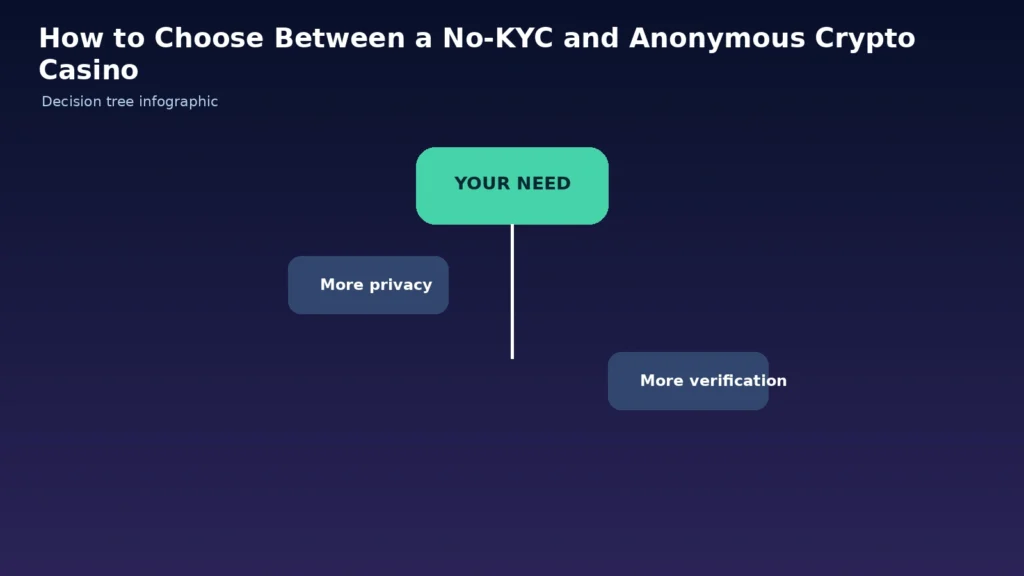
How to Choose Between No-KYC and Anonymous Crypto Casinos
The right choice depends on what matters most.
| Priority | Better Fit |
| Faster registration | No-KYC casino |
| Less paperwork | No-KYC casino |
| Maximum privacy focus | Anonymous crypto casino |
| More traditional account controls | KYC crypto casino |
| Crypto-only payments | No-KYC or anonymous casino |
| Privacy-focused transactions | Anonymous approach |
Before choosing any platform, evaluate:
1. Verification Policy
Check:
- When KYC may be requested.
- Withdrawal-related requirements.
- Required documents.
- Account review procedures.
2. Cryptocurrency Support
Look at:
- Supported coins.
- Available networks.
- Transaction fees.
- Wallet compatibility.
- Readers comparing crypto casino games should check game rules, RTP, fairness tools and bonus eligibility separately from a platform’s privacy claims.
3. Withdrawal Conditions
Review:
- Minimum withdrawal amounts.
- Processing times.
- Limits.
- Bonus restrictions.
- Payment rules.
A casino offering privacy but creating unclear withdrawal conditions may not provide a good overall experience.
The site’s guide to the crypto casino withdrawal process can help readers distinguish operator approval, blockchain settlement and receiving-wallet delays.
The site’s overview of crypto casino bonuses explains why wagering requirements, maximum bets and cashout caps should be checked before an offer is claimed.
Risks and Limitations of Anonymous Crypto Casinos
Privacy-focused platforms can provide convenience, but users should understand the limitations.
Reduced Consumer Protection
Some anonymous or offshore platforms may operate outside the regulatory systems available in certain jurisdictions.
This can affect:
- Complaint procedures.
- Dispute resolution.
- Oversight standards.
Fake Privacy Claims
Not every platform using the word “anonymous” provides meaningful privacy.
Marketing terms should be checked against:
- Privacy policy.
- Registration requirements.
- Payment methods.
- Terms of service.
Responsible Security Practices Are Important
Users should protect:
- Wallet access.
- Account passwords.
- Two-factor authentication.
- Recovery phrases.
A legitimate platform should never request a wallet seed phrase or private key.
Cryptocurrency Transactions Are Usually Irreversible
The Federal Trade Commission warns that cryptocurrency payments are typically not reversible and usually can be recovered only if the recipient returns the funds.
Before sending funds:
- Confirm the address.
- Confirm the network.
- Confirm the payment details.
Are Anonymous Crypto Casinos Legal in the US?
The answer depends on the state, the specific operator and the form of online gambling involved. Cryptocurrency does not change the underlying licensing requirement.
The American Gaming Association reported seven states with lawful online casino markets during 2026: Connecticut, Delaware, Michigan, New Jersey, Pennsylvania, Rhode Island and West Virginia.
Maine enacted a law in January 2026 authorizing internet gaming by the Wabanaki Nations under a state licensing framework, but availability depends on implementation, licensing and current regulator approvals.
An offshore license or an accessible website does not establish authorization in another state. Check the current state regulator list, legal gambling age, operator restrictions and the exact licensed domain before depositing.
Responsible Gambling
Privacy features and fast signup do not reduce gambling risk. Set a fixed entertainment budget, do not chase losses, and use deposit limits, time-outs or self-exclusion where available. The site’s responsible gambling tools and support page explains practical safeguards.
For free, confidential U.S. support available 24/7, call or text 1-800-MY-RESET through the National Problem Gambling Helpline.
No-KYC vs Anonymous Crypto Casinos: Final Verdict
No-KYC and anonymous crypto casinos overlap, but they are not identical.
A no-KYC casino focuses mainly on reducing or delaying identity-verification requirements.
A platform marketed as an anonymous crypto casino claims a broader privacy focus, including:
- Personal data collection.
- Wallet separation.
- Cryptocurrency choice.
- Transaction visibility.
- User privacy practices.
The most important takeaway:
No-KYC describes a casino policy. Anonymous describes a privacy approach.
A user looking for more privacy should evaluate the entire system rather than relying only on a label.
Key Takeaways
- No-KYC does not automatically mean anonymous.
- Platforms marketed as anonymous focus on broader privacy protection.
- Bitcoin transactions are visible on public blockchains.
- Wallet choices influence privacy.
- Verification may still occur in some situations.
- Privacy-focused platforms require users to evaluate security and reputation carefully.
- Cryptocurrency does not remove legal or financial responsibilities.
FAQ
No. A no-KYC casino mainly avoids routine identity verification, while a platform marketed as an anonymous crypto casino claims to reduce personal-information exposure across accounts, payments and transactions.
Yes. Some casinos may request verification later because of withdrawals, security reviews, compliance checks or unusual account activity.
No. Bitcoin transactions are publicly recorded on the blockchain. Bitcoin can provide privacy because identities are not displayed directly, but transactions can sometimes be linked through external information.
There is no single answer. Privacy depends on the cryptocurrency’s design, the wallet and exchange services involved, account data and user behavior. Some assets provide stronger protocol-level privacy than transparent blockchains such as Bitcoin, but no cryptocurrency guarantees complete anonymity across an entire casino transaction.
Not always. Requirements vary between platforms. Some may require an email for account recovery, while others may use alternative account systems.
Not automatically. Privacy and safety are different factors. A platform can offer privacy features while still having unclear ownership, weak support or poor withdrawal policies.
Potentially, yes. Casinos may see deposits and withdrawals connected to their wallets and may also collect account, device or network data. Public blockchain records can provide transaction history, while traceability varies by asset, wallet practices and information held by third parties.