
The Mines casino game is an instant-win game in which players reveal tiles while trying to avoid hidden mines. A safe selection increases the available payout multiplier; selecting a mine ends the round and normally loses the stake. Players decide how many mines to place on the board, how much to wager and when to cash out.
The most important fact is also the least exciting: no tile pattern, mine setting or staking system can guarantee a profit. Strategy in Mines is about controlling volatility, setting limits and deciding when to stop. It does not reveal where the mines are or remove the mathematical advantage built into the payout table.
Many versions use a 5×5 grid with 25 tiles and allow players to select between one and 24 mines. However, game rules, RTP and multiplier schedules can vary, so the information panel inside the exact version being played remains the primary source.
US gambling notice: Real-money online casino availability is regulated at state level. Cryptocurrency does not make an otherwise prohibited game legal. Check the relevant state regulator and the operator’s terms before depositing.
Mines casino game quick facts
| Feature | Typical format |
| Game type | Instant-win probability game |
| Common grid | 5×5, containing 25 tiles |
| Player selects | Stake, mine count, tiles and cash-out point |
| Safe selection | Increases the displayed multiplier |
| Mine selection | Ends the round and loses the stake |
| RTP | Depends on the game and provider |
| House edge | 100% minus the theoretical RTP |
| Fairness system | Certified RNG, provably fair algorithm or both |
| Main strategic control | Volatility, stake size and stopping point |
| Guaranteed strategy | None |
Certified online games should use outcome-generation systems designed to prevent predictable or biased results. Gaming Laboratories International lists source-code review, seed assessment and outcome-distribution testing among the methods used to evaluate RNG systems.
What is the Mines casino game?
Mines is inspired visually by Minesweeper, but the two games work differently.
Minesweeper is a logic puzzle: Numbers reveal information about neighboring bombs, allowing a player to deduce which squares are safer.
Casino Mines is a game of chance: The hidden positions are generated randomly or through a published provably fair process. Previously selected tiles do not provide clues about the positions of the remaining mines beyond reducing the number of unopened spaces.
The meaningful decisions are therefore:
- How many mines to select.
- How large the stake should be.
- How many safe tiles to target.
- When to accept the available cash-out value.
- When to end the session.
The location of a click—corner, center, diagonal or any visual pattern—does not create an informational advantage in a properly randomized game.
How does the Mines game work?
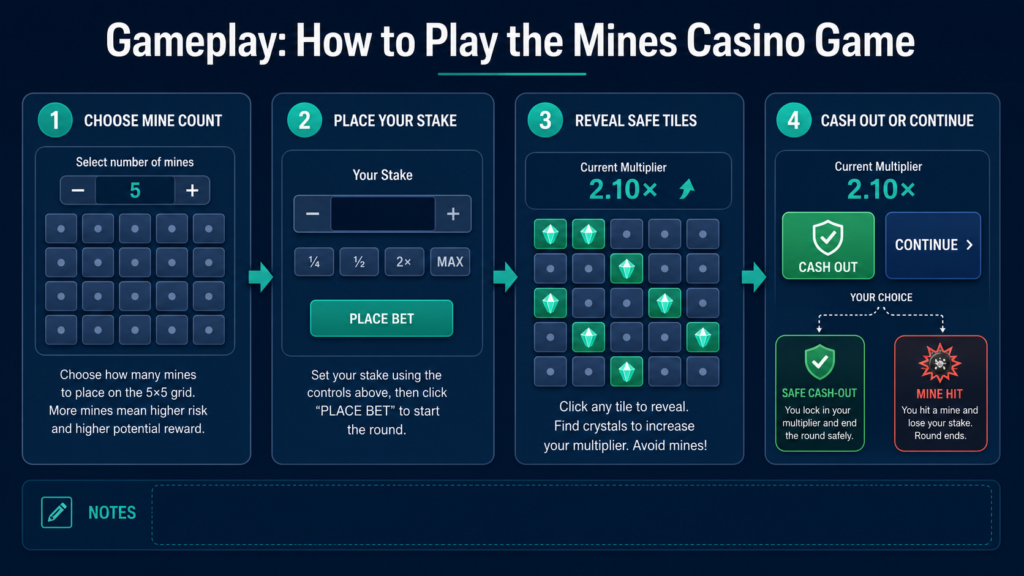
A standard round follows a simple sequence.
1. Select the number of mines
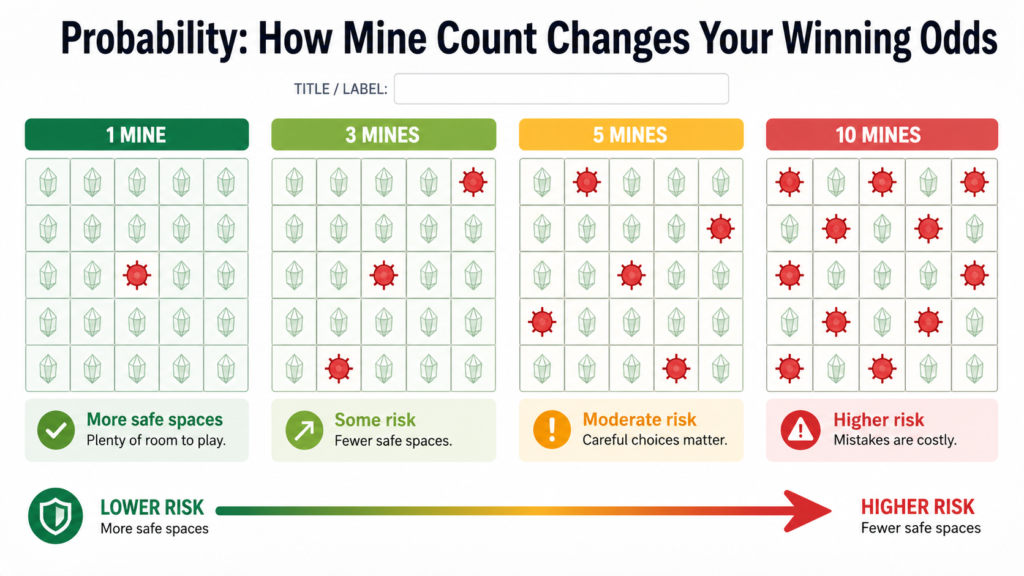
Fewer mines leave more safe tiles on the board. Multipliers generally rise slowly because surviving is comparatively likely.
More mines reduce the number of safe tiles. The multiplier usually increases faster because each successful selection is less likely.
2. Set the stake
The entire stake is normally at risk from the first selection. A mine on the first click can end the round immediately.
3. Start the round
The game generates or commits to the mine layout. Depending on the implementation, the result may be produced through a certified RNG, a provably fair seed system or a combination of both.
4. Reveal a tile
A safe tile increases the cash-out multiplier. A mine ends the round.
5. Continue or cash out
After every safe selection, the player chooses whether to:
- Cash out at the current multiplier.
- Risk the accumulated value by opening another tile.
This repeated decision is what separates Mines from one-result games such as slots or Limbo.
How to play Mines online step by step
- Open the game rules. Confirm the grid size, available mine counts, RTP and payout rules.
- Use demo mode first. Learn where the mine selector, bet control and cash-out button are located.
- Choose a mine count. Lower counts generally produce a less volatile round.
- Enter the stake. Treat the full amount as potentially lost on the first selection.
- Choose a cash-out target. Decide on a number of safe tiles or a multiplier before starting.
- Reveal the first tile. Cash out when the predetermined target is reached.
- Review the result. When provably fair data is available, inspect the round history and verification tool.
- Stop at the session limit. Do not increase the budget to recover a previous loss.
Mines probability explained
The mathematics below applies to a standard 25-tile board where mines are placed randomly without replacement.
Let:
- T = total tiles
- M = mines
- S = safe tiles already revealed
The probability that the next tile is safe is:
P(next safe) = (T − M − S) ÷ (T − S)
For a 25-tile game with five mines before any tile has been selected:
20 safe tiles ÷ 25 total tiles = 80%
After one safe tile has been revealed:
19 remaining safe tiles ÷ 24 remaining tiles = 79.17%
The probability falls after each successful selection because the number of mines remains unchanged while the number of unopened tiles decreases.
Probability of reaching several safe tiles
To calculate the chance of reaching a target, multiply the probability of every required safe selection.
With five mines, the probability of reaching three safe tiles is:
20/25 × 19/24 × 18/23 = approximately 49.57%
The following table shows the probabilities for common mine counts.
| Mines selected | First tile safe | Reach 2 safe tiles | Reach 3 safe tiles | Reach 4 safe tiles |
| 1 | 96.00% | 92.00% | 88.00% | 84.00% |
| 3 | 88.00% | 77.00% | 66.96% | 57.83% |
| 5 | 80.00% | 63.33% | 49.57% | 38.30% |
| 10 | 60.00% | 35.00% | 19.78% | 10.79% |
These calculations describe survival probability, not the amount paid. The multiplier is determined by the game’s payout schedule.
How Mines multipliers relate to probability
In a hypothetical game with no house edge, the mathematically fair multiplier would be the reciprocal of the probability of reaching the target.
For the five-mine, three-safe example:
1 ÷ 0.4957 = approximately 2.02x
A no-edge game would therefore need to return about 2.02 times the stake when three safe tiles are reached.
Real-money games generally display a lower multiplier because the provider’s mathematical advantage is deducted. Rounding and game-specific payout design can also affect the posted value.
This creates a simple check:
Survival probability × displayed multiplier ≈ theoretical RTP
It will not always match perfectly at every stage, but a substantial difference is a reason to inspect the game rules rather than assume the payout table is standard.
What is the Mines game RTP?
RTP, or return to player, is the theoretical percentage of wagered money a game is designed to return across a very large volume of play.
It is not a prediction for one session. A game displaying 97% RTP does not promise that a player wagering $100 will finish with $97. Actual short-term outcomes may be much higher or lower. The UK Gambling Commission explains that RTP is measured across a large number of games and that current results are not made more likely by previous wins or losses in a random game.
The house edge is calculated as:
House edge = 100% − RTP
Examples:
| Displayed RTP | Theoretical house edge |
| 99% | 1% |
| 97% | 3% |
| 96% | 4% |
| 95% | 5% |
There is no universal Mines RTP
Some operator-specific versions advertise 99%, while other Mines-style games use different values. One platform’s RTP should not be applied to another game simply because both use a 5×5 grid. Stake.us, for example, publishes a 99% figure for its own Mines version, not for every Mines game online.
Before playing:
- Open the help or information panel.
- Find the theoretical RTP.
- Confirm whether it changes by mode or mine count.
- Review the payout table.
- Leave the game if the RTP cannot be located or explained.
Does selecting more mines lower the RTP?
Not necessarily.
Selecting more mines clearly raises volatility: the probability of surviving each selection declines while available multipliers rise faster.
Whether the theoretical RTP remains identical across all mine counts depends on how the provider has constructed the payout table. Well-balanced variants may maintain a similar house edge across settings, but players should not assume this without reviewing the game’s rules.
Are there winning Mines strategies?
There is no strategy that identifies safe tiles or converts a negative-expectation game into a guaranteed source of profit.
Useful strategies can still:
- Reduce the size of bankroll swings.
- Prevent impulsive stake increases.
- Establish a consistent cash-out point.
- Limit time and money spent.
- Help a beginner understand the game in demo mode.
The following approaches are better described as risk templates than winning systems.
Lower-risk Mines strategy
Typical setting: One to three mines
Target: One or two safe selections
Stake: Small and fixed
This approach produces a comparatively high survival probability but modest multipliers.
With one mine:
- First-pick survival probability: 96%
- Three-pick survival probability: 88%
It may suit someone learning the interface or prioritizing a longer session, but it does not eliminate the chance of an immediate loss.
Medium-risk Mines strategy
Typical setting: Three to five mines
Target: Two or three safe selections
Stake: Lower than the amount used with one mine
This range creates more noticeable multiplier growth without making the first selection as unlikely as a high-mine configuration.
At five mines, reaching three safe tiles has a probability of about 49.57%. In practical terms, failure occurs slightly more often than success before the third safe tile is reached.
High-risk Mines strategy
Typical setting: Eight or more mines
Target: One or two safe selections
Stake: The smallest session stake
At 10 mines, the first tile is safe 60% of the time. The probability of reaching three safe selections falls to approximately 19.78%.
This setup creates rapid multiplier growth and frequent losing rounds. It should not be described as an efficient route to profit; it is simply a more volatile configuration.
The most useful cash-out strategy
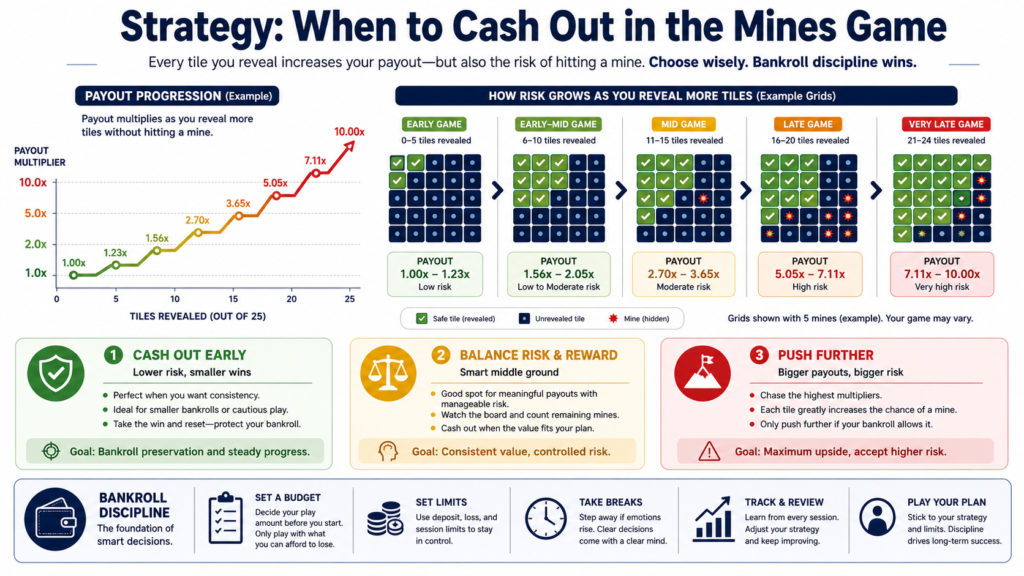
The strongest practical rule is to choose the cash-out point before the round begins.
A pre-committed plan might be:
Five mines, two safe tiles, then cash out.
This does not increase the mathematical return. It removes an impulsive decision after the multiplier has started rising.
A structured cash-out plan should define:
- Mine count.
- Stake.
- Number of target selections.
- Maximum rounds.
- Session loss limit.
- Session time limit.
Reaching the target and selecting “one more tile” is not a new strategy. It is abandoning the original strategy at the moment more money is exposed.
Bankroll management example
Suppose the session budget is $50.
- A $0.50 stake provides the equivalent of 100 base stakes.
- A $1 stake provides 50 base stakes.
- A $2 stake provides only 25 base stakes.
The lower stake does not improve RTP or tile odds. It simply provides more capacity to absorb normal losing rounds before the entire entertainment budget is exhausted.
Avoid choosing a stake based on the size of a hoped-for win. Choose it based on the amount that can be lost without affecting essential expenses.
Mines strategies that do not work
Choosing corners or following patterns
Corners, diagonals, zigzags and checkerboard patterns do not change the probability of selecting a mine in a properly randomized game.
A visual pattern may help a player follow a routine, but it does not reveal information.
Martingale betting
Martingale requires doubling the stake after a loss. It does not change the probability of the next result and can cause the stake to rise quickly during an ordinary losing sequence.
Independent random outcomes do not become safer because the previous round lost. Testing standards are intended to ensure that RNG outcomes are unpredictable and free from systematic bias.
Increasing the mine count after losses
A losing streak does not make a high-risk board more likely to succeed. Raising both the stake and mine count increases exposure at the moment the bankroll has already declined.
Chasing a specific multiplier
A large multiplier reflects a low-probability survival path. Its size is not evidence that it is due to occur.
Using bonuses without checking eligibility
Some promotions exclude instant-win or low-house-edge games from wagering contributions. Others apply maximum-bet rules or cashout limits.
Readers researching a No Deposit Bonus for US Players should confirm whether Mines is an eligible game before placing a promotional wager.
What does provably fair mean in Mines?
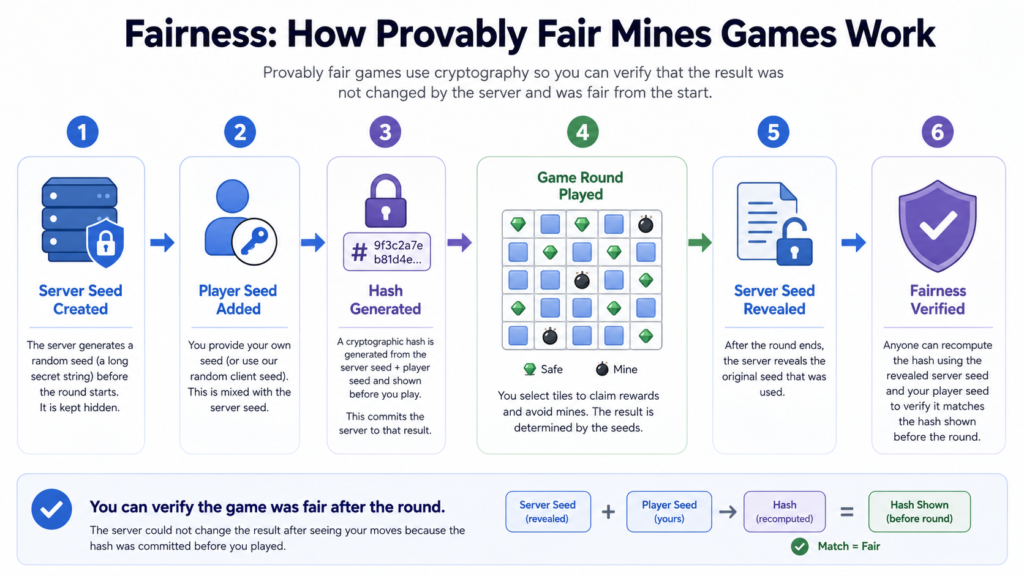
A provably fair system gives the player data that can be used to check how a result was generated.
A common implementation contains:
- Server seed: A secret value produced by the operator.
- Server-seed hash: A cryptographic commitment displayed before the result is revealed.
- Client seed: A value created or selected by the player.
- Nonce: A counter that changes with each wager.
- Published algorithm: The process that converts the inputs into a result.
Stake’s implementation, for example, uses a client seed, server seed and incrementing nonce to generate new results through SHA-256-based cryptographic functions. Exact implementations vary, so verification must follow the documentation for the relevant game.
How to verify a provably fair Mines round
- Open the game’s fairness or round-history panel.
- Record the server-seed hash shown before the seed is revealed.
- Copy the client seed and nonce.
- Complete or close the seed cycle.
- Obtain the revealed server seed.
- Confirm that its hash matches the earlier commitment.
- Enter the data into the provider’s official verifier.
- Compare the generated mine positions with the completed board.
A built-in calculator may automate this process. The purpose is to confirm that the published inputs reproduce the result.
What provably fair does not prove
Provably fair does not automatically prove that:
- The operator is licensed in the player’s jurisdiction.
- Withdrawals will be paid promptly.
- Account terms are fair.
- The casino has sufficient funds.
- The RTP is favorable.
- Identity verification will never be requested.
- The game can be beaten.
It verifies a defined result-generation process. It is not a complete casino-safety assessment.
Mines demo versus real-money play
A demo is useful for learning:
- Where game controls are located.
- How multipliers progress.
- How quickly risk changes at different mine counts.
- How the cash-out process works.
- Whether the mobile interface causes accidental selections.
A demo does not predict real-money results. A winning demo session does not make a later loss more or less likely.
Players comparing promotional access should also distinguish between virtual demo credits and actual No Deposit Bonuses and Instant Withdrawals. A no-deposit promotion can have wagering, eligibility and maximum-cashout restrictions, while an instant-withdrawal claim concerns the processing of an approved real-money cashout.
How to choose a casino offering Mines
Do not choose a casino solely because it offers the game or advertises a high RTP.
Check the following factors.
Availability and jurisdiction
Confirm that the operator is permitted to offer casino games in the player’s location. Being able to access a website does not establish legal availability.
Readers researching No KYC Casinos USA should separately verify their state’s gambling rules and the operator’s location restrictions.
Exact game and provider
Different Mines titles may use different:
- Grid sizes.
- Mine-count ranges.
- RTP settings.
- Payout curves.
- Auto-play controls.
- Provably fair methods.
Published RTP
The RTP should be available inside the game rules or an official provider document.
Fairness information
Look for independent RNG testing or a published provably fair verification process.
Withdrawal conditions
Review:
- Minimum and maximum withdrawals.
- Pending periods.
- Supported coins and networks.
- Network fees.
- Bonus-related withdrawal restrictions.
- Verification triggers.
Some Bitcoin casinos offer Mines alongside other instant-win games, but accepting cryptocurrency does not by itself establish fairness, legality or reliable payments.
Identity-verification rules
“No KYC” should not be interpreted as a permanent guarantee that documents will never be requested. The editorial policy of nokyccasino.us itself notes that verification can be triggered by withdrawals, large wins, bonus claims or anti-money-laundering checks.
For a broader explanation of the onboarding model, see the site’s guide to no KYC crypto gambling.
Responsible-gambling tools
Prefer platforms offering:
- Deposit limits.
- Loss limits.
- Session reminders.
- Cooling-off periods.
- Self-exclusion.
- Accessible account history.
Is the Mines casino game legal in the US?
US online casino gambling is regulated state by state. The American Gaming Association reported seven states with lawful online casinos during 2025, although legislation, market launches and individual game approvals can change.
Before playing for real money:
- Check the state gaming regulator.
- Confirm that online casino gaming—not only sports betting—is permitted.
- Confirm that the operator is authorized.
- Check whether the specific Mines game is available.
- Complete required age and geolocation checks.
- Do not use a VPN to bypass a geographic restriction.
Cryptocurrency use does not override state law or an operator’s terms.
Are Mines winnings taxable in the US?
The IRS states that gambling winnings are fully taxable and must be reported, including winnings not shown on a Form W-2G. Loss deductions have separate recordkeeping and itemization rules.
Maintain records of:
- Deposits.
- Stakes.
- Wins and losses.
- Withdrawals.
- Cryptocurrency values in US dollars at the relevant time.
- Operator statements.
- Transaction IDs.
Tax treatment can depend on individual circumstances, so this article does not replace advice from a qualified tax professional.
Mines versus Crash, Plinko and Limbo
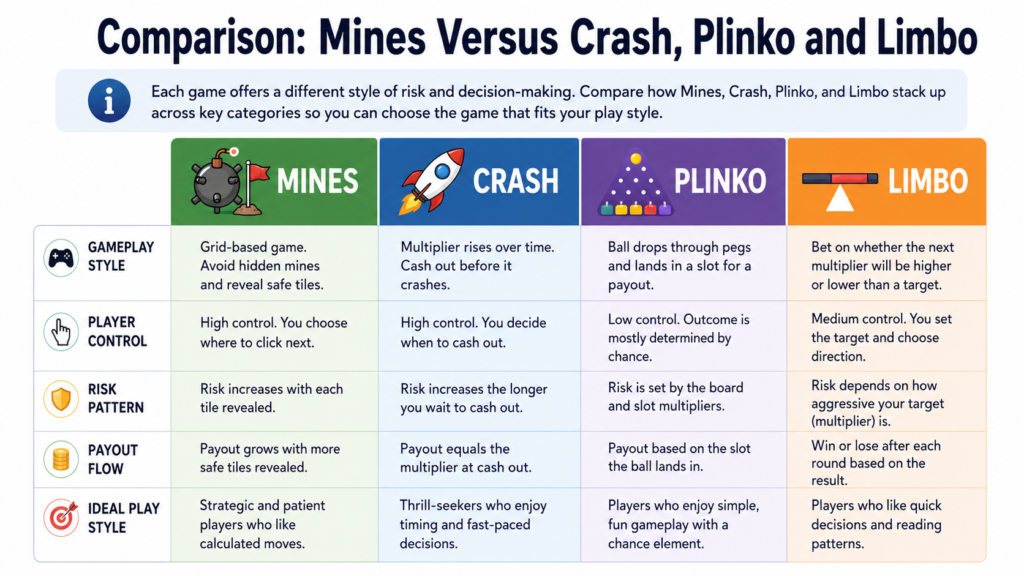
| Game | Main decision | Player interaction | Typical risk control |
| Mines | Which tiles to reveal and when to cash out | Multiple decisions per round | Mine count and target selections |
| Crash | When to cash out before the multiplier ends | One timing decision | Target multiplier |
| Plinko | Risk mode, rows and stake | Limited after release | Payout-table selection |
| Limbo | Target multiplier | One decision before the result | Multiplier target |
Mines creates a stronger feeling of control because every tile is a decision. That control affects exposure and stopping behavior, not the random location of mines.
Common Mines mistakes
Starting with too many mines
Large headline multipliers can distract from the sharp decline in survival probability.
Failing to inspect the RTP
A familiar grid does not mean two versions use the same payout table.
Opening another tile after reaching the target
This turns a planned decision into an emotional one.
Raising the stake after a loss
The next board is not safer because the previous round ended immediately.
Treating provably fair as profitable
A result can be verifiable and still contain a house edge.
Using money needed elsewhere
A session budget should consist only of money that can be lost without affecting bills, debt payments, food or savings.
Ignoring withdrawal and verification terms
Game fairness and casino reliability are separate questions.
Practical Mines checklist
Before the first real-money round, confirm:
- The game is legal and available in the current location.
- The operator is appropriately authorized.
- The exact RTP is displayed.
- The grid and payout rules are understood.
- The fairness process can be checked.
- The session budget is fixed.
- The stake is small relative to that budget.
- The mine count is selected before betting.
- The target number of safe tiles is predetermined.
- A loss and time limit have been set.
- Bonus, withdrawal and verification rules are clear.
Responsible-gambling guidance
Mines is designed to create repeated decision points and fast results. That pace can make it easy to continue beyond the original plan.
Stop playing when:
- The session budget is reached.
- The planned time expires.
- Stakes begin increasing emotionally.
- Losses are being chased.
- Gambling stops feeling like entertainment.
- Money intended for other purposes is at risk.
The National Problem Gambling Helpline serves all US states and territories through call, text and chat services, 24 hours a day. Call or text 1-800-MY-RESET for confidential support and referrals.
Key takeaways
- Mines is a probability game, not a logic puzzle.
- A common version uses 25 tiles, but providers can use different rules.
- More mines increase volatility and reduce survival probability.
- RTP is game-specific and describes long-run mathematical performance.
- No tile pattern or staking progression removes the house edge.
- The most useful strategy is a predetermined mine count, stake, cash-out target and stopping limit.
- Provably fair tools can verify result generation but do not establish legality, profitability or withdrawal reliability.
- US players must verify state law and operator authorization.
- Gambling winnings are generally reportable to the IRS.
Conclusion
The Mines casino game is easy to understand because every round presents the same choice: accept the current payout or expose the stake to another tile.
The mathematics does not reveal where the mines are, but it does reveal how quickly risk increases. A five-mine board gives an 80% chance of surviving the first selection, yet the probability of reaching three safe tiles is already below 50%.
The practical approach is therefore not to search for a hidden winning pattern. Check the exact RTP, use a demo, choose a mine count that matches an affordable level of volatility, decide the cash-out point in advance and stop when the session limit is reached.
FAQ
It is primarily a game of chance. Players control the mine count, stake and cash-out timing, but they do not control the location of the mines. Those decisions influence volatility and money exposed, not the random outcome.
One to three mines generally creates a lower-volatility learning environment on a 25-tile board. It does not guarantee a win, but it leaves more safe tiles and allows beginners to practise cash-out decisions.
There is no single RTP for every Mines game. The percentage depends on the provider and payout table. Check the information panel in the exact version being played rather than relying on a figure quoted for another operator.
No. Strategies can control stake size, mine count, cash-out targets and session limits, but they cannot predict mine positions or remove the house edge.
No. In a properly randomized game, a corner, center or repeated visual pattern has no better chance of being safe than another unopened position.
Choose the target before the round begins. A fixed number of safe tiles or a fixed multiplier is more disciplined than deciding after the displayed value has started rising.
No. Provably fair refers to a method for checking result generation. Licensing concerns regulatory authorization and operating requirements. A casino may offer verifiable games while still being unavailable or unauthorized in a particular jurisdiction.
It depends on the state, operator and game approval. Online casino gambling is available only in a limited number of US jurisdictions. Check the relevant state regulator before depositing.