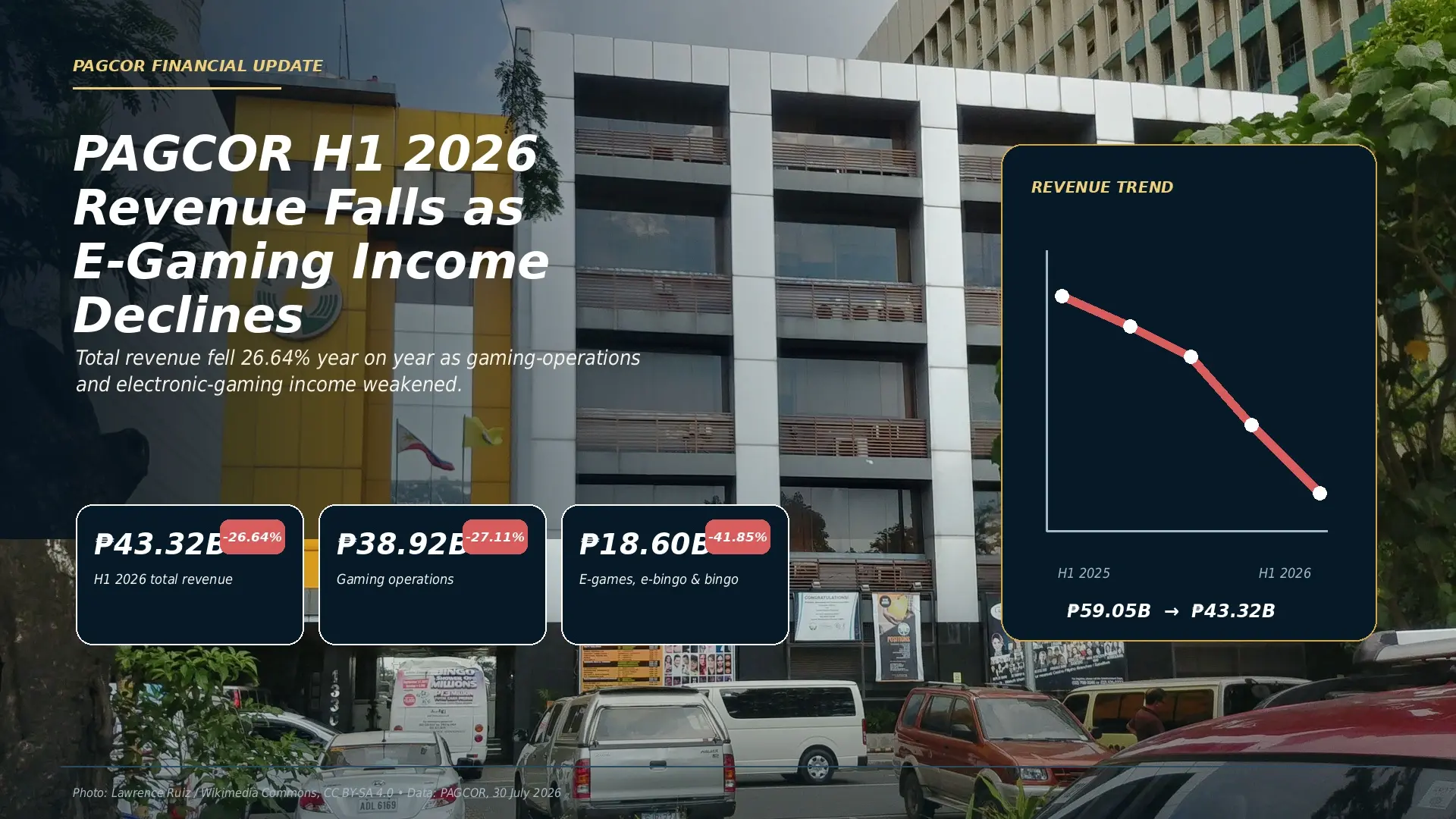

The Philippine Amusement and Gaming Corporation reported PHP43.32 billion in total revenue for the first half of 2026, a 26.64% decline from the same period last year. PAGCOR announced the results on July 30, identifying a 41.85% fall in revenue from eGames, eBingo and bingo grantees as the main source of the downturn.
Key facts
| Detail | Confirmed result |
| Reporting period | January through June 2026 |
| Announcement date | July 30, 2026 |
| Total PAGCOR revenue | PHP43.32 billion |
| Year-on-year change | Down 26.64% |
| Gaming-operations revenue | PHP38.92 billion, down 27.11% |
| Electronic and bingo revenue | PHP18.60 billion, down 41.85% |
| Net operating income | PHP31.75 billion, down 35.05% |
| Net income | PHP1.58 billion, down 85.29% |
| Government and nation-building contributions | PHP30.16 billion |
| Current status | PAGCOR said Q2 conditions improved, but uncertainty remains |
Source: PAGCOR’s official first-half announcement.
Electronic gaming accounted for most of the decline
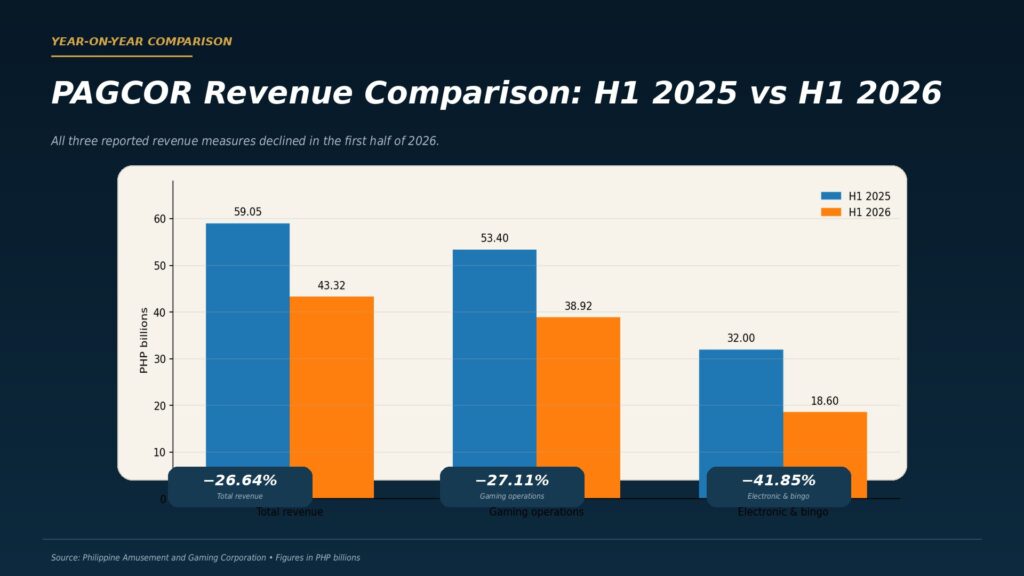
PAGCOR’s total revenue fell from PHP59.05 billion in the first six months of 2025 to PHP43.32 billion in the corresponding 2026 period.
Gaming operations remained its largest source of income but generated PHP38.92 billion, down 27.11% from PHP53.40 billion.
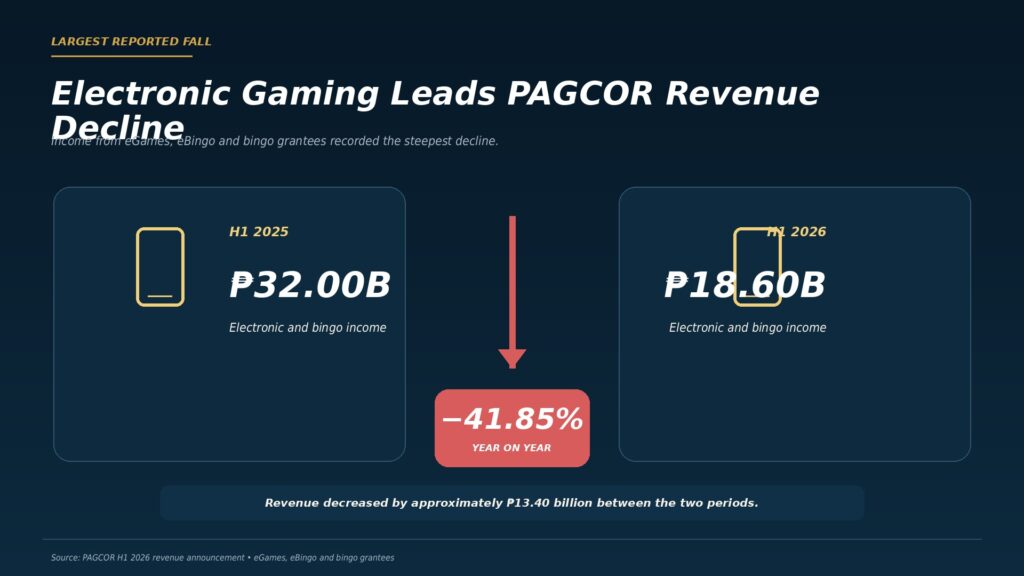
The sharpest decline occurred in the electronic and bingo segment. Revenue from eGames, eBingo and bingo grantees fell from PHP32 billion to PHP18.60 billion, representing a 41.85% year-on-year reduction. That segment alone accounted for PHP13.40 billion of the total decline.
Revenue associated with licensed casinos fell by a more moderate 3.85%, while PAGCOR-operated casino revenue declined 8.67%. The agency did not publish the peso values for those two categories in its announcement.
PAGCOR Chairman and CEO Alejandro Tengco attributed the overall performance to weaker electronic-gaming income and softer consumer spending during the first quarter. He linked those conditions to geopolitical and fuel-price pressures, while reporting some improvement during Q2. That explanation should be treated as PAGCOR management’s assessment rather than a proven single cause of the decline.
PAGCOR revenue is not the same as industry GGR
PAGCOR’s PHP43.32 billion figure represents the corporation’s own revenue. It should not be confused with the gross gaming revenue generated by all licensed gaming operators across the Philippines.
Gross gaming revenue, or GGR, generally measures stakes retained by gaming operators after winnings are paid. PAGCOR’s corporate revenue includes income received through its regulatory and commercial roles.
PAGCOR operates its own Casino Filipino properties while also licensing and regulating private casinos, electronic-gaming operators, bingo operations and other authorized gaming activities.
The regulator has not yet published a complete H1 2026 industry-GGR figure in the material reviewed for this article.
Its latest official industry report covers the first quarter. Philippine gaming GGR declined 15.87% to PHP87.60 billion in Q1 2026, from PHP104.12 billion a year earlier.
Electronic-gaming GGR declined 22.43% during that quarter. Licensed casinos generated PHP44.52 billion, electronic gaming contributed PHP39.90 billion and PAGCOR-operated casinos produced PHP3.17 billion.
The Q1 statistics support the conclusion that the industry experienced a slowdown early in 2026. They do not establish that total industry GGR fell by the same 26.64% recorded in PAGCOR’s first-half corporate revenue.
Net income fell more sharply than revenue
PAGCOR’s net operating income declined 35.05% to PHP31.75 billion during the six-month period.
Net income dropped more sharply, falling 85.29% to PHP1.58 billion.
PAGCOR said the net-income result reflected both weaker revenue and higher mandated payments to the Philippine Sports Commission.
The agency remitted PHP2.01 billion to the PSC during the first half of 2026, up 58.68% from PHP1.26 billion in the corresponding 2025 period.
The increased payment follows a Philippine Supreme Court ruling concerning the calculation required under the PSC Charter. The Court held that PAGCOR must remit 5% of its gross annual income to the commission without applying the deductions that had been disputed in the case.
The PSC payment therefore helps explain why net income declined substantially faster than total revenue.
PAGCOR contributed PHP30.16 billion to government programs
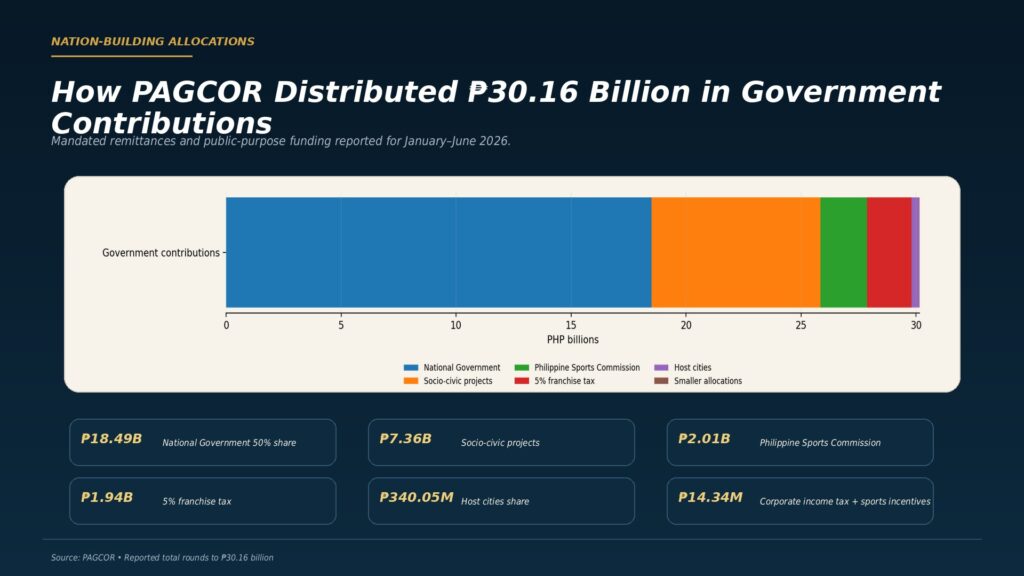
Despite the weaker financial results, PAGCOR reported PHP30.16 billion in mandatory contributions, taxes and nation-building allocations during the first half.
The largest component was the National Government’s 50% share, which totaled PHP18.49 billion.
Other allocations included:
- PHP7.36 billion for socio-civic projects.
- PHP2.01 billion for the Philippine Sports Commission.
- PHP1.94 billion in franchise tax.
- PHP340.05 million for cities hosting PAGCOR operations.
- PHP9.87 million in corporate income tax.
- PHP4.47 million in incentives for winning athletes, coaches and trainers under Republic Act No. 10699.
The listed categories correspond to PAGCOR’s reported PHP30.16 billion total, with minor differences caused by rounding.
PAGCOR’s official breakdown shows that the National Government share and socio-civic projects were the two largest components of the PHP30.16 billion total.
What the results mean for Philippine operators
The results show that PAGCOR’s financial performance has become increasingly sensitive to electronic-gaming activity.
In the first half of 2025, the wider electronic-games sector had produced PHP114.83 billion in industry GGR and represented 53.47% of the Philippine market.
The subsequent decline in both first-quarter electronic-gaming GGR and PAGCOR’s first-half electronic-gaming income marks a reversal from that earlier expansion.
For licensed operators and service providers, slower revenue may lead to closer scrutiny of market conditions, compliance costs and player-acquisition strategies. No new tax, license suspension or marketwide operating restriction was announced as part of the July 30 financial release.
PAGCOR said it intends to work with regulated stakeholders and continue strengthening industry performance through regulation. It did not announce a formal revenue target for the second half of 2026.
No direct change for U.S. casino players
The results concern the Philippines and do not change the legal status of online casino gambling in any U.S. state.
A PAGCOR authorization applies within the Philippine regulatory framework. It is not equivalent to a license from a U.S. state gaming commission and does not establish that an operator is authorized to accept players throughout the United States.
For U.S. readers, the development is relevant mainly as an international iGaming-market indicator, particularly because electronic gaming had previously been a major source of Philippine growth.
Players should continue checking the laws and licensed-operator lists that apply in their own jurisdiction. No-KYC registration or access to a foreign website does not override location restrictions.
Responsible-gaming rules remain in force
PAGCOR’s financial slowdown does not reduce the obligations imposed on licensed operators.
The regulator says gaming establishments must comply with its Responsible Gaming Code of Practice. PAGCOR-regulated gaming establishments are restricted to people aged 21 or older, and PAGCOR provides self-exclusion and family-exclusion procedures across licensed and operated locations.
Readers seeking practical guidance on limits, warning signs and support services can review No KYC Casino’s responsible-gambling guidance.
What happens next?
PAGCOR said conditions improved during the second quarter but warned that uncertainty remained. The July announcement did not provide a full-year forecast or confirm that revenue will recover during the second half.
The next important indicators will include:
- Complete H1 industry-GGR statistics.
- Third-quarter electronic-gaming performance.
- Changes in revenue from licensed and PAGCOR-operated casinos.
- Future government and PSC remittances.
- Any additional regulatory measures affecting electronic gaming.
Until those figures are available, the confirmed position is that PAGCOR’s first-half corporate revenue fell 26.64%, with electronic and bingo income recording the largest segment decline.
FAQ
PAGCOR reported PHP43.32 billion in total revenue. That was 26.64% below the PHP59.05 billion recorded during the first six months of 2025.
The largest decline occurred in revenue from eGames, eBingo and bingo grantees. That segment fell 41.85% to PHP18.60 billion. PAGCOR also attributed the result to weaker consumer spending and broader economic uncertainty.
No official H1 industry figure showing a 26.64% decline was identified. That percentage applies to PAGCOR’s corporate revenue. Separately, industry GGR fell 15.87% during Q1 2026.
Lower operating revenue and higher mandatory remittances contributed to the decline. PAGCOR paid PHP2.01 billion to the Philippine Sports Commission, 58.68% more than in H1 2025.
No. PAGCOR regulates Philippine gaming activity. Its financial results do not change the licensing or availability of online casinos in U.S. states.